






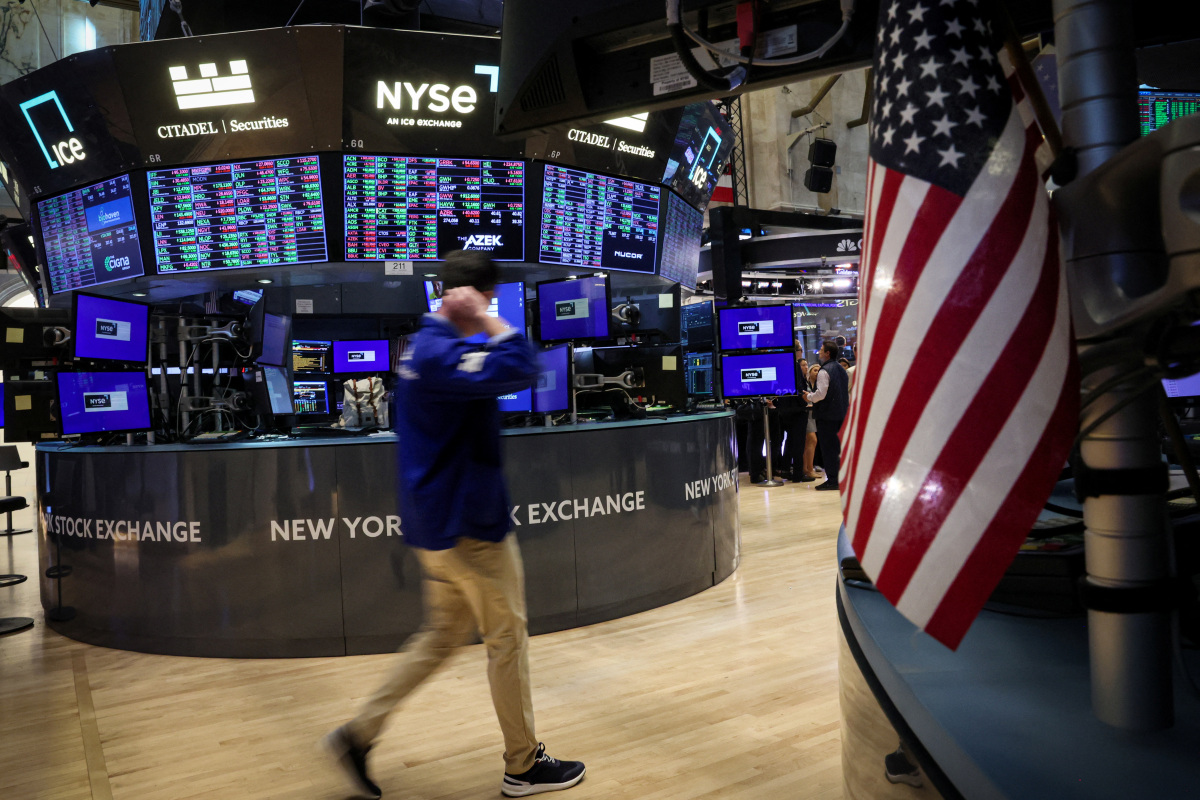
U.S. stocks fell on Friday (July 17), capping off a bruising trading week as a deepening correction in the semiconductor sector dragged all three major indices to their first collective weekly decline since early June.
The tech-heavy Nasdaq Composite Index led Friday's retreat, shedding 361.70 points, or 1.4 percent, to close at 25,520.24. The benchmark S&P 500 sank 76.08 points, or 1.01 percent, to 7,457.69, while the blue-chip Dow Jones Industrial Average fell 406.55 points, or 0.77 percent, to finish at 52,146.42.
Market internal breadth was overwhelmingly negative, with 10 of the 11 primary S&P 500 sectors ending the session in the red. Communication services and consumer discretionary shares paced the laggards, plunging 2.38 percent and 1.58 percent, respectively. In contrast, the energy sector completely bucked the broader market's downward trend, advancing 1.16 percent.
PHLX Semiconductor Index officially slipped into a technical bear market, marking a 20-percent decline from its recent cyclical peaks. Chinese AI company Moonshot publicly unveiled "Kimi K3" on Friday. Touted as the world's largest open-source AI model, the new architecture reportedly rivals the existing capabilities of the U.S. leading players.
Despite the initial wave of selling, the semiconductor sector staged a partial late-afternoon recovery as institutional dip-buyers stepped in. Nvidia finished the day down 2.21 percent, while major peers Advanced Micro Devices (AMD), Broadcom, and Intel all closed lower.
Meanwhile, Netflix sank 7.26 percent to a fresh two-year low after the streaming pioneer issued cautious third-quarter revenue guidance. SpaceX declined an additional 5.43 percent, dropping further below its recent initial public offering price. The selling pressure followed a high-profile setback on Thursday in which a scheduled Starship rocket test flight was automatically aborted on the launchpad.
On the economic front, the University of Michigan's preliminary consumer sentiment index climbed 10 percent for the second consecutive month to hit 54.4 in July. "This month's rise in sentiment was pervasive across the population, seen across groups by age, income, wealth, and political party," said Joanne Hsu, director of the Surveys of Consumers, in a statement. "Particularly strong increases were seen among consumers without a bachelor's degree."
However, underlying data showed that consumer budgets remain structurally tight. U.S. consumer prices continued to climb at a 3.5 percent annualized rate, with annual gains in average hourly earnings barely outpacing core inflation.
(Source: Xinhua)
Related News:
US stocks rally as cooling CPI defuses rate fears
S. Korea's memory chipmaker SK Hynix makes debut on Nasdaq, riding US AI frenzy




Comment