






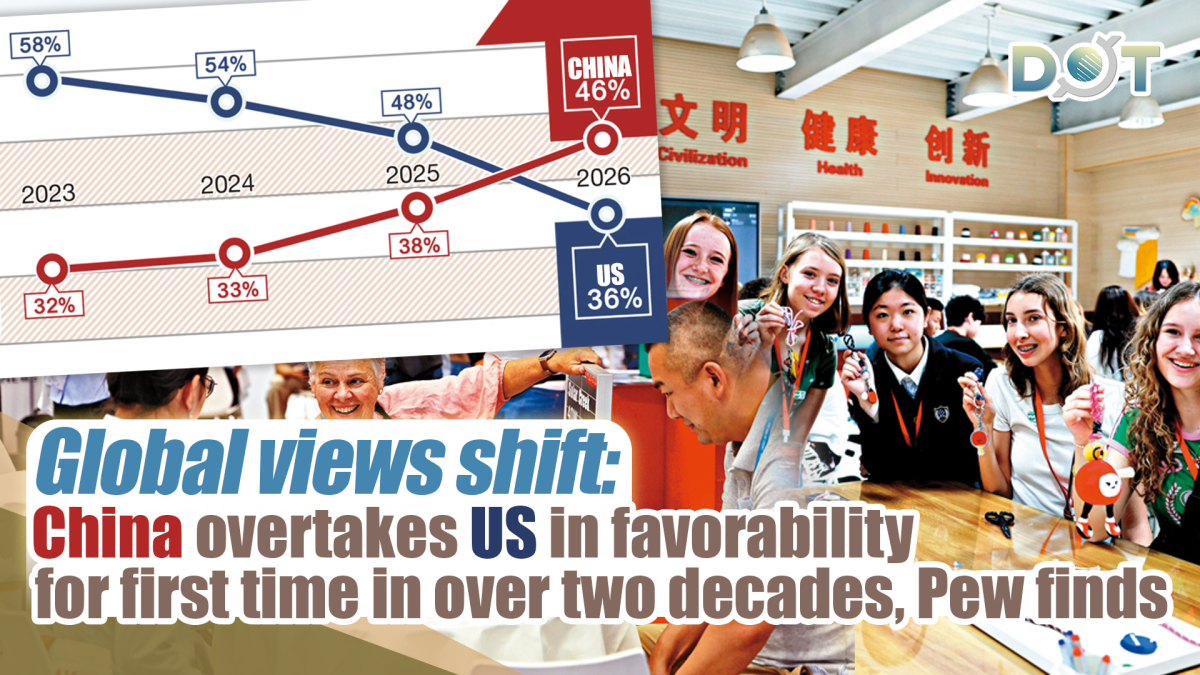
China is now viewed more favorably than the US in most of the countries surveyed by the Pew Research Center, marking the first time in more than two decades that global public opinion has tilted toward China since the US think tank began tracking attitudes toward both countries in 2002.
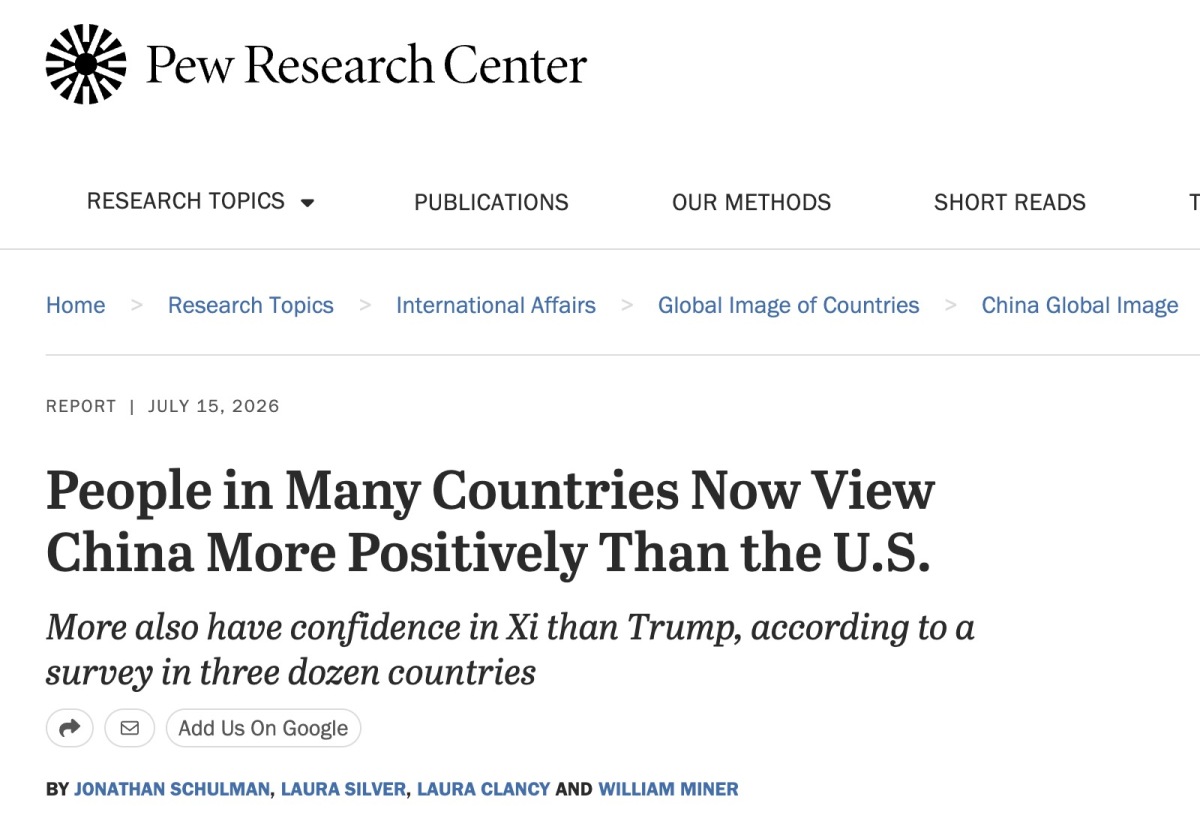
The latest Pew report, released on July 15, local time, combines the center's long-running surveys on global views of China and the US. It covers 36 countries and territories, including Australia, Canada, France, Germany, Japan and the UK, based on responses from 42,151 people.
According to the survey, respondents in 25 of the 36 countries now hold more favorable views of China than of the US. The gap is particularly pronounced across parts of the Asia-Pacific and the Middle East. The shift is also evident among longstanding US allies, including Australia, Canada, France and Germany, where China now receives higher favorability ratings than the US. Even in Canada's and Mexico's public opinion, China is viewed more positively than the US.
Canada illustrates the trend. In 2023, 57% of Canadians viewed the US favorably, while only 14% held positive views of China. By 2025, favorability toward the two countries had reached parity. In the latest survey, 44% of Canadians expressed favorable views of China, compared with 33% for the US.
The report also noted that the median favorability rating for the US has continued to decline across 20 countries with comparable trend data, while China's median rating has steadily increased.
In eight countries—Italy, Spain, Colombia, Mexico, Indonesia, Malaysia and two others included in the survey—China's favorability reached its highest level on record.
Only six countries—Poland, Israel, Japan, South Korea, the Philippines and India—continue to rate the US more positively than China.

Jonathan Schulman, a researcher at the Pew Research Center, said this is the first time the organization has recorded such a result since it began tracking global perceptions of the two countries in 2002.
Among the 20 countries with comparable data dating back to 2023, nearly half of respondents now hold favorable views of China, while only 36% view the US positively, compared with 32% for China and 58% for the US three years ago.
Respondents were also asked whether they had confidence in Chinese President Xi Jinping and US President Donald Trump to make the right decisions in world affairs. Across the surveyed countries, confidence in Xi was higher than confidence in Trump.
Pew analysts said the survey period coincided with the US's military action against Iran, while confidence in US leadership has declined globally in recent years, further weighing on America's international image.
Responding to the findings, a White House spokesperson said Trump had contributed more than anyone else to global stability, citing the destruction of Iran's nuclear facilities and the elimination of hundreds of "drug terrorists." The spokesperson added that Trump is the leader of the free world and that his bold leadership has made the US stronger than ever.
Chinese Embassy spokesperson Liu Pengyu said the survey reflects growing international recognition of China's development achievements and governance capacity.
"We welcome more Americans to visit China and see for themselves a real, multidimensional and comprehensive China," Liu said. "A friendly China-US relationship is the shared aspiration of the two peoples and serves the common interests of both countries."
Liu also called on Washington to ease visa and entry restrictions on Chinese citizens and increase the number of direct flights between the two countries.
The Pew findings are not an isolated case. Several international organizations have published reports this year pointing to improving global perceptions of China. Pew had previously released similar findings, while a Gallup survey also indicated that China's global approval had edged slightly ahead of that of the US.
Shen Yi, executive director of the Centre for National Security Studies, said public opinion is an important indicator for observing international politics. He said the rise in China's global favorability reflects international recognition of the country's development path, diplomatic philosophy and practical contributions, while also demonstrating people's shared aspirations for peace, development, fairness, justice and cooperation.
(Source: Wen Wei Po; Reporter: Zhu Ye; English Editor: Zoey SUN)
Related News:




Comment