






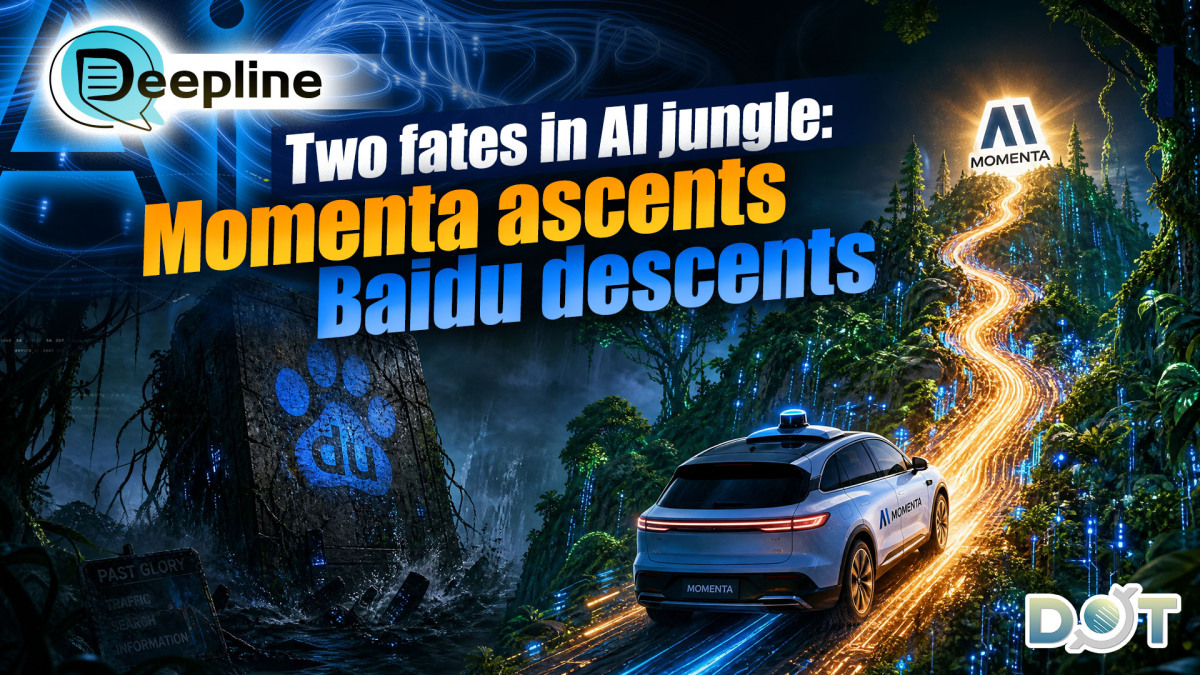
- In the jungle of the technology industry, there are no permanent moats; only narratives that are constantly being rewritten.
Turning our gaze to China's AI area, the intertwined fates of two companies have unfolded with striking dramatic tension: on one side, Momenta, riding the halo of being the "first physical AI stock" as it pushes toward a Hong Kong IPO, basking in capital-market success; on the other, Baidu, which has spent more than a decade on autonomous driving, now mired in a crisis of trust after its "Apollo Go" robotaxis suffered large-scale breakdowns in Wuhan, while also showing visible fatigue across the broader LLM-driven AI market.
The once-undisputed leader of BAT—the company that was the first to enshrine "all in AI" in its corporate strategy—now seems to be drifting further from the AI era.
On June 23, Momenta officially released its prospectus, with an IPO market capitalization of approximately HK$69.5 billion.
According to the prospectus, Momenta's revenue has grown by leaps and bounds over the past three years: from 2023 to 2025, its operating revenue surged from 743 million yuan to 2.413 billion yuan, tripling in three years, with a compound annual growth rate exceeding 80%.
On the commercialization front, Momenta has established partnerships with 24 global automakers, secured production design wins for over 210 vehicle models, and surpassed the 900,000-vehicle mark in total installations. In the highly valuable urban NOA (Navigate on Autopilot) segment, its deployment accounts for approximately 65% of third-party suppliers, maintaining an absolute industry lead. Backed by these hard-core metrics, Momenta has truly earned its title as the autonomous-driving champion.
Yet in this IPO, Momenta has revealed an even greater ambition, upgrading its positioning from an "autonomous-driving supplier" to a "builder of general artificial intelligence for the physical world." Just two months ago, Momenta released its R7 World Model. Through massive data ingestion, R7's core capability lies in enabling the system to see, understand, and predict the world—marking a fundamental leap in its core AI technology.
However, just as Momenta is riding high and telling a new story of "physical-world AI," the elimination race in autonomous driving is accelerating toward its conclusion, with the industry experiencing a stark and unforgiving divide between the haves and the have-nots.
Over the past year or more, a slew of once-stellar autonomous-driving startups have been forced off the board. Behind this long list of casualties, none is more sobering than that of former industry pioneer Baidu Apollo.
As the "elder statesman" of China's autonomous-driving space, Baidu began its R&D in self-driving technology as early as 2013, pouring tens of billions of yuan into the effort. For years, Baidu stubbornly adhered to the asset-heavy, operation-heavy Robotaxi route. More than a decade later, despite its deep accumulation in test-mileage data, its series-production solutions for consumer-facing automakers have remained lukewarm at best.
Some tech media outlets argue that today, with automakers increasingly developing their own in-house solutions or turning to third-party mass-production suppliers like Momenta and Huawei, Baidu's autonomous-driving technology has been gradually marginalized in the passenger-vehicle market. The rise of the new capital darling and the decline of the former pioneer mercilessly reflect the brutal clash between two distinct business models.
Over the years, Robin Li has drawn no shortage of criticism from outsiders. Within Baidu's broader AI portfolio, if its large-language-model monthly active users have already fallen behind competitors like ByteDance and Alibaba, then looking around, the only tangible "physical achievement" it can still hold up appears to be Apollo Go.
Based on the latest disclosed Q1 2026 financial report, Apollo Go's numbers are undeniably impressive: it completed 3.2 million rides in the quarter, a year-on-year surge of over 120%; its fleet's cumulative autonomous mileage has surpassed 330 million kilometers, including over 220 million kilometers of fully driverless travel.
As the vanguard of Baidu's Robotaxi commercialization, the large-scale deployment of "Apollo Go" in Wuhan was once hailed as a sign that Baidu's autonomous-driving strategy had finally come to fruition. But this seemingly validated business loop was ruthlessly shattered in early 2026 by an unprecedented system-wide paralysis.
On March 31, 2026, Wuhan's 122 traffic command center began receiving a stream of reports: multiple Apollo Go vehicles had stopped inexplicably in the middle of the road, immobilized. On-site tallies showed that 80 to 100 vehicles had broken down, causing severe congestion on several major thoroughfares. By April 1, Apollo Go's official customer service confirmed that "services in all Wuhan districts have been suspended."
In truth, autonomous driving has always been an exam with an extremely slim margin for error. Every large-scale public-road breakdown erodes not only road-use rights but also the last remnants of public and capital-market trust in the maturity of Baidu's AI technology.
Today, these white vehicles have all but vanished from Wuhan's streets. Apollo Go has fallen into a prolonged silence. Opening the app, even though Wuhan still appears on the list of "available cities," the system merely responds with the icy prompt: "No vehicles available at the moment."
While suffering this Waterloo on its home turf, Baidu's overseas business has simultaneously been advancing at full throttle, creating a dramatic and almost theatrical sense of fragmentation. Just one day before the Wuhan breakdown (March 30), Apollo Go officially launched fully driverless commercial operations in Dubai.
At present, Apollo Go's footprint has extended from Abu Dhabi and Dubai to London and Switzerland, and it is attempting to fast-track entry into the European market through partnerships with Lyft and Uber.
But can a system that has yet to fully resolve the long-tail challenges of autonomous driving under China's extraordinarily complex road conditions—and has even experienced large-scale outages—truly resolve its underlying vulnerabilities simply by "going global"?
Whether it is Apollo Go's domestic setbacks or its overseas expansion, or being overtaken by Momenta in the passenger-vehicle market, Baidu's autonomous-driving woes are merely the tip of the iceberg of its broader AI anxiety.
Looking back at Baidu's history, the company has been among the earliest movers in nearly every major internet trend. Yet, apart from securing the largest traffic gateway during the search era, Baidu has consistently been the first to take a seat at the table in every other race—only to find itself perpetually short of chips.
During the heyday of PC and mobile internet, search was Baidu's lifeblood. At that time, Baidu was the "super gateway" for virtually all Chinese netizens. Relying on the underlying logic of "one killer app rules them all," the steady stream of advertising cash from its search engine firmly cemented its position atop the BAT hierarchy.
But today, the information silos of the mobile internet have shattered Baidu's cash cow. Users no longer follow the traditional path of "search box → click links → find answers"; instead, they have grown accustomed to obtaining distilled results directly from AI tools. The direct-answer model of large language models is relentlessly dismantling Baidu's once-proud search moat.
Facing the erosion of traditional search traffic, Baidu has not been idle in AI. On the contrary, to defend its stronghold, Baidu displayed remarkable aggression in the LLM race. Yet when it came to the true battlefield of consumer-facing AI, Baidu failed to deliver satisfactory results.
In late August 2023, Baidu's ERNIE Bot was fully opened to the public, becoming China's first ChatGPT-like product and enjoying a brief moment of glory.
But driven by the democratizing effect of open-source models, the competitive landscape quickly escalated. Major internet players and up-and-coming tech stars all stormed into the arena: DeepSeek, with its focus on extreme reasoning; Doubao, leveraging Douyin for endless user acquisition; Tencent Yuanbao, backed by WeChat's vast social ecosystem; and a host of formidable contenders like Kimi and Zhipu—all swarming like schools of fish to capture market share.
As Baidu's once-cherished first-mover advantage rapidly eroded, and its self-proclaimed technological moat was gradually flattened and even ruthlessly surpassed by a pack of rivals, Baidu has found itself increasingly on the defensive in this decisive AI battle that will shape the next decade.
(Source: 36kr)
Related News:
Deepline | Meta eyes cloud monetization of AI assets as BofA sees upside, skepticism remains
Deepline | The hidden eye in router: When Wi-Fi knows who you are




Comment