






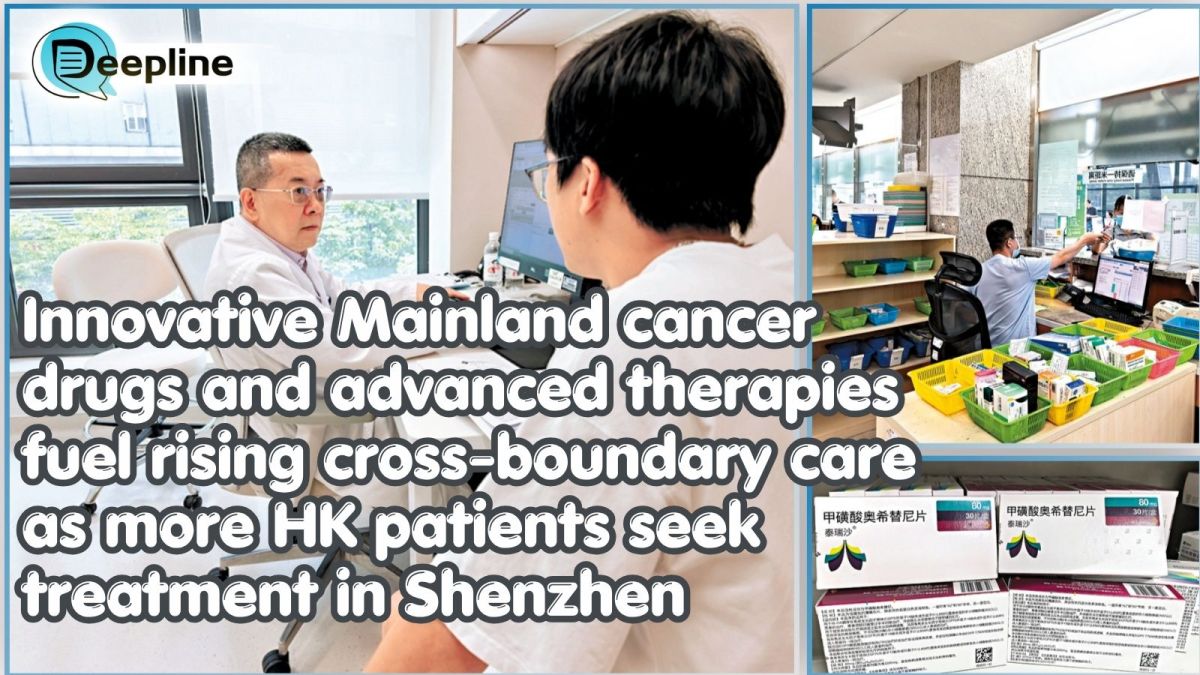
Medical integration in the Guangdong–Hong Kong–Macao Greater Bay Area continues to deepen, with cross-boundary healthcare trends showing new momentum. Clinical data from Shenzhen New Frontier United Family Hospital indicate that approximately 75% of patients seen in its oncology department are Hong Kong residents, and more than half travel specifically to access original, innovative drugs developed on the mainland.
At The University of Hong Kong–Shenzhen Hospital (HKU Shenzhen Hospital), oncology patient volumes from Hong Kong have also increased sharply recently. Hospital specialists said that Hong Kong patients are increasingly choosing Shenzhen for care because of advanced radiotherapy equipment, a standardized multidisciplinary treatment (MDT) system, and the continued rollout of innovative mainland cancer medicines.
A senior oncology specialist at HKU Shenzhen Hospital said the scale of Hong Kong cancer patients seeking care has grown rapidly. In 2025, the hospital recorded a 100% year-on-year increase in oncology outpatient visits from Hong Kong patients, while inpatient cases from Hong Kong rose by 120%. Total Hong Kong-related oncology visits for the year were approximately 16,000, accounting for about 30% of the department's overall volume, with the share expected to rise further in 2026.
In terms of case mix, Hong Kong patients seeking care in Shenzhen are mainly treated for common solid tumors, including lung cancer, gastrointestinal cancers, breast cancer, nasopharyngeal cancer, prostate cancer, cervical cancer, and ovarian cancer. Precision radiotherapy was highlighted as a distinctive service advantage supported by comprehensive hardware capabilities.
Hospital data indicated that among Hong Kong patients, who make up roughly 30% of its oncology caseload, about 20% travel specifically to access innovative mainland drugs, while others seek screening, radiotherapy, chemotherapy, immunotherapy, surgery, and integrated treatment services.
Clinicians noted that innovative anti-tumor medicines—such as targeted therapies, bispecific antibodies, and antibody–drug conjugates (ADCs)—have advanced rapidly in recent years. A key driver for cross-boundary treatment is a time lag in drug approvals, with innovative drugs often approved and launched on the Mainland first, while registration and market launch in Hong Kong may trail by two to three years. For some patients who develop resistance to existing targeted therapies, newer-generation treatment options may be available on the mainland earlier, with hospitals meeting patient needs through designated procurement channels.
Clinicians also said the reasons Hong Kong patients seek treatment in Shenzhen have changed: they now focus more on access to newer therapies and treatment pathways backed by clinical data and broader recognition, rather than solely on cost-effectiveness. A cross-boundary care model has also been developed, enabling patients to complete phase-based treatment in Shenzhen and continue follow-up and ongoing care in Hong Kong.
Industry observers noted a two-way, complementary pattern: policies that facilitate the use of overseas medicines and devices for mainland patients can benefit Shenzhen's care offerings, while earlier mainland access to domestically developed innovative drugs can draw Hong Kong patients north, together supporting more efficient oncology resource allocation across the Greater Bay Area.
(Source: Wen Wei Po)
Related News:
Deepline | Behind meals for 36,000: High-tech logistics of China's National Games




Comment