






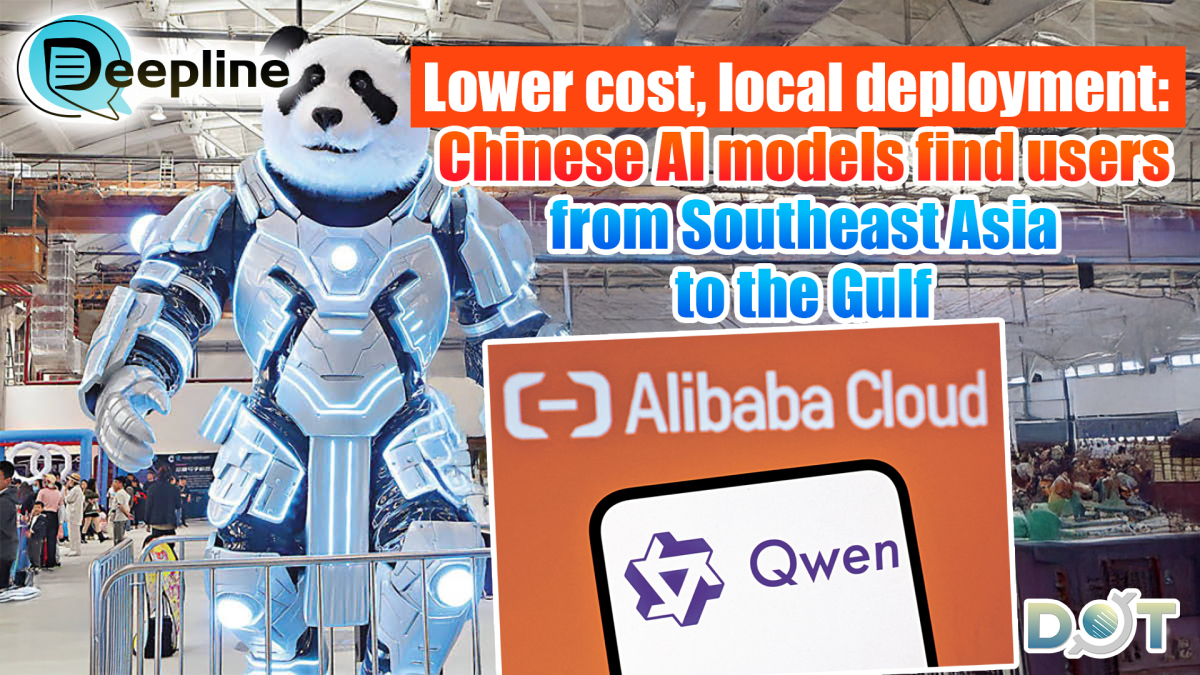
A recent U.S. media report suggests that while American artificial intelligence companies remain ahead on some frontier model capabilities, Chinese firms are increasingly expanding their global market presence by offering AI products that are more commercially attractive—often emphasizing lower costs, higher efficiency, and open-source availability.
The report comes amid intensified competition over AI leadership. U.S. political leaders have framed AI as central to future global influence, with US President Donald Trump arguing that leadership in the field would translate into broader geopolitical leadership. However, some analysts caution that such claims can be misleading and may reflect only a temporary advantage.
A May report from JPMorgan Chase's Geopolitics Center argued that top-tier frontier performance may not diverge dramatically over time. Instead, outcomes could depend more on factors such as prompt quality, toolchains, and integration into specific domains—areas where Chinese AI laboratories are working on models designed to "win on breadth of use."
Over the past year, Chinese companies have reportedly made notable progress in promoting their AI models overseas, with users ranging from Southeast Asia to governments and businesses in the Gulf region. Examples mentioned include a Singapore government-backed AI initiative said to be building on Alibaba's Qwen models and Saudi Arabia's reported cooperation with ByteDance and Huawei to apply AI to urban infrastructure.
Industry-wide concerns about the cost of using advanced AI systems may also be creating opportunities for Chinese providers. According to the report, Chinese AI models often have lower prices and run more efficiently. A salesperson at a leading Chinese AI company was quoted as saying that many industries may only need a portion of the capabilities offered by top U.S. models—and that delivering "80% of the value" at significantly lower cost could be sufficient to capture market share.
Beyond pricing, the report noted that many Chinese AI models are open-source, allowing users to download and deploy them locally. This can be attractive to companies handling sensitive information and to users concerned about potential price increases from cloud-based services.
By contrast, the report pointed to U.S. restrictions that may complicate the international rollout of some American models. It referenced a June 12 U.S. export-control measure involving AI firm Anthropic, which required the company to suspend access for foreign nationals to certain models, further limiting the overseas availability of U.S. AI products.
Some analysts cited in the report argued that America's advantage in AI could be vulnerable if U.S. companies focus heavily on frontier breakthroughs while paying less attention to commercialization and distribution. They suggested that if Chinese firms secure larger global market share, they could replicate strategies seen in other sectors—such as solar equipment, rare earth processing, and electric vehicles—using commercial profits to feed continued technological development.
(Source: Hong Kong Wen Wei Po, citing The Washington Post and other analyses.)
Related News:
Opinion | How America and its allies fell for the Guo Wenghui fraud




Comment