






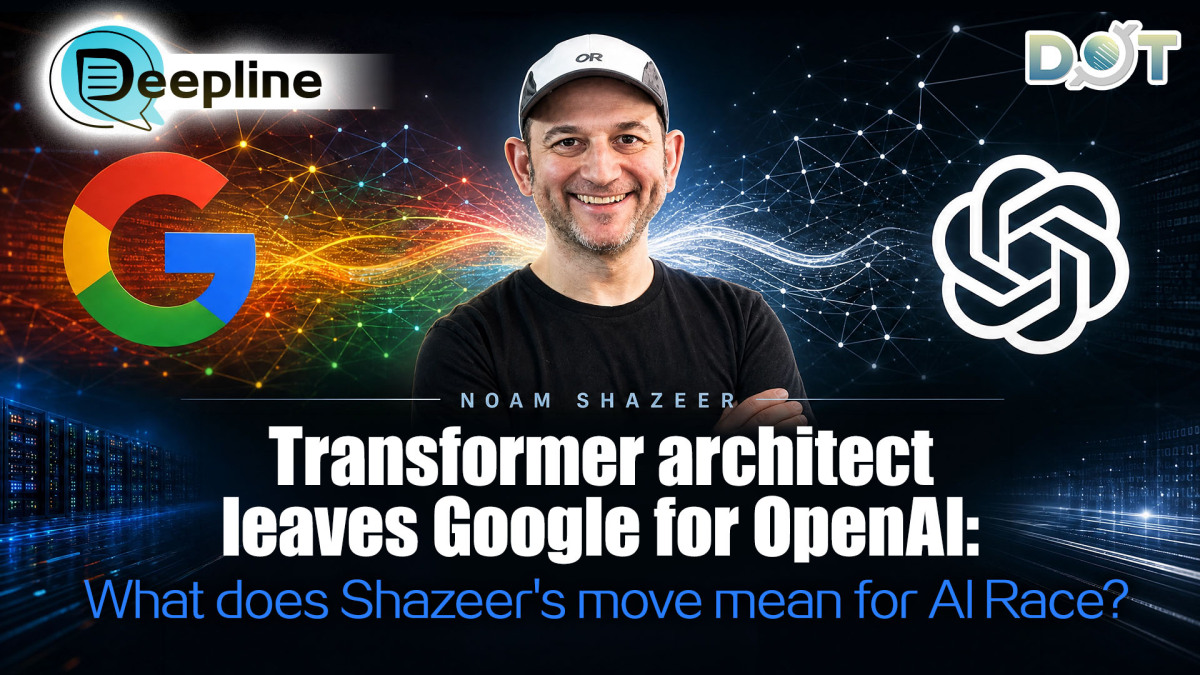
Today (June 18), Noam Shazeer, a researcher at Google DeepMind and co-lead of Gemini, has officially joined OpenAI as Lead for Architecture Research. In this role, he will be responsible for exploring next-generation AI model architectures and driving further evolution of the transformer architecture.
Shazeer also announced his move on X, the social media platform, saying, "I'm excited to share that I'll be joining OpenAI and look forward to working with the exceptional team here."
At the same time, he expressed gratitude to the Google team, "It was a difficult decision to move on. I am incredibly proud of the amazing team at Google and everything we built together."
A Google spokesperson responded to Reuters, saying the company appreciates Shazeer's significant contributions over the years and wishes him well in his future endeavors.
As a legendary figure in the AI field, Shazeer is a core author of the seminal 2017 paper "Attention Is All You Need," which first introduced the transformer architecture and directly laid the technical foundation for modern large models such as GPT, Gemini, and Claude.
Before joining OpenAI, Shazeer left Google in 2021 to found Character.AI. The company bet early on the "AI companionship" space, even before the ChatGPT boom, allowing users to engage in long-term conversations with various AI characters, and it quickly became one of the fastest-growing consumer AI applications globally. By 2023, Character.AI was valued at over US$1 billion.
In 2024, Google reached a technology licensing agreement with Character.AI valued at approximately US$2.7 billion, bringing Shazeer and part of the core team back into DeepMind. Shazeer was appointed co-lead of Gemini, participating in the pre-training and development of the next-generation Gemini models.
For OpenAI, which is locked in intense competition with Anthropic, this move is widely seen as one of the most significant top-tier talent acquisitions in recent years. Following the announcement, OpenAI executives and several prominent researchers immediately welcomed him on X.
At the same time, some netizens lamented, "Losing a transformer author and Gemini co-lead is undoubtedly a heavy blow to Google."
Looking at the history of generative AI, Shazeer has been involved in nearly every critical milestone. He joined Google in 2000, serving as a software engineer and later as a senior software engineer, accumulating over 18 years of service.
In 2017, together with seven other Google researchers, he co-authored the landmark paper "Attention Is All You Need," introducing the transformer architecture. Compared to the previously dominant RNN and LSTM models, the transformer could process long-form text more efficiently and offered greater scalability.
Over the past several years, models including OpenAI's GPT series, Google's Gemini, Anthropic's Claude, as well as DeepSeek and Llama, have all been built fundamentally on the transformer architecture. In other words, the wave of large language models sweeping the globe today rests largely on the technical foundation established by that paper.
However, the transformer is just one of Shazeer's representative works.
During his tenure at Google, he also contributed to several other influential large-model technologies. In 2017, he was the first author on the sparse gated Mixture of Experts (MoE) architecture, which provided key technical inspiration for later models such as GPT-4, Gemini, and DeepSeek-V3. In 2018, he co-developed Mesh TensorFlow, which provided foundational tooling for training ultra-large-scale transformers. He subsequently contributed to the T5 model and Google's dialogue model LaMDA, among other key projects.
In 2021, Shazeer left Google to co-found Character.AI with Daniel De Freitas.
At the time, large language models had not yet experienced the ChatGPT moment, but Character.AI had already pioneered the effort to bring chatbot products to the mass market and quickly amassed a substantial user base.
In 2024, Google brought Shazeer and his core team back into DeepMind through a partnership valued at approximately US$2.7 billion. He subsequently became one of the key leaders of the Gemini project and participated in the pre-training of the next-generation Gemini models.
Shazeer's return came at a time when Google's AI business was under immense pressure. ChatGPT had exploded in popularity, while Gemini was still in catch-up mode. After rejoining DeepMind, Shazeer contributed to model R&D and eventually became co-lead of Gemini, establishing himself as one of Google's technical leaders in AI.
Since then, the Gemini 3 series of models has ranked among the industry's best across multiple benchmarks, including programming and reasoning, becoming a critical asset for Google in its competition with OpenAI and Anthropic.
From Google researcher to entrepreneur to Gemini co-lead, Shazeer has witnessed nearly every major turning point in Google's AI development over the past decade. As a result, his departure from Google to join OpenAI has been regarded by many industry insiders as one of the most significant talent losses for Google in recent years.
Shazeer's move comes against the backdrop of increasingly fierce talent competition in the AI industry.
Over the past year, competition between OpenAI and Anthropic has intensified. The two sides are not only competing on model capabilities but also vying for top researchers and core engineers.
The Financial Times reported that OpenAI internally views Shazeer's addition as a significant strengthening. In the future, he will focus on exploring new architectural directions beyond transformers and on how to further enhance model capabilities.
Notably, transformers have dominated the AI field for nearly a decade. With the development of reasoning models, multi-agent systems, and world models, a growing number of researchers are asking: Will the transformer undergo its next major architectural upgrade?
And Shazeer is precisely one of the people best qualified to answer that question.
For Google, this means losing a transformer author, a Gemini co-lead, and one of its most seasoned AI architecture designers. For OpenAI, its lab gains someone who personally helped shape the modern AI technology stack.
As technology edges ever closer to the frontier, top researchers themselves have become one of the scarcest resources. Noam Shazeer's career trajectory connects four key nodes: transformer, Character.AI, Gemini, and OpenAI.
Now, this transformer author's departure from Google to join OpenAI is not only a talent shift but also a reflection of the increasingly intense competition among today's AI giants.
Especially as OpenAI and Anthropic engage in fierce competition over next-generation models, enterprise markets, and top research talent, Google is also playing catch-up through Gemini. Losing a transformer founding author and Gemini co-lead at this juncture is undoubtedly a considerable loss for Google.
For the industry as a whole, the question worth watching going forward may be: When a transformer author takes on the task of researching "architectures beyond transformers," where will the next generation of AI models head?
(Source: 36kr)
Related News:
Deepline | OpenAI, Anthropic, and SpaceX set to test US capital markets in historic IPO wave




Comment