






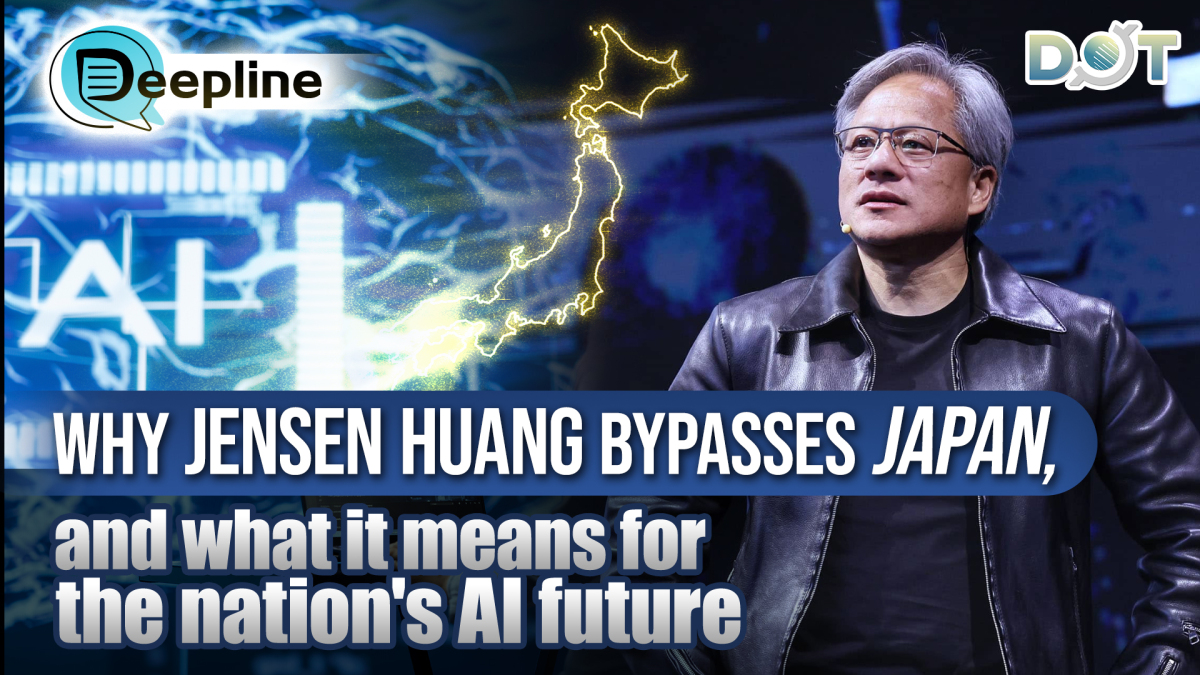
Jensen Huang, the CEO of NVIDIA, made back-to-back visits to the Chinese mainland, Taiwan, and South Korea between May and June but skipped Japan.
These stops were part of Huang's high-level marketing campaign during a packed schedule. After arriving in Taiwan on May 23, he dined with TSMC CEO C.C. Wei and other production partners, then hosted a dinner for more than 40 Taiwanese business leaders, including prominent figures from Hon Hai Precision Industry, drawing considerable attention.
Upon arriving in South Korea on June 5, Huang dined that evening with SK Group Chairman Chey Tae-won and other top executives from leading companies, enjoying grilled pork belly and soju. On June 6, he taped a popular variety show, and on June 7, he threw out the ceremonial first pitch at a professional baseball game—keeping a frenetic pace.
He also did not overlook China, where the US is vying for technological supremacy. In mid-May, Huang joined President Trump's business delegation to the China-US summit in Beijing. In addition to attending meetings with Chinese officials at the Great Hall of the People, he also sampled local street food.
In both South Korea and Taiwan, Huang visited companies that play an indispensable role in NVIDIA's AI semiconductor supply chain. As a fabless company, NVIDIA outsources the bulk of its manufacturing to TSMC. Its graphics processing units (GPUs) also rely on high-performance memory (HBM) from SK Hynix and Samsung Electronics to deliver their computational power.
China, meanwhile, is a future sales market too big to ignore. Although the US government prohibits NVIDIA from exporting its most advanced semiconductors to China, the company is permitted to export its "H200" chips—just below the cutting edge—under certain conditions. While these exports have not yet materialized, reportedly because the Chinese government has barred domestic companies from using them, NVIDIA's sincere hope is to avoid being shut out entirely.
Turning to Japan, which Huang passed over, the country retains strengths in semiconductor production equipment from Tokyo Electron and Advantest, as well as raw materials like silicon wafers from Shin-Etsu Chemical.
Yet few Japanese companies have direct ties to NVIDIA. One executive at a Japanese equipment maker described NVIDIA as "our customer's customer," referring to TSMC and similar clients.
Japan also lacks AI development firms on the scale of China's, which compete globally and prompt NVIDIA to rush semiconductors to them. US tech giants like Google and Microsoft are pouring vast sums into data centers and snapping up NVIDIA's chips, but Japanese companies cannot match China or the US in scale.
Huang's decision to skip Japan this time highlights that the risks Japan faces extend beyond immediate business transactions. A closer look at his itinerary reveals that he is elevating Taiwanese and South Korean companies from "suppliers" to "partners" in co-leading the AI revolution.
NVIDIA's market capitalization once topped $5 trillion, making it the world's most valuable company. But as investors have recently turned their attention to memory-chip firms, NVIDIA's stock has underperformed relative to some semiconductor peers. Huang is determined not to cede control of the AI revolution and is seeking to craft a new AI growth narrative alongside his Korean and Taiwanese partners.
During a speech in Taiwan, Huang repeatedly described NVIDIA as an AI infrastructure company. His ambition is to embed NVIDIA's offerings—from AI data center servers to AI personal computers—into every facet of corporate activity and daily life.
His growth vision is to move beyond being a supplier of GPU components and, together with partners, enter the market at the design stage of AI utilization to capture larger profits. He is also pushing co-creation with partners.
For example, the AI PC semiconductors NVIDIA showcased at a company event in Taiwan were co-designed with Taiwan's MediaTek. These key chips efficiently connect GPUs and CPUs, enabling "AI agents" to perform automated processing across a range of tasks.
At Taiwan's Hon Hai (Foxconn), which manufactures servers for NVIDIA, new technologies are being adopted to upgrade production. AI agents help operate robots and manage signals from sensors and machinery, boosting efficiency. Hon Hai is expected to equip one facility under construction with as many as 10,000 GPUs.
In South Korea, NVIDIA announced a partnership with SK Group to launch a next-generation data center called an "AI factory" in 2027. By combining GPUs and HBM, the facility aims to achieve high-efficiency computing with lower power consumption, improving productivity for client companies. SK also plans to market AI Factories to Japan and other parts of Asia.
Beyond SK, NVIDIA is pursuing joint development with LG, Hyundai Motor, Doosan, and other major conglomerates in the field of "physical AI," which includes autonomous control robots.
In China, NVIDIA has partnered with humanoid-robot developer Unitree and invested in self-driving technology startup WeRide.
What about Japanese companies? Huang visited Japan in 2025 and announced a joint AI semiconductor development project with Fujitsu. Industrial robot giant Fanuc is also collaborating with NVIDIA to develop AI-equipped robots. Yet the scope of co-creation with Japan remains limited compared with South Korea and Taiwan.
Through partnerships and investments, NVIDIA draws semiconductor manufacturers, optical-component suppliers, server makers, AI developers, and related firms into its ecosystem. In today's Japan, how many companies are compelling enough for Huang to carve out time in his busy schedule to visit and call for co-creation?
When Apple sparked the smartphone revolution with the iPhone, Japanese component makers such as Murata Manufacturing and TDK, along with semiconductor firms like Sony Group and Kioxia, joined Apple's ecosystem. By becoming Apple's partner, Japan, which had stumbled in the digital consumer electronics arena, managed to catch the new wave.
Can Japan catch the next wave of the AI revolution? Prominent US AI firms like Anthropic and Palantir have recently been visiting Japan, but the country is seen less as a partner in AI development and more as a customer for their systems.
Japan's "digital trade deficit"—the excess of payments for US IT services over receipts—has become a pressing issue. Japan's Ministry of Economy, Trade, and Industry estimated in April 2025 that this deficit could swell to 18 trillion yen by 2035. Whether Japan can become a partner to front-runners like NVIDIA in the AI revolution will shape the nation's future wealth.
Related News:




Comment