






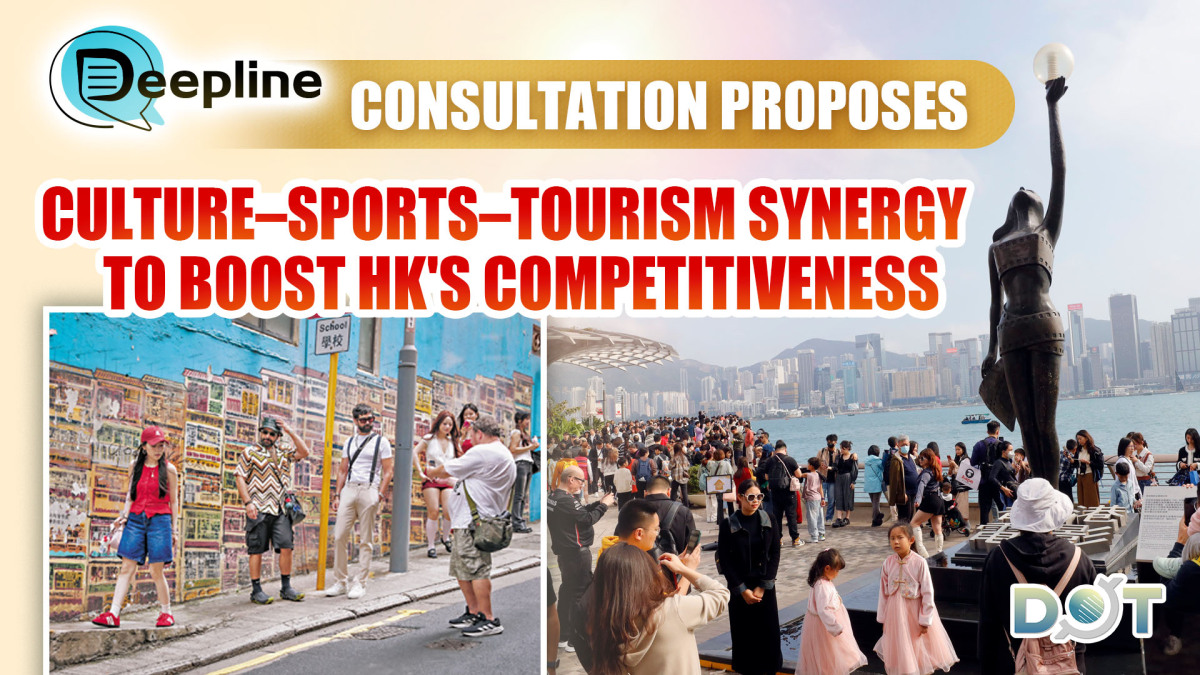
Hong Kong's public consultation document for The First Five-Year Plan for Economic and Social Development of the Hong Kong Special Administrative Region (2026–2030) (Hong Kong's Five-Year Plan) proposes treating culture-sports-tourism synergy, green transformation, and safety governance as key pillars for enhancing the city's competitiveness and residents' well-being.
Speaking to Hong Kong Wen Wei Po on Monday, figures from the sports and tourism sectors said that building Hong Kong into a center for international cultural and artistic exchange and an "events capital" in Asia requires long-term planning—especially for venue construction and utilization—and a stronger push to secure more international programs. They noted that major cultural and sporting projects typically involve years of preparation and therefore demand clear long-range targets.
According to the consultation document, Hong Kong should leverage its advantages as a hub for cultural exchange and as a leading events destination in Asia to drive coordinated development across culture, sports, tourism, and mega-events. It calls for creating more products and experiences that are distinctly Hong Kong and globally appealing, while making full use of the Kai Tak Sports Park and other large venues to support more major international sporting events, concerts, cultural programs, conventions, and exhibitions—thereby boosting tourism, consumption, and related industries.
To deepen the visitor experience and attract higher value-added travelers, the consultation document proposes developing and enhancing a range of signature tourism offerings, including:
- City walks and walking-route products
- Distinctive festivals and seasonal events
- Horse-racing tourism
- Gastronomy and food tourism
- Cruise tourism
- Island-hopping tours
- Theme-park tourism and other themed experiences
It also recommends strengthening cooperation with mainland provinces and cities to promote "one trip, multiple stops" itineraries. At the same time, it suggests upgrading tourism services and supporting facilities—such as smart tourism applications, tourism talent development, and Muslim-friendly facilities—to improve overall reception capacity and convenience.
Kenneth Fok, a Legislative Council member representing the sports, performing arts, culture, and publication sector, said he had earlier organized two consultation sessions at the Legislative Council with strong attendance, reflecting the industry's need for long-term planning and its high expectations for Hong Kong's Five-Year Plan.
On cultural development, Fok noted the consultation document's emphasis on consolidating Hong Kong's positioning as a "center for international cultural and artistic exchange." Over the next five years, he said, efforts should not stop at government funding. Instead, policymakers should consider how an "active government" can work with an efficient market to channel more market resources into cultural development—such as through tax measures and promotional incentives that encourage sponsorship and investment.
On venues, Fok said the Kai Tak Sports Park has achieved notable results within a short period and has helped underpin Hong Kong's positioning as an events capital. The next step, he added, is not only internal planning within the park but also creating stronger links between the park and nearby districts such as Sung Wong Toi and Kowloon City so that the surrounding areas can benefit through greater synergies.
The sports sector, he said, also hopes to secure more sports facilities. Noting that Hong Kong hosts multiple ATP and WTA tennis tournaments each year, he said the main venue at Victoria Park has been used for many years and should be reviewed under Hong Kong's Five-Year Plan to see whether upgrades are needed. He added that visiting players enjoy Causeway Bay's convenience—because accommodation is close to the competition venue and athletes can shop, dine, and spend before and after matches—highlighting the area's geographic advantage. If hardware and supporting facilities improve appropriately, he said, Hong Kong will be better positioned to attract more major tennis tournaments.
Timothy Chui, Executive Director of the Hong Kong Tourism Promoters Association, said the consultation document was a welcome development. He said dedicating an independent section to culture–sports–tourism synergy demonstrates that the HKSAR government attaches importance to and recognizes the value of Hong Kong's tourism industry.
He noted that the consultation document also covers multiple tourism-related tasks. In particular, the regional cooperation section proposes promoting closer ties among residents across three jurisdictions and building a high-quality living, working, and travel circle in the Greater Bay Area—supporting youth development, livelihood cooperation, and people-to-people as well as cultural exchanges.
Chui said tourism is one of the most effective ways to bring communities closer and strengthen mutual understanding. On one hand, the industry can organize Hong Kong residents to visit Greater Bay Area cities and deepen their understanding of those places. On the other, it can help residents from the mainland gain a more comprehensive understanding of Hong Kong.
He added that the tourism sector has long benefited from Hong Kong's development, and the industry should use Hong Kong's Five-Year Plan to think about how tourism can contribute more to society. For example, the sector can promote "culture + tourism" and "sports + tourism" models, collaborate with Greater Bay Area cities to co-host major sports events and activities, and use Hong Kong's international platform to promote Chinese culture and the Greater Bay Area's distinctive cultural features to global audiences. With Hong Kong continuing to welcome large numbers of international visitors, he said, the industry can generate returns while contributing to broader national development.
(Source: Hong Kong Wen Wei Po)
Related News:




Comment