






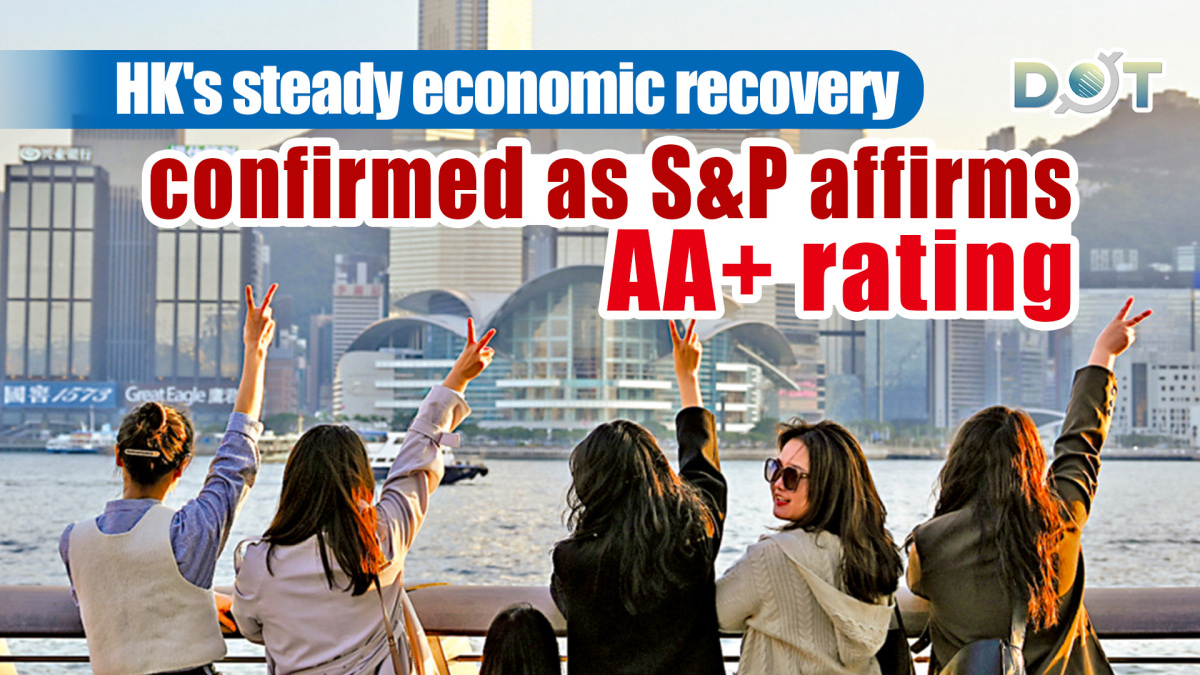
Hong Kong's economy is steadily recovering, with gross domestic product (GDP) growing 5.9 percent year-on-year in the first quarter of 2026, Ta Kung Pao reported. International credit rating agencies have consecutively affirmed Hong Kong's ratings.
S&P Global Ratings has affirmed Hong Kong's long-term and short-term issuer credit ratings at "AA+" and "A-1+" respectively, with a stable outlook. S&P stated that despite an uncertain international economic environment, the Hong Kong economy is expected to remain relatively resilient over the next three to four years, leading to the affirmation of the ratings and outlook.
While the Hong Kong government's overall fiscal balance remains in deficit, its operating account has returned to surplus, alleviating pressure on fiscal reserves.
S&P noted that Hong Kong's economic growth prospects will likely depend on several strategic initiatives. These include the large-scale infrastructure projects of the Northern Metropolis, the development of the Guangdong-Hong Kong-Macao Greater Bay Area (GBA), and deeper market integration with the mainland through various connectivity schemes. The agency believes that even as the government increases infrastructure spending, the overall fiscal deficit will average below 4 percent of GDP.
Northern Metropolis development to attract investment
S&P expects the Northern Metropolis plan to attract more investment from government-linked entities and the private sector, thereby helping to promote the development of technology-related industries and high-value-added professional services. This is particularly significant as traditional economic growth drivers — such as tourism, retail, and property construction — show signs of weakening, prompting the government to actively seek more diversified engines of growth.
Regarding the impact of geopolitical military conflicts in the Middle East on Hong Kong, S&P said the city's balance sheet continues to repair, market sentiment is improving, and domestic consumption demand has surged by 16 percent. However, due to the uncertainty arising from the Middle East conflicts, the pace of growth may moderate in the coming quarters. S&P added that because Hong Kong's manufacturing sector is relatively small and the city can import energy from the mainland, its economy remains less vulnerable to energy shocks.
Related News:
Gold, silver prices fall sharply as crude oil rebounds more than 4%




Comment