






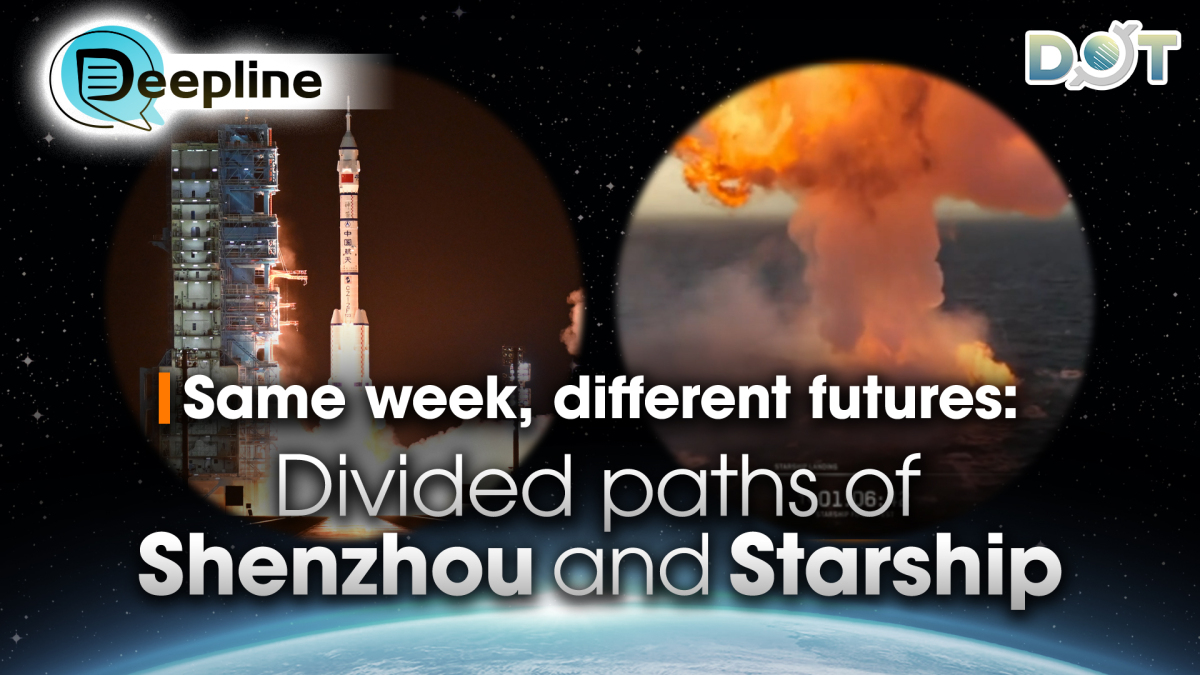
Two rockets have been launched into space in the same week. One was Musk's SpaceX Starship V3; according to a report by 21st Century Business Herald on May 23, 2026, the largest rocket ever built by humanity lifted off from the US-Mexico border after a six-month hiatus, completing its maiden flight and a simulated satellite deployment. However, the flight was fraught with issues, including multiple technical failures.
The other was China's Shenzhou-23. On May 24, 2026, at 11:08 p.m. that night, the Long March 2F rocket ignited at the Jiuquan Satellite Launch Center. About ten minutes later, the spacecraft entered its designated orbit with precision, the astronauts were in good condition, and the launch was a complete success.
Did Starship's failure mean it was no good? Did Shenzhou's success mean China had won?
But consider this from a different angle. Both rockets were essentially doing the same thing: gambling. The only difference is that the bets they placed were completely different.
The key to understanding this is not which rocket flew more smoothly, but what each was gambling on.
First, consider Starship's "launch first, blow up later" approach.
In many people's eyes, a rocket failure is a monumental event. But SpaceX has long followed a path of rapid trial and error, rapid iteration—build it, launch it, analyze the data after it explodes, fix it, and launch again. According to Science and Technology Daily, this time the V3 featured 33 new-generation SpaceX Raptor 3 engines, and both the structure and launch pad were almost entirely new. The bigger the changes, the greater the risk.
What allows SpaceX to gamble like this? Funding and speed. This maiden flight was, in essence, paving the way for something much bigger. 21st Century Business Herald reported that on May 20, SpaceX submitted an IPO prospectus to the US Securities and Exchange Commission, with plans to go public as early as June, at a valuation of nearly US$200 billion—some reports citing even higher benchmarks.
As a result, for SpaceX, a failure means no defeat; it is a stress test for its IPO narrative. Its bet is this: as long as the core roadmap works, a few explosions here and there do not matter, and the market is willing to pay for imagination.
Shenzhou follows the exact opposite path: stability.
Why can't China's crewed space program do the same? Because aboard the spacecraft are living human beings. According to the China Manned Space Engineering Office, Shenzhou pursues extreme reliability. Every step is repeatedly verified, redundancies are built in, and risks are minimized before launch. Before this launch, the rocket-ship combination was transferred to the launch pad early, and all propellant loading was completed.
Its bet is on certainty. At this stage, Starship is an experimental transport vehicle carrying simulated satellites; an explosion would cost hardware. Shenzhou, by contrast, is a mature crewed system carrying human lives. Its stability is not conservatism; it is responsibility.
One gambles on imagination. The other believes in certainty. To mock Starship for its failures or to belittle SpaceX's ambition because of Shenzhou's reliability is to miss the point.
One might think rockets have little to do with them, but that is not really true.
The most direct impact is on investors focused on commercial spaceflight. Eastmoney revealed on May 25, 2026, that this Starship test flight was a critical validation step before the IPO. How well it flew directly affects nearly US$200 billion in real money. On China's A-share market, the dual catalysts of Shenzhou and Starship have led to early capital positioning in the commercial spaceflight sector.
Beyond that, consider ordinary people who will use satellite internet. Starship is expected to carry future batches of Starlink satellites for large-scale deployment. Its success or failure affects how many people worldwide will eventually have access to low-cost satellite internet.
Then some care about how far Chinese manufacturing can go. Shenzhou's stability is backed by an entirely independent and controllable aerospace industrial chain. Every smooth launch and landing is a collective showcase for China's high-end manufacturing.
Now back to the original question: Which path is closer to the future?
There is no standard answer, because the two are solving different problems.
If the future means driving down the cost of reaching space enough to turn spaceflight into a scalable business, then SpaceX's aggressive iteration is indeed ahead at the moment.
If the future means sending people safely and sustainably into space and keeping them there long-term, then China's steady, methodical approach to crewed spaceflight provides a different kind of certainty—evident in the regular operation of its space station and the successive smooth rendezvous of its astronauts.
A more likely answer is that the future needs both approaches to coexist. Use aggressive commercial forces to drive down costs, and use steady national engineering to secure the baseline. Insisting on declaring one better than the other is a false dichotomy.
Under the same sky, two rockets placed bets on two entirely different tables.
One blew up its way to a nearly US$200 billion valuation. The other flew its way to becoming a routine national capability.
They may look like they are competing, but in fact, they are simultaneously betting on two different paths to space for humanity. And that, in itself, is far more important than which one "gets there first."
(Source: BusinessTime)
Related News:
Shenzhou-23 lifts off! How to become next HK astronaut?
Dreams are not distant, nor defined by background: Astronaut Lai Ka-ying sends message to HK youth




Comment