






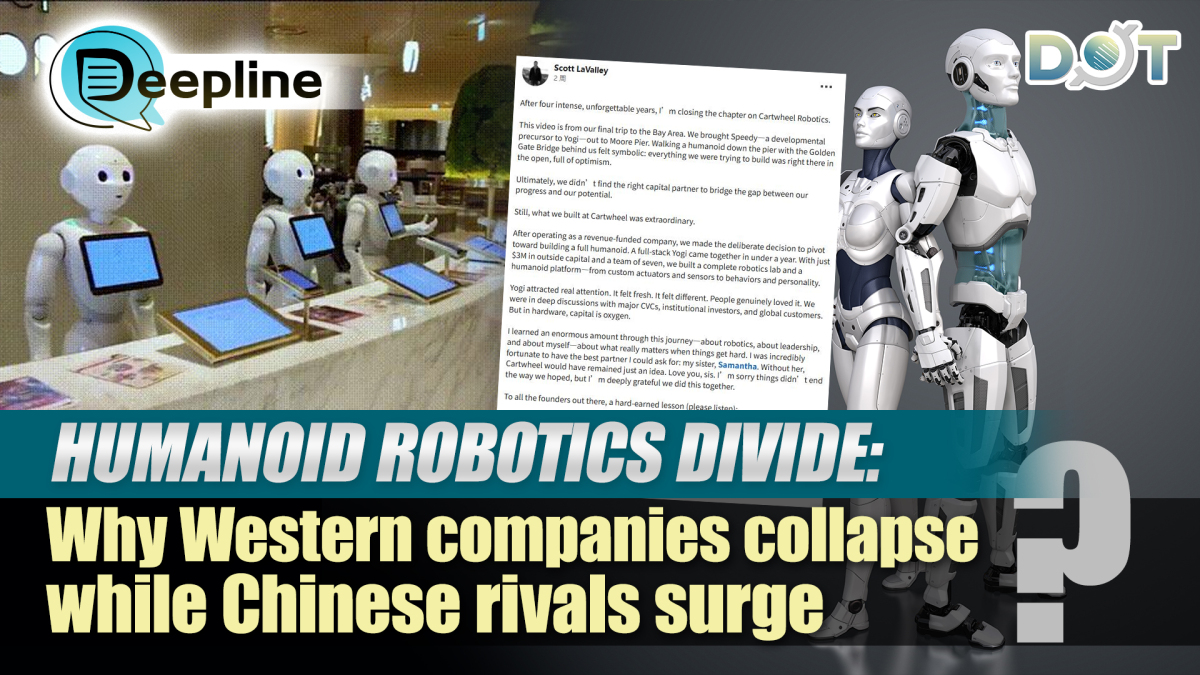
In early February, the American humanoid robotics startup Cartwheel Robotics announced its closure. Its founder had previously worked at Boston Dynamics and Disney Imagineering, bringing extensive industry experience to the table. With a team of just seven people, the company developed two humanoid robot products within a year of its founding.
This is not an isolated case. Starting in 2025, from Silicon Valley upstarts to established European firms, several robotics companies, including K-Scale Labs, Rethink Robotics, and Aldebaran, have collapsed one after another on the eve of mass production due to funding issues.
At the same time, Chinese humanoid robotics companies are raising capital at an accelerating pace, with funding amounts hitting new highs.
On one side, hot money surges; on the other, capital runs dry. The humanoid robotics track is witnessing a stark divide, a tale of two extremes. What insurmountable hurdle have these fallen Western companies failed to clear?
Looking back at founder Scott LaValley's career, it is nothing short of impressive. He spent about seven years at Boston Dynamics working on the early bipedal robot Petman, until the company was acquired by Google.
After that, he continued working for Google's parent company, Alphabet, for another two years as a senior mechanical design engineer on the original Atlas robot, contributing to research that also participated in the DARPA Robotics Challenge.
In 2016, he moved to Walt Disney Imagineering, where he stayed for five years and personally worked on the Baby Groot robot. These two vastly different experiences planted the seed for his entrepreneurial venture.
Although Baby Groot was never commercialized, for LaValley, it redefined what robots could be. In 2022, when industry star Figure AI reached out to him, he declined and instead founded Cartwheel Robotics, targeting the home companion robot space.
This team of just seven people developed two prototypes in less than a year.
Yogi, designed for social companionship, featured a unique "toddler-proportion" design—curved lines, a large head, and even a slightly chubby look.
"I don't see a robot, I see a character," LaValley said.
The other prototype, Speedy, was positioned as a customizable commercial platform that could be shaped into various IP characters, much like Baby Groot.
In the months before shutting down, Cartwheel also demonstrated its core technological achievement—a "motion language model" (MLM). This model could convert text or voice commands directly into expressive robot behaviors, enabling Yogi to walk with self-balance, mimic gestures, and generate personalized interactive actions through large models, overcoming the "stiff interaction" pain point of traditional robots.
Looking at its funding history, however, Cartwheel Robotics never managed to attract sufficient capital interest.
After its founding in 2022, the company raised a total of nearly US$3 million through its own revenues and a small amount of outside investment. Its last funding round took place in June 2025, when Canadian investment firm New Wave made only a strategic investment of US$150,000.
For a robotics company, that amount was far from enough.
On Feb. 7, LaValley posted on LinkedIn, detailing the reasons for the collapse. "In hardware, capital is oxygen," he said bluntly. Cartwheel Robotics ultimately failed to find the right capital partner to bridge the gap between its current progress and future potential, and that was the final straw for the startup.
Looking back on the four-year journey, LaValley was deeply moved. The team took the Speedy prototype to Moore's Wharf for one last demonstration against the backdrop of the Golden Gate Bridge. "Everything we were trying to build was right there in the open, full of optimism." Though they didn't make it to the end, he said he was immensely proud of what the team accomplished.
Notably, LaValley ended his post with a warning to all entrepreneurs: No money is better than the wrong money.
Behind that statement likely lie the difficulties the company encountered in fundraising: when capital is scarce, desperate funding choices can be even more dangerous than getting no funding at all.
The fall of Cartwheel reflects the harsh reality of today's humanoid robotics landscape. Industry leaders routinely raise hundreds of millions of dollars while smaller innovative companies face a capital crunch. The gap between technological passion and commercial viability has become a matter of life and death for countless startups.
The team that tried to bring warmth through a home companion robot ultimately could not wait for capital to change its mind.
In November 2025, Benjamin Bolte, founder of Silicon Valley humanoid robotics startup K-Scale Labs, sent a farewell letter to investors. The letter announced that the team had disbanded, all orders would be fully refunded, and all technology would be open-sourced.
The company, less than a year old, had drawn significant attention—three successful funding rounds, two products nearing launch, orders exceeding US$2 million, and even the head of robotics at OpenAI appearing on its customer list. Yet, on the eve of mass production, its funding pipeline suddenly broke. By November 2025, only US$400,000 remained in the bank—not even enough to pay salaries.
In a post-mortem video, Bolte admitted that aside from failed fundraising and uncontrolled cash burn, competition from Chinese robotics manufacturers had also squeezed its room to survive.
Even a veteran of the robotics world could not escape a fatal blow. Rethink Robotics, founded by MIT legendary scholar Rodney Brooks, had pioneered the collaborative robot category with Baxter and Sawyer. After first going bankrupt in 2018, the company was acquired by Germany's HAHN Group. It made a high-profile return to the US market in September 2024 with a new product line.
But in less than a year, in August 2025, it declared death for the second time. Former CEO Julia Riemenschneider revealed that the product was rushed to market before it was ready, sales fell far short of expectations, and the investors eventually pulled out.
In the social robotics space, in February 2025, Aldebaran, the manufacturer of the once-globally popular Pepper and Nao robots, entered judicial liquidation. This pioneering company, founded in Paris and once backed by SoftBank, had its robots appear in Japanese stores, French airports, and Chinese bank showrooms. After its collapse, its core assets were taken over by a Chinese company.
That same month, Embodied, which focused on emotional companionship for children, also shut down. Its signature product, Moxie—a small blue robot priced at US$799, designed for children with autism, has accompanied countless children in learning to express emotions. The company's investor roster was star-studded, including Intel Capital, Toyota's AI Ventures, Amazon's Alexa Fund, Sony Innovation Fund, and Vulcan Capital.
Regarding the cause of its collapse, Embodied publicly stated, "Despite our best efforts to seek alternative funding, we were unable to complete a critical financing round. The lead investor withdrew at the final stage, making it impossible for the company to continue operations."
From Silicon Valley upstarts to established European players, the wave of closures in that year left the industry in shock.
The successive bankruptcies of multiple high-profile robotics companies in 2025 revealed the brutal survival rules of the humanoid robotics track.
First, there is the broken supply chain. Western startups face an awkward reality. As Benjamin Bolte noted in his post-mortem, Chinese robotics companies are rising rapidly on the back of their complete local supply chains—much as DJI came to dominate the drone market. This is not just about cost; it is about the United States lacking the industrial ecosystem to build complex hardware.
Second, there is the funding gap. Developing humanoid robots requires immense investment. Companies that raise only a few million dollars simply cannot survive until mass production.
Most critically, there is the failure of commercialization. Many companies focus their efforts on making their robots look impressive, but fail to answer the most fundamental question: Why do customers need it? When a product can only shoot demos, give tours, or perform, and cannot find real application scenarios, the only ones paying are investors—not the market.
The three hurdles determine who will survive and who will fall. The humanoid robotics industry is returning to rationality: telling a good story is no longer enough. Only practical companies that can solve real problems will go the distance.
(Source: 36kr)
Related News:
Deepline | Familiar land, unfamiliar race: Tesla's China story shows evolution of local automakers
Deepline | From US$13 bn to fire sale: How action camera pioneer GoPro losts its crown




Comment