





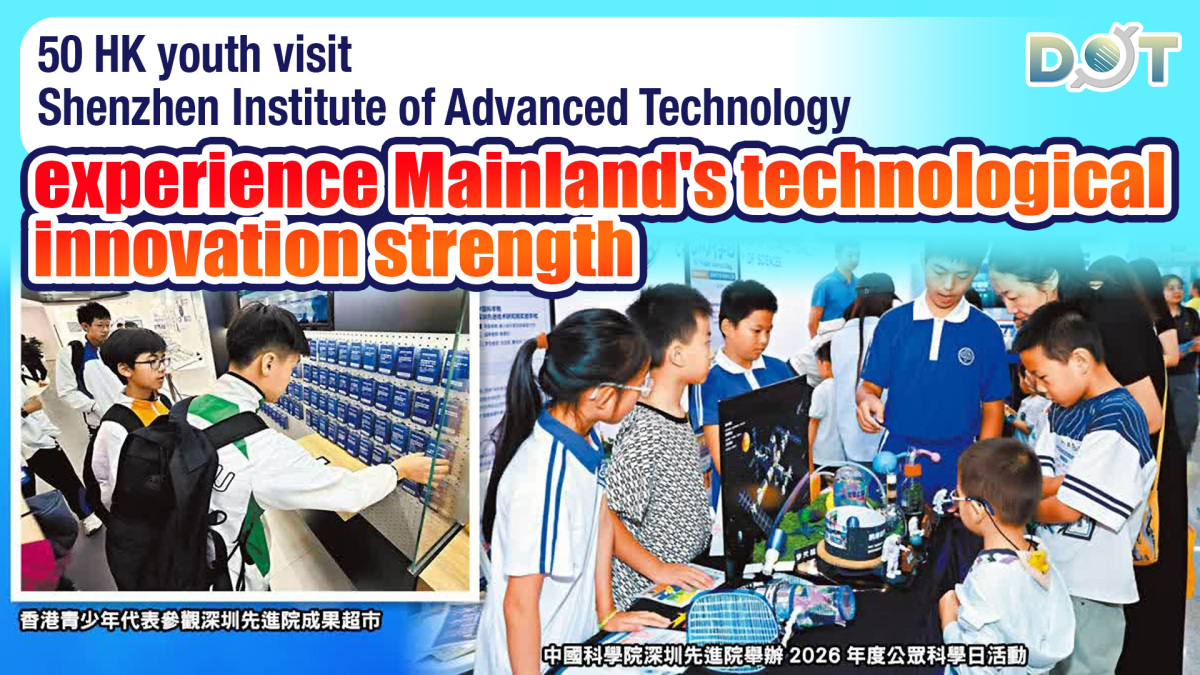
Supported by the Hong Kong STEM Education Alliance, 50 young representatives from Hong Kong visited the Shenzhen Institute of Advanced Technology (SIAT) yesterday for its 2026 Public Science Day. They toured high-end research platforms, experienced the mysteries of marine life under optical imaging, observed how the brain responds to stress, and engaged in face-to-face exchanges with researchers.
This year's Public Science Day was themed "Answering the Call of Science, Shaping the Wings of the Future — Chasing the Light, Twenty Years Toward Innovation," showcasing SIAT's hard-core technological achievements over the past two decades in fields including medical imaging, artificial intelligence, synthetic biology, and neuroscience. The young delegates from Hong Kong toured the core exhibition areas, gaining a deep understanding of the original mission of "scientific and technological self-reliance," the inspiring stories of pioneering researchers, and the latest accomplishments of scientists in the new era.
Throughout the visit, a series of cutting-edge technology experiences were presented. A dark-field plankton camera clearly revealed the microscopic world, eye-tracking technology intuitively demonstrated brain responses, and interactive activities such as remote-controlled experiments and biological dye redox reactions proved highly engaging. At the opening ceremony, researchers delivered captivating science lectures: Associate Research Fellow Liu Xin'an presented a talk titled "What Does Your Brain Secretly Do When You Feel Stressed?" revealing the link between stress and the brain; Associate Research Fellow Ma Yinzhong decoded the science of stroke, explaining prevention and response strategies — leaving the Hong Kong students with valuable knowledge.
"This visit has been truly eye-opening and has completely reshaped my understanding of the mainland's technological innovation capabilities," said a Secondary 4 student at Pui Kiu Middle School in Hong Kong. Another Secondary 3 student from the same school who aspires to become a forensic scientist participated in the event with that goal in mind. After observing high-end medical imaging equipment and learning about cutting-edge single-cell research technologies — and witnessing that many medical research devices in the mainland have been independently developed, free from import dependence — she felt deeply the strong momentum of the nation's technological advancement. This experience strengthened her determination to excel in the sciences and pursue a career in medicine, giving back to society with her knowledge and skills.
A biology teacher at the school noted that the school has long prioritized fostering technological innovation literacy among its students. It regularly invites mainland scientists to give science lectures on campus and frequently organizes student visits to high-tech research platforms and innovation enterprises in the mainland to broaden their horizons. She hopes that this scientific innovation tour will plant seeds in the students' hearts — seeds of respect for science and ambition to serve the country — and that more young people from Hong Kong will be encouraged to join the wave of technological innovation development in the Greater Bay Area and contribute to the nation's scientific and technological construction.
Related News:
Miriam Yeung 'welcomes daughter' at 5:30 am for new character IP launch in Shenzhen
Former HKO chief warns of more frequent heatwaves and heavy rainfall in HK this year




Comment