






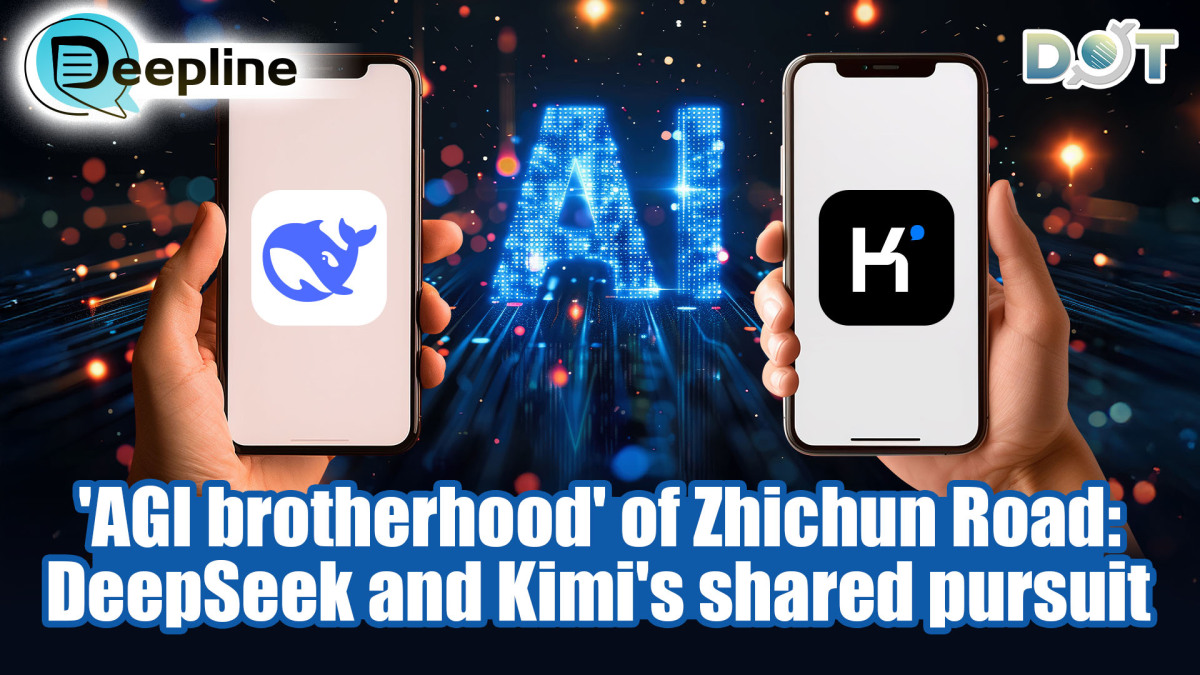
DeepSeek (Beijing Subsidiary) and MoonShot AI are both located in the Zhichun Road area of Haidian District, Beijing, just 1.4 kilometers apart—a walk of only about ten minutes. Standing in the conference room of one company, one can look across the distance and see the other company's office building. Perhaps at certain moments, their researchers gaze at each other across the cluster of buildings, their minds filled with visions of the AGI blueprint.
This physical proximity has fostered a similar temperament among employees of both companies: low-key, pure, and relentlessly focused on AGI. It was the emergence of DeepSeek R1 that educated the market—proving that true capability is the best form of promotion. Last year, Kimi also chose the reasoning path that DeepSeek had pioneered, and has since steadily surpassed others in agent capabilities.
This mutual respect and recognition are also evident among DeepSeek's researchers. On social media, you can see that almost every DeepSeek researcher's following list includes Kimi researchers, and vice versa.
One DeepSeek researcher said that he personally is quite optimistic about Kimi. He believes the two companies share similar technical ideals and are also more pure in their approach, though they differ slightly in management. DeepSeek tends to move a bit slower but does things more meticulously.
"If Kimi's leadership sets the right direction, they might reach AGI faster than DeepSeek."
This shared technical ethos leads both companies to favor directions that are costly, long-cycle, and highly uncertain—and therefore more likely to trigger paradigm-level capability leaps.
They are also both favorites of the capital. A source from a top-tier domestic investment firm that participated in Anthropic's financing last year noted that, among domestic model companies, if they could invest in two with their eyes closed, one would be DeepSeek and the other Kimi.
From investors and large-model scientists to industry practitioners, people are increasingly placing both companies in the same coordinate system for evaluation. Examining the companies also means examining their founders, Liang Wenfeng and Yang Zhilin. Both believe deeply in the foundational power of scaling laws, adhere to the minimalist logic that "the model is the product," have defended their user base against the traffic siege of internet giants, and have similarly carved out a brand presence for Chinese large models in overseas markets.
Zhichun Road has long been considered a blessed place for entrepreneurs. Zhang Yiming founded Jinri Toutiao in a residential apartment on Zhichun Road in 2012, embarking on his entrepreneurial journey. In the current AI era, these two rising AI startups rooted near Zhichun Road are increasingly moving in sync—in technological iteration, strategic choices, and even certain mindsets.
During the penultimate week of April, new models from Qwen, Kimi, DeepSeek, Xiaomi, and Tencent were released in close succession. On April 20, Kimi released Kimi 2.6 and open-sourced it. This model surpassed closed-source models such as GPT-5.4 and Claude Opus 4.6 on multiple coding benchmarks, significantly enhanced autonomous agent execution capabilities, and notably improved long-horizon coding abilities.
Just four days later, DeepSeek V4 finally arrived amidst widespread anticipation. DeepSeek officially stated that, compared to its predecessor, DeepSeek-V4-Pro's agent capabilities have been significantly enhanced. On the agentic coding evaluation, V4-Pro has achieved the best performance among current open-source models and also excelled in other agent-related benchmarks.
By this time, 484 days had passed since the release of the previous generation V3. During this period, DeepSeek went from explosive fame to near-invisibility, its user numbers declined sharply, and it was even accused of being a flash in the pan.
No one understands the feeling of being overlooked by the world better than Yang. When DeepSeek first shot to fame early last year, Yang, as a startup star, quietly bore the pressure. External criticism accused MoonShot AI of falling into a traffic-dependence trap, with slow progress on its foundation model, lagging comprehensively behind the suddenly emerged DeepSeek in trillion-parameter competition, reasoning breakthroughs, and open-source ecosystem development.
Yang never responded to this criticism publicly, instead leading his team in focused R&D on new models. Then, on July 11, 2025, Kimi K2 was released—with a trillion total parameters and trained using the Muon second-order optimizer, marking the first large-scale use of second-order optimization by a domestic large model. Kimi K2 caused a global sensation; Nature magazine called it "another DeepSeek moment."
The similarity between Liang and Yang is rooted in their shared belief in AGI. Both firmly believe that the upper limits of large model capabilities are defined by continuous breakthroughs in base architecture and parameter scale, and that all product experience and commercial value must be built upon the leading capability of the foundation model. This belief has led the two companies to follow a rare trajectory of co-evolution in their technical paths.
Since last year, media narratives about DeepSeek and Kimi have often described "collisions"—such as the release of new papers and models with similar architectures and parameter counts. For example, DeepSeek V4 uses a Mixture-of-Experts (MoE) architecture, with total parameters of 1.6 trillion and about 37 billion activated parameters. Kimi's K2 series similarly uses a trillion-scale MoE architecture, with 1 trillion total parameters and 32 billion activated parameters.
In reality, the situation is far more than a simple "collision"; the two companies have formed an unspoken understanding of mutual validation and even cross-utilization. Behind this is a spiritual resonance between the two founders.
Liang, starting from quantitative investment, brings a philosophy of "using super engineering capabilities to achieve a model efficiency revolution." Since its inception, DeepSeek has insisted on using its own capital to support foundational R&D, simply to avoid interference from short-term commercial goals.
Yang, a top academic talent in the NLP field who graduated from Tsinghua University and Carnegie Mellon University, set the core direction of "breaking through AGI boundaries with long-context capabilities" when he founded MoonShot AI. Even during the most intense phases of the industry's traffic wars, he insisted on investing core resources into foundation model R&D.
These two men, just 1.4 kilometers apart in the Zhichun Road area, are likely so busy that they rarely meet in person. Yet they may also be kindred spirits who have long understood each other without frequent contact.
Another commonality between DeepSeek and Kimi is their overseas reputation, which is also a key reason they attract investment. A top-tier investment firm entered Kimi when its valuation was US$60 billion and chose to follow on in the subsequent two rounds.
"Good model, good product, good understanding, good globalization, and a fast-responding team," said a source from this investing firm. As a clear example of globalization, they cited the overseas product Cursor "shelling" Kimi in March of this year.
On March 20, Cursor officially released its new programming model, Composer 2. Its official blog emphasized proprietary development, continuous pre-training, and large-scale reinforcement learning throughout, claiming to surpass Claude Opus 4.6 at only one-tenth the price.
Hours later, a developer debugging the Cursor API intercepted an internal model ID: kimi-k2p5-rl-0317-s515-fast. Elon Musk replied to a comment under the post "Yes, Kimi 2.5!" triggering a global explosion of discussion.
"You can tell from Cursor training its model that Kimi's global recognition is certainly very good," said the aforementioned investor.
Since releasing Kimi K2 last year, Kimi has had a major release almost every two months. In November of that year, Kimi launched the trillion-parameter K2 Thinking large model, which scored 93% in agent tool-calling capability tests—ranking first globally and surpassing overseas closed-source flagship models from OpenAI, Anthropic, and others, becoming the "largest and best open-source model" at the time.
Launched in January this year, K2.5 featured comprehensive upgrades in multimodality, long-term memory, and agent capabilities, subsequently gaining popularity in tech communities thanks to the "Little Lobster" trend. In February, it topped the oversea model aggregation platform OpenRouter, becoming the weekly champion in call volume.
Also in March, Kimi released a significant technical report considered a challenge to the residual connection mechanism that had been used in Transformers for 11 years. Former OpenAI VP of Research, Jerry Tworek, called it the beginning of "Deep Learning 2.0." Musk reposted with the comment: "Impressive work from Kimi."
DeepSeek's overseas influence needs little introduction. Early last year, DeepSeek R1 first gained popularity overseas. Among many overseas developers and entrepreneurs, DeepSeek is revered as the "god of open source."
After the release of DeepSeek V4 this month, it has again sparked massive discussion overseas. Citing its cost-performance ratio, Bloomberg described DeepSeek V4 as a formidable challenge to OpenAI and Anthropic. Although many voices suggest that V4's impact is less than that of V3, for developers, domestic open-source models like DeepSeek, Kimi, and Zhipu—while still a few months behind overseas closed-source models—offer the best value and are the most competitive options," said the investor.
Capital market interest in DeepSeek has also reached unprecedented levels. Reports about DeepSeek's financing are flying around, yet the company has not officially responded.
Financing is, to some extent, a means to retain talent. Previously, several of DeepSeek's core technical personnel were poached with high salaries. A DeepSeek insider said that one of the biggest benefits of obtaining financing for DeepSeek is perhaps reducing the likelihood of talent being poached.
Kimi similarly values talent. In an internal letter last December, Yang stated that Kimi had over 10 billion RMB in cash on hand and was not in a hurry to go public in the short term. He also said that the financing was aimed at more aggressively expanding GPU reserves, accelerating the training and development of the next-generation K3 model, and allocating some funds to significantly increase employee incentives to attract and retain top talent.
According to reports in early April this year, Kimi plans to launch a new top-talent campus recruitment program, intending to grant company options to interns who have not yet graduated. After passing a 3-to-6-month evaluation period at MoonShot AI, selected candidates would be directly granted a certain number of option shares, even if they have not officially graduated.
The large model race is a comprehensive contest of capital, talent, and computing power. DeepSeek's shift from never seeking financing to announcing financing, and Kimi's shift from stating no rush to go public to having ample cash on hand and raising billions of RMB, both reflect a consensus already formed in capital markets: the massive productivity gains brought about by leaps in fundamental large model capabilities are now very clear.
However, compared to overseas, these domestic financing rounds seem modest. In March 2026, OpenAI completed a massive US$122 billion financing round at a post-money valuation of US$852 billion, with Amazon, Nvidia, and SoftBank participating. In February 2026, Anthropic completed a US$30 billion Series G round at a valuation of US$380 billion, led by Singapore's GIC and Coatue.
Behind this investment fervor, a more direct phenomenon is the very optimistic revenue growth of model companies. As of April 7, Anthropic's publicly disclosed ARR exceeded US$30 billion, more than triple its revenue at the end of 2025. The investor who participated in Anthropic's financing told us, "Anthropic's 2026 ARR is expected to surpass US$100 billion."
According to sources, in recent months, Kimi's equity has been in high demand, with one dollar fund hesitating for only a few days before its allocation was fully subscribed.
Nevertheless, money has never been the goal for either company. Liang gave his only interview in July 2024, during which he said, "Our starting point is not to make a quick profit, but to reach the forefront of technology." This aligns with Yang's statement: "Not eager for short-term monetization, focusing on technological frontiers and long-term AGI goals."
This valuable purity is precisely the reason they continue to attract external attention.
(Source: White Whale)
Related News:
Deepline | Crossroads in front of DeepSeek's Liang Wenfeng: Talent, options, and becoming 'normal'
Deepline | China prohibits Manus acquisition, targeting 'cosmetic' offshore moves




Comment