






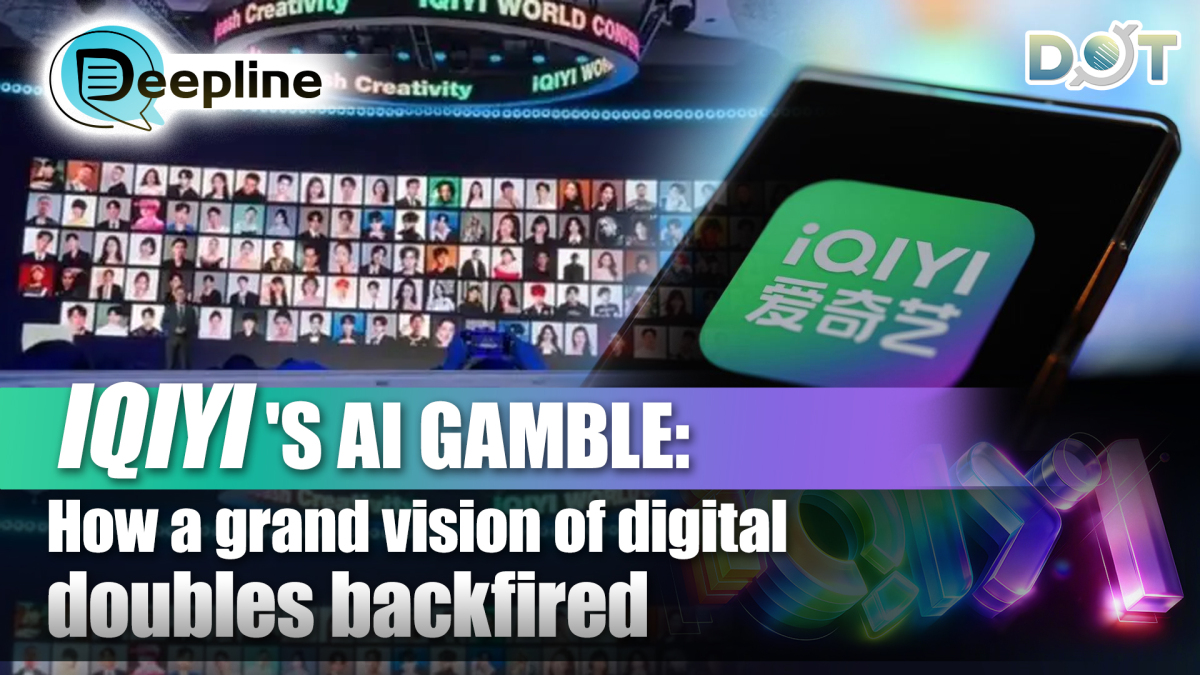
Every year, the iQiyi World Conference never fails to stir up some controversy. In 2025, the company sparked nationwide outrage over its "skip-watch" feature (a function that lets users skip to the climax), landing it at the top of trending lists. In 2026, it followed up with a spectacular three-act train wreck: a high-profile announcement, an instant public backlash, and an overnight damage control.
This time, the trouble came from AI. On April 20, iQiyi founder Gong Yu took the stage with grand visions for an AI-reshaped film-and-television utopia. The official launch of iQiYi's "AI artist library" and the commercial release of the Nadou Pro platform, with "over a hundred artists already onboarded," were announced. In his script, creators could freely summon digital doubles of celebrities, reducing production barriers and costs to near zero.
But as soon as he finished speaking, the photo wall of artists scrolling across the conference screen became a powder keg. Social media was flooded with doubts. Then, the involved actors quickly distanced themselves. Zhang Ruoyun, Yu Hewei, Wang Churan, and many others issued late-night statements denying any signed AI licensing agreements, publicly calling iQiyi out for what they saw as fake news.
In the early hours of April 21, iQiyi was forced into an emergency PR response, awkwardly reinterpreting the word "onboarded" to mean "expressed willingness to engage."
The hashtag "iQiyi has gone crazy" trended. Gong's remark, "In the future, live-action filming may become an intangible cultural heritage," was translated by netizens into "Actors will be replaced by AI." The comment section then exploded, "If actors can be AI, then let AI viewers pay for memberships." Gong posted three consecutive Weibo posts insisting that "technology is never meant to replace people," but all three had comments restricted to approved selections, a move that spoke volumes.
Why did a seemingly cost-cutting, efficiency-boosting technical solution manage to anger everyone? What landmines did iQiyi step on in this high-stakes AI gamble?
The photo wall at the conference was the spark. Fan groups erupted, "Our idol just sold their digital rights like that?"
What escalated the situation was the swift disassociation by top-tier artists. On the evening of April 20, Zhang Ruoyun, Yu Hewei, Wang Churan, and others issued statements through their studios and fan liaison accounts, explicitly denying any signed AI licensing agreements. Although iQiyi had never claimed these specific artists were on its cooperation list, the message was clear. The vigilance and pushback from A-list talent instantly turned the controversy into a "truth or falsehood" standoff over contract signing.
In the early hours of April 21, iQiyi rushed to clarify: being "onboarded" into the Nadou Pro artist library merely indicated potential interest in collaboration, not that any artist had been included without consent. Overnight, "onboarded" became "interested," and the narrative slid from "fact" to "wishful thinking." Gong's three Weibo posts, all with comment sections restricted, made the situation even more awkward than an AI face swap.
iQiyi's miscalculation first and foremost struck at the core interests of the artists.
What is an actor's primary asset? Not their paycheck, but their unique image, performance style, and years of built public recognition. The essence of an AI artist library is to turn these irreplaceable human qualities into infinitely replicable, combinable, and distributable "digital assets." Once portrait data is fed into an AI model, what could happen next? Who owns the copyright to AI-generated performances? Could biometric data be stolen by third parties? After a license expires, could the likeness be reused improperly?
iQiyi had no answers to any of these questions at launch.
What sent chills down artists' spines even more was Gong's statement.
"Actors work very hard, often shooting a single drama for three or four months, working 13 to 14 hours a day. If they authorize AI collaboration for film and television, they could work like regular office employees — still busy but with some personal life, and earn a bit less than before. Instead of two projects a year, they could take on four."
Translation: per-project income drops, the number of projects increases, and total income may stay the same. But for top-tier talent accustomed to high fees, "earning a bit less" is not an attractive option.
A deeper anxiety lies here: if AI matures, platforms could bypass expensive A-list actors altogether and work directly with mid-tier or even unknown performers, using AI to enhance their performances for commercial productions. Some companies already film unknown actors first and then apply AI processing to improve their acting. One AI film and TV director noted that the results are "comparable to or better than average actors."
Once this logic takes hold, the bargaining power of top actors would be severely compressed. They would no longer be irreplaceable scarce resources but just one option among many. That is why they are so alert; once the trend is set, no one can remain unaffected.
iQiyi emphasized that "onboarded" merely indicated an intention to engage, with specific projects requiring separate authorization. However, the problem is: when a platform publicizes an "intention" as "already onboarded," the artist is already put at a disadvantage.
To understand why iQiyi is pushing so aggressively into AI, one must first look at its situation.
In 2025, iQiyi's revenue was 27.29 billion yuan, falling for the second consecutive year. More concerning was its profit: Non-GAAP operating profit plunged from 2.3 billion yuan in 2024 to just 620 million yuan, a drop of over 70%; full-year GAAP operating profit was 229 million yuan, down 87.3% year-on-year. The company swung to a net loss of 206.3 million yuan — after having made a profit of 764.1 million yuan in 2024.
All four of its business lines underperformed. Membership revenue fell 5% year-on-year; online advertising was squeezed by short-video platforms; content distribution and other businesses were also weak. Market capitalization fell from around US$31 billion at its 2018 IPO to less than US$1.4 billion today, a loss of over 95%.
A company once compared to Netflix now has a market cap smaller than many mid-sized A-share companies.
In eight years, its market value shrank by nearly 300 billion yuan. To put it in real estate terms: a property you bought for 1 million yuan eight years ago is now worth just 30,000 yuan. That kind of pain would make anyone desperate.
In traditional film and TV production, iQiyi has almost reached a dead end. Producing hit shows is costly and risky. Its stock price has collapsed, and it urgently needs a narrative that can reignite investor confidence. AI is precisely the theme that capital is most excited about right now.
Gong's proposed "Media 112 Rule" (reducing unit content cost to one-tenth or even one-twentieth, increasing the number of creators tenfold, and multiplying the number of works a hundredfold) sounds appealing. But viewed through iQiyi's financial statements, the underlying reality becomes stark.
In 2025, iQiyi's total content cost reached 15.45 billion yuan, eating up more than half of its revenue. If AI truly reduces content costs to "one-third to one-tenth," it could theoretically save billions or even tens of billions of yuan annually. For a platform with less than 30 billion yuan in annual revenue, struggling around the breakeven point, this temptation is deadly.
Despite the uproar, iQiyi's current stance remains "all in on AI." To put it simply: aside from AI, it doesn't have much of a story left to tell.
Everyone is tired of hearing about the "winter of film and TV." In 2024, 593 TV dramas were filed for record, nearly half of the 1,163 six years earlier. In 2025, short dramas exploded, with ByteDance's Hongguo Short Drama's monthly active users approaching iQiyi's. By the time iQiyi tried to enter the short-drama market, it was already too late. What's more, ByteDance's situation doesn't seem particularly promising either.
Even more fatal: "clips" made by individuals on short-video platforms can dissect the core plot of an entire drama; viewers who watch a few clips feel like they've seen the whole show, then why should they pay for a long-form video platform?
Look at iQiyi's own content output. In previous years, it indeed spent heavily and produced some good work. But the problem is that hit dramas are too rare. Producing them requires huge investment and carries high risk, far less attractive than AI-generated productions with low input and short cycles. Gong even predicted that, using AI technology, successful commercial blockbusters could be produced in three to six months — a dramatic compression compared to the one- to two-year production cycles of traditional film and TV.
Moreover, live-action dramas carry a fatal risk: if one lead actor gets into trouble, the entire show is doomed. AI actors, by contrast, never "go wild."
Not to mention that iQiyi is part of the Baidu ecosystem. CEO Robin Li has stated that Baidu is the most aggressive search engine in terms of AI transformation. Although iQiyi is no longer as close to Baidu as before, becoming the most AI-driven video platform is practically in its DNA. Besides, Baidu currently has no spare resources to fund iQiyi. To survive on its own, iQiyi must invent a new story.
Choosing to go all in on AI can't be defined as a mistake. The mistake lies in handling information disclosure too crudely and adopting an overly confident communication stance. This train wreck, from triumphant launch to emergency backtrack, exposed not just a weakness in PR capabilities but an industry-wide failure to balance commercial interests with human dignity in the face of technological change.
The wave of AI in film and television is rising, and no one can stop it. But the direction of that wave depends on the choices of every participant. iQiyi's gamble is not just about its own future; it is also about the entire industry's valuation of what it means to be human.
If it wins, it may find a way out of the quagmire. If it loses, it may lose not just its stock price but the last shred of trust from its audience.
(With input from SciTech Moment)
Related News:
Deepline | Apple announces new CEO: Post-Cook era begins, but Cook isn't leaving
Deepline | Crossroads in front of DeepSeek's Liang Wenfeng: Talent, options, and becoming 'normal'




Comment