






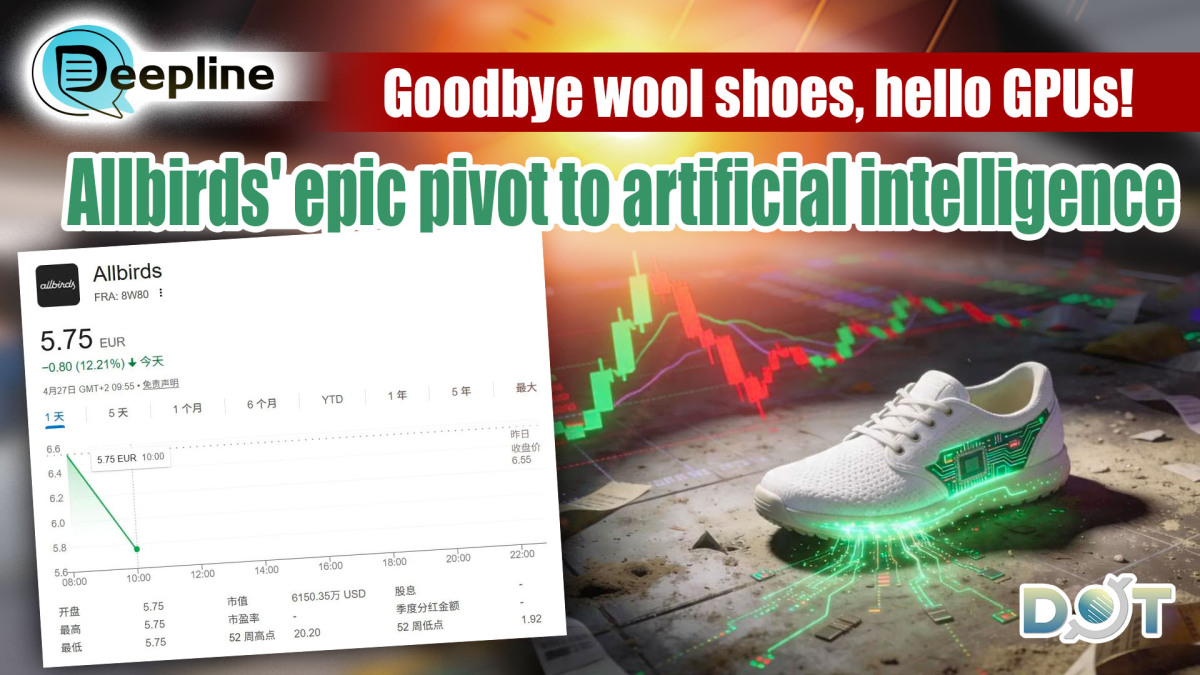
From "Silicon Valley elite must-have" to the new darling of market computing power, eco-friendly footwear brand Allbirds has officially announced the sale of its footwear business, rebranded as "NewBird AI," and fully pivoted to the field of artificial intelligence.
Who would have thought that Allbirds, whose market value once exceeded US$4 billion at its IPO in 2021, would sell its footwear business, trademarks, and all assets and liabilities as a package in March 2026 to the American Exchange Group for just US$39 million, thereby completely exiting physical retail. And that US$39 million, at its peak in 2021, was merely one-tenth of the US$348 million raised in its IPO.
Once famous for its wool shoes, Allbirds ultimately exited the footwear market at a wool-price fire sale.
Although Allbirds' sudden cross-sector transformation has been called a "2026 magical event" by media outlets, it is not without reason. On the one hand, as an 11-year-old brand, since going public, Allbirds has continuously expanded its retail operations and related product categories, such as Merino wool leggings and high-performance running shoes, but these have failed to resonate with core customers, leading to widening losses.
From 2022 to 2025, its sales steadily declined from US$298 million to US$152 million, roughly halving, and its net loss for the first quarter of 2026 is projected to reach as high as US$19.6 million.
On the other hand, consumers are no longer buying the "eco-friendly, sustainable" brand story. As major sportswear brands like Patagonia and Nike have all embraced sustainability, and even fast-fashion brands are making a big deal out of "eco-friendliness," Allbirds has gradually lost ground in terms of quality, style, and price.
The pivot, thus, is a necessary path for the brand to save itself.
As soon as the news broke, the company's stock price soared 600% in a single day, from US$2.49 to an intraday high of US$24.30, catapulting its market cap to US$148 million. But market sentiment cooled quickly, and the stock fell back 30% to 35% the next day.
Thus, whether a wool-shoe brand turning to AI is pure fantasy or a long-planned move remains to be seen. But there is no denying that this pivot has allowed the once-teetering Allbirds to pull off an epic "rags-to-riches" comeback.
Reborn as "NewBird AI," the former shoe icon steps into a new AI era. As part of the transformation, the company previously announced a US$50 million convertible financing agreement with an institutional investor to enter the AI computing infrastructure space, with the deal expected to close in the second quarter of 2026.
Allbirds' rise was plain for all to see, but its fall is equally sigh-inducing: how did the "Silicon Valley standard" become a "tear-jerker"?
In its early days, Allbirds raised US$119,000 on an e-commerce platform in just five days. With the dual tags of "extremely comfortable feel + carbon neutrality," it precisely captured and matched the "eco-friendly, sustainable ethos" then prevalent among Western elite circles, thereby cashing in on "green premiums" in business.
Labels like "the world's most comfortable shoes," "Silicon Valley uniform," and "elite first choice" became its trademarks.
Not only did Google co-founder Larry Page wear them early on, but former US president Barack Obama was also photographed several times wearing Allbirds while recording podcasts, and Hollywood star Leonardo DiCaprio took an equity stake and endorsed the brand for salary. Even in 2018, then-New Zealand Prime Minister Jacinda Ardern gave a pair of Allbirds wool running shoes as a gift to then-Australian Prime Minister Malcolm Turnbull during a visit to Australia.
The story always starts perfectly, but perfection is eventually replaced by time.
In June 2024, the exclusive operating rights for Allbirds in China were handed over to Belle Group. At that time, Allbirds' full-year 2024 revenue fell 25% to US$190 million. From the CEO's departure to a 98% stock price crash, the brand was still deep in a self-rescue crisis. Compared with the growth trajectories of On, Hoka, and even Fila, Arc'teryx, and Descente, which entered the Chinese market around the same time, Allbirds clearly fell behind.
Moreover, Allbirds' early hype was always tied to elites and celebrities, distancing itself from long-term mass consumer demand, which eventually led to a full-blown crisis. Copycats emerged, competition intensified, and its direct-to-consumer model failed.
Many consumers reported that the wool shoes deformed and developed holes after a few months of wear. The imbalance between quality and price further reduced repurchase rates. Four consecutive years of losses drove its stock price from a high of US$28 down to US$2.49 in April 2026, erasing 95% of its market value, and it received a delisting warning from Nasdaq.
"Profitability collapse," "brand label failure," "growth stagnation"—unable to make money, grow, or maintain uniqueness put immense pressure on the brand's valuation, making a pivot a last-ditch struggle.
Thus, Allbirds sold its footwear assets at a low price, retaining only the public shell, to search for its next step in the AI market.
"It's not that shoes are hard to sell, but that the shoes you sell have lost their market."
"Sustainability" was once Allbirds' proudest label. Wearing a pair of Allbirds felt like gaining entry into an upper-class mindset: "I am rich in compassion, I care about the future of the planet."
According to statistics, in Allbirds' IPO prospectus, the company used the word "sustainable" more than 220 times. Early on, the "green premium" powered its high growth and valuation.
But now, is anyone still willing to pay for sustainability?
Even Allbirds itself, after renaming the company, amended its charter to remove the core tenet it had long touted: "to operate with the mission of promoting environmental public benefit."
Similarly, in recent years, "sustainability" is no longer exclusive to Allbirds. For example, Adidas launched the Ultra Boost sneaker made from ocean plastic waste, selling millions of units. Nike implemented a "waste prevention jersey redesign" program, blending sustainability with technology.
Consumers' attitude became negative, "Why should I pay 30% more for a pair of shoes?" Once users see through the "green premium" act, no one will pay an extra price for it.
Earlier, Patagonia, a brand long known for its environmentalism, made grand gestures with its "Earth Usage Fee" campaign intended to promote sustainable consumption, but it triggered a crisis of trust. Some media interpreted it as "moral blackmail" and "making consumers pay for sustainability is just a marketing gimmick," sparking negative discussions.
Moreover, the UK's Advertising Standards Authority even listed "sustainable" as a sensitive word in advertisements. Thus, environmentalism has gone from a plus to a high-risk term.
With sustainability losing its power, Allbirds has to compete on the product itself, but the results are a steady retreat.
Market expansion and product range expansion have been like tossing stones into the ocean—silent and waveless.
In terms of comfort, Allbirds has plenty of substitutes: Birkenstock for spring and fall, Crocs for summer, and UGG for winter. In terms of trends, Allbirds fails to capture young people's preferences—it can't become Gen Z streetwear standard, nor can it, like UGG, use wool to stake a claim in both trendy and high-end markets.
On the professional side, ASICS has its wide fit, HOKA its cushioning and support, Salomon its tech-forward, trendy designs—each can be cited for strengths. But aside from "comfort and sustainability," Allbirds notably lacks a core competitive edge in the market.
Naturally, eco-friendly footwear is a mature market with no surprises. Allbirds' lack of buzzworthy new models, its narrow product matrix, and its faded celebrity appeal have gradually pushed the brand out of the public eye.
2026 is the year of AI, from small things like company employees drawing inspiration from AI data when writing plans, to large trends like billions of dollars in global capital fully betting on AI.
Allbirds, from being warned by Nasdaq for delisting to selling off its assets to go all-in on AI, has experienced a phoenix-like rebirth overnight, with its stock price surging. Regardless of how magical the market finds this move, one thing is undeniable: compared with sustainable wool shoes, the market is far more willing to pay for AI.
At the same time, skepticism exists.
Comparing capital within the same arena: for instance, AI computing giant CoreWeave plans to invest US$30–35 billion in expanding its GPU clusters in 2026, and the company raised US$1.5 billion in its 2025 IPO. Nebius plans to ramp up capital expenditures to US$16–20 billion. In contrast, the US$50 million financing Allbirds secured is less than one-six-hundredth of CoreWeave's budget.
Data shows that global data center spending on AI infrastructure in 2026 exceeds US$450 billion. A single NVIDIA H100 GPU sells for US$25,000 to US$40,000; a fully equipped 8-GPU H100 server costs US$200,000 to US$320,000. In those terms, US$50 million might only buy a few hundred GPUs.
A more realistic question is: from selling shoes to doing AI, can the talent needed to operate a professional data center be secured?
Some professionals analyze that running a GPU data center (operating a high-density computing cluster) requires a team of senior engineers proficient in network architecture, thermal management, distributed scheduling, and fault tolerance. Allbirds' current team, from the CEO down to middle management, comes from the consumer retail industry.
As a result, many suspect that Allbirds' phenomenon is another case of bubble economics.
A company on the verge of delisting changes its name, jumps into the hottest field of AI, and sees its market value magically increase by over US$100 million in a single day. That is clearly "label over substance." It seems no one really cares about "what it can actually do after the pivot"; instead, investors are more focused on "how much more it can rise." When it later fails to deliver real results, the stock price will likely return to where it started.
Still, Allbirds' current CEO, Joe Vernachio, described the transformation as a new beginning for the brand. Thus, the AI dream of the wool-shoe brand remains to be seen as it unfolds.
(Source: GymSquare)
Related News:
Deepline | Apple's post-Cook test: Can John Ternus save it from missing AI?




Comment