






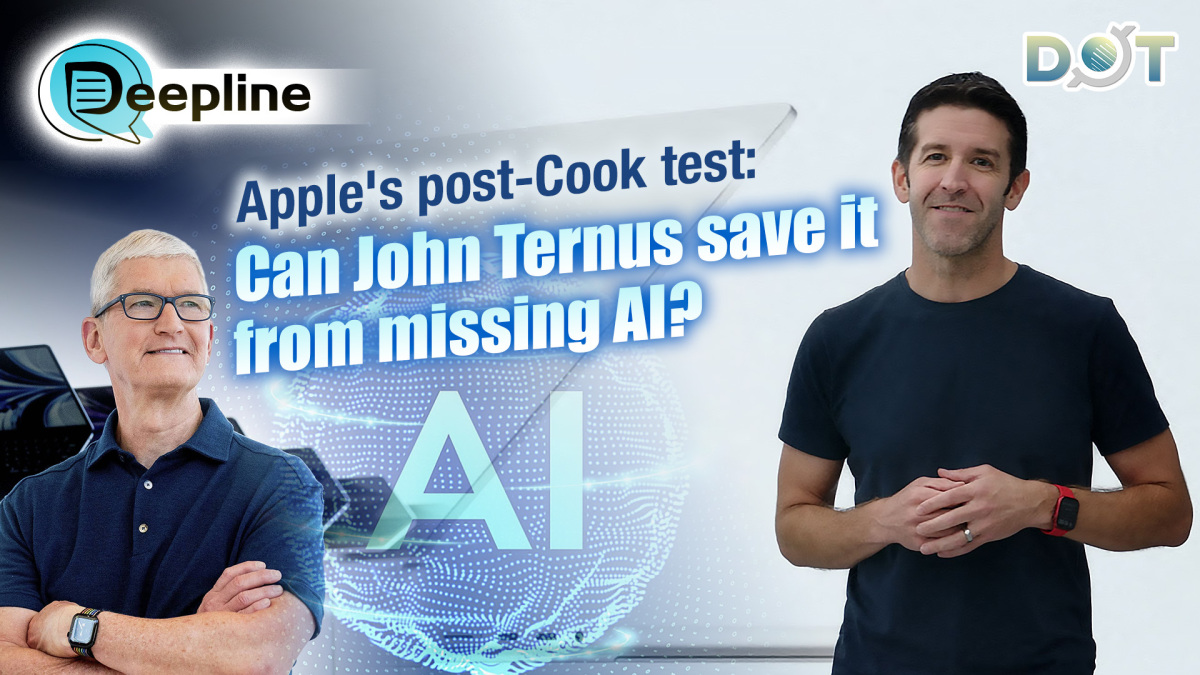
On April 21, 2026, when Apple's website posted that letter titled "Community Letter from Tim," traders on Wall Street barely looked up. The stock edged up 1.04%, and the company's market value firmly stood above US$4 trillion, enough to buy the entire German stock market. Yet the capital market's reaction to this major leadership change was eerily calm.
Tim Cook announced he would step down as CEO on Sept 1 and transition to Executive Chairman. John Ternus, the head of hardware engineering, will take the helm. There was no geopolitical storm, no hasty exit, just a composed farewell at the peak of financial performance. Over 15 years under Cook, Apple's market value swelled from US$350 billion to US$4 trillion, an 11‑fold increase; revenue soared from US$108 billion to US$400 billion; and the services business, built from scratch, now generates over US$100 billion annually.
But as Cook departs, Apple faces an awkward reality. In the AI revolution, Apple has become a bystander. Siri lags at least one generation behind in intelligence, Apple's generative AI efforts are nearly nonexistent, and sales of the Vision Pro mixed‑reality headset have fallen short of expectations. In 15 years, Cook turned Apple into the world's most profitable company, but also let it miss the most important technological wave.
Wall Street analysts are now reassessing Apple's value proposition. Over the past decade, investors paid a premium for Apple because they were buying "certainty"—steady annual product updates, predictable cash flows, and consistently growing dividends. Cook proved that Apple could keep making money without taking risks.
But the iron law of tech is that a giant without innovation is far more dangerous than a giant that tries to innovate but sometimes fails.
Ternus is taking over Apple at a delicate turning point. Hardware sales growth has peaked, the services business faces regulatory pressure, and an AI technology gap has already formed. The market expects not another Cook‑style caretaker, but a disruptor who can lead Apple across the "innovation chasm." At 50, the same age Cook was when he took over, this hardware engineering chief faces a far more complex situation than Cook did.
What Cook leaves Ternus is a vast but rigid empire. The iPhone dependency ratio has dropped from a peak of 70% to 50%, which looks like successful diversification but actually reveals growth bottlenecks. Services contribute 25% of revenue, but the EU's Digital Markets Act is forcing Apple to open its ecosystem, potentially eroding that high‑margin business. The awkward position of Vision Pro shows that Apple has lost its ability to define the next computing platform.
The AI lag has already created a "generation gap." While Google, Microsoft, and Meta pour tens of billions into generative AI, Apple's Siri team still struggles with basic commands like "What's the weather tomorrow?" Internal documents show Apple's AI R&D spending is only one‑third of its rivals', and its talent attrition rate is as high as 40%. Cook's era of excessive focus on short‑term financial returns made Apple miss the most critical technological revolution.
What Cook leaves Ternus is a financially healthy but technologically lagging giant. US$400 billion in revenue, US$4 trillion in market cap, US$200 billion in cash reserves—these numbers form an unbreachable financial moat. But outside that moat, new technology waves like AI and AR are reshaping the industry. The question Ternus must answer is: How to use the money Cook left behind to buy back the innovation capability of the Steve Jobs era?
First, why has Apple failed so badly at AI? Why did Siri stagnate in the 2020s? The problems are a tangle of technological path and organizational structure; Apple's "perfectionism" hurt itself.
A former Apple executive once admitted, "In AI, you have to invest first to know what the product is. That's not how Apple works. When Apple develops a product, it already knows the final goal… Our usual strategy is to enter late, leverage over a billion users, move steadily, and eventually beat everyone."
According to Bloomberg in 2023, Apple's internal chatbot capable of basic image generation was at least 25% behind ChatGPT. While OpenAI's GPT‑4 took the world by storm, Apple was still building up its MR device. Cook was still worried about the privacy risks of large language models last year, and it wasn't until February 2024 that he told shareholders Apple would "break new ground" in generative AI.
A decade of stagnation left a full generation gap in technology. Siri has gone from leader to laughingstock, exposing a fundamental flaw in Apple's innovation system.
Ternus's ascension may signal a shift from "operations‑driven" to "product‑driven." His biggest challenge is to make Apple re‑engage with and lead the technological narrative of the AI era.
The root cause of Apple's AI lag in recent years is not weak hardware—it's strategic and organizational failure. The neural engine in the A‑series and M‑series chips that Ternus helped develop has long been capable. The A18 chip reaches 45 TOPS peak performance, fully capable of running 10‑billion‑parameter models on the device.
But Apple's software, AI frameworks, and organizational structure never kept up. The core of on‑device AI is not high parameter counts—it's full‑stack integration of chip, hardware, software, and algorithms.
That is precisely Ternus's strength. He understands chip fundamentals, hardware architecture, and Apple's entire product ecosystem. He can unify Apple's AI pipeline from the ground up and turn hardware advantages into real AI superiority.
In Apple's official announcement, Cook described Ternus this way: "John Ternus has the mind of an engineer, the soul of an innovator, and the heart to lead with integrity and with honor." Clearly, that is not a description of "someone like Cook." What Cook did this time is exactly what Jobs did back then: choose someone who can solve the problems that went unsolved during his own era, not someone who will simply perpetuate his approach.
Today's tech industry is no longer the lawless age of "disruptor takes all," nor the expansion cycle where scale rules. Apple needs neither a second genius nor a second operations master. It needs an "innovation practitioner" who can inherit its legacy and adapt to the demands of the era. Simply put, Apple needs to pull the competition back into the hardware world it excels at, translating new AI technologies into tangible product experiences. Whether Ternus can restore Apple's ability to define products may be the core test he faces.
Some analysts noted that on paper, Ternus is not the most brilliant candidate. His biggest original product is the Touch Bar—one of Apple's most widely acknowledged failures in the past decade. More often, he has been a refiner than a definer. The Mac's transition to Apple silicon followed a predetermined roadmap, and he had little to do with defining Vision Pro. Some inside Apple say he is more of a caretaker than someone like Jobs or Ive, who would dare to overturn existing plans.
But for a commercial empire as vast as Apple with US$400 billion in revenue, what is needed more is careful, incremental business innovation, not a once‑in‑a‑generation GPT‑4. Moreover, monetizing AI investment is not yet a mature business.
Under Ternus's leadership, the AirPods Pro quickly captured the market with active noise cancellation. The MacBook Neo, released this March, sold out immediately, and delivery times in China, the United States, and the UK have stretched to two to three weeks. According to foreign reports, he was also a driving force behind the dedicated operating system iPadOS, which in turn spurred accessories like the Apple Pencil and Magic Keyboard. At last year's fall event, Ternus unveiled the iPhone Air. Reports say the iPhone 17 series and the much‑rumored foldable iPhone are both being led by him.
These are also well‑received innovations, perhaps not earth‑shattering, but commercially compelling enough to keep Apple's financial results solid and stable. Apple's lag in AI is not due to a lack of technical capability, but systemic failure in strategic priorities and organizational culture.
But seen from another angle, Apple's "lateness" may not be a bad thing. While the industry indulges in cloud‑based large models, Apple insists on an "on‑device first" approach. If it can find the right balance between privacy and computing power, it could carve out a unique path.
Apple's stock has fallen by about 7% this year. Unlike Microsoft, Meta, and other tech giants that have poured billions into AI infrastructure and model R&D, Apple has not deeply participated in this capital expenditure frenzy.
That has insulated Apple from the widespread anxiety over whether such massive AI investments will pay off, so it is somewhat rash to conclude that "Apple has completely missed AI and will become the next Nokia."
At the same time, "de-sinicization" is becoming a financial noose for Apple. Productivity in Vietnamese and Indian factories is only 60% of China's, defect rates are 15% higher, and logistics costs are 30% higher. The global supply chain efficiency that Cook built is eroding.
More dangerous is the tariff game. US tariffs on Chinese goods have pushed the iPhone Pro Max's US price to US$1,599, and Apple's pricing power is bumping up against social limits.
Also, India's manufacturing ecosystem is still immature; most components and raw materials must be imported from China. Assembling in Vietnam or India essentially lengthens the supply chain (China → Vietnam/India → global markets), without truly reducing dependence on China—instead, it increases logistical complexity and cost.
Beyond manufacturing headaches, Apple faces an awkward loss of "bargaining power" in the AI era. As OpenAI, Google, Nvidia, and others frenzily buy AI chips and companion memory chips, global DRAM and NAND prices have soared, and supplier pricing models have changed. In TSMC's advanced capacity allocation, Nvidia has replaced Apple as the largest customer. Apple's priority in accessing the most advanced chip capacity is waning.
In the post‑Cook era, Ternus faces not just the technological challenge of catching up in AI, but a life‑or‑death struggle over supply chain geopolitical restructuring. WWDC 2026 will become Ternus's "debut test." Investors are waiting for a signal: can Apple show the posture to redefine products, or will it continue telling a story of decent financial results that lacks real excitement?
(Source: 36kr)
Related News:
Deepline | Apple announces new CEO: Post-Cook era begins, but Cook isn't leaving




Comment