






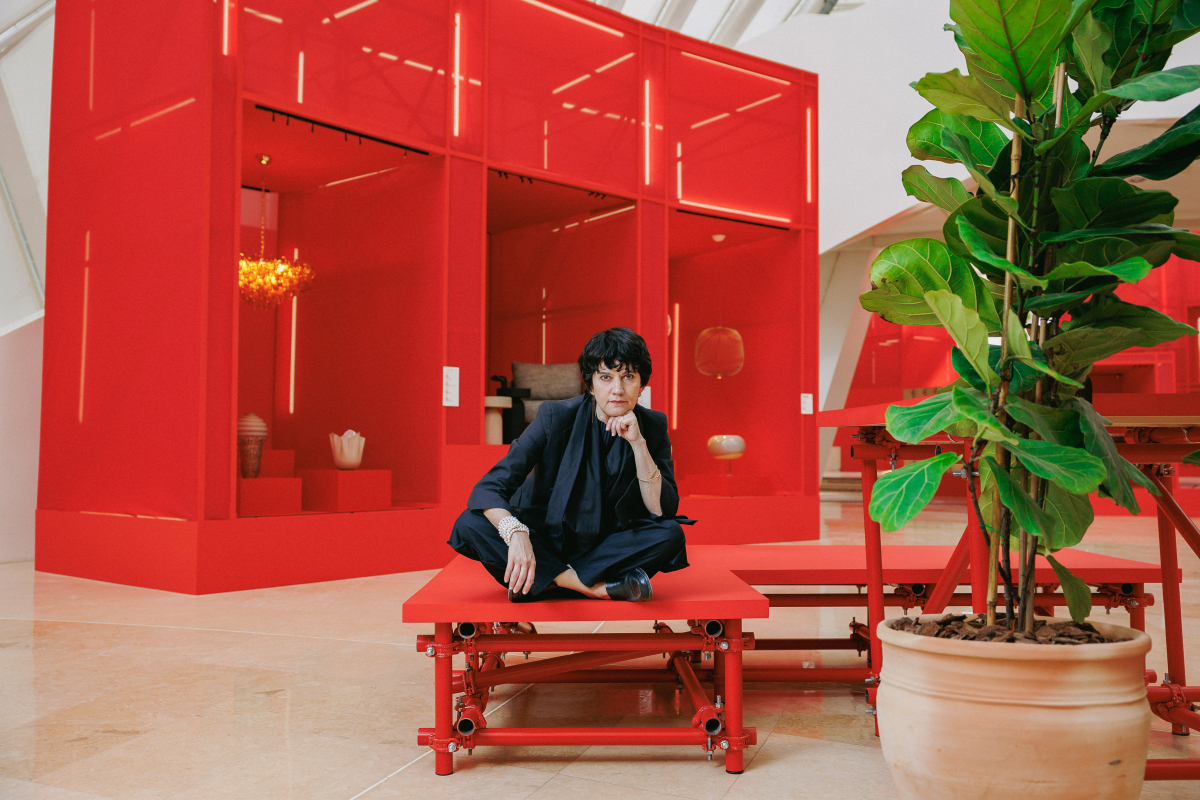
For many people, the word "curation" still sounds abstract—something that belongs to museums, niche exhibitions, or insider conversations. But at a global platform such as Salone del Mobile.Milano, curation is anything but vague. It is a practical method for shaping how ideas are understood, how emotions are triggered, and how culture and industry can speak to one another in a coherent language.
That is exactly where Annalisa Rosso works. A contemporary design specialist, she is currently Editorial & Cultural Director and Advisor at Salone del Mobile.Milano, and Director of The Euroluce International Lighting Forum (as introduced on the Salone del Mobile.Milano author page). Her career bridges editorial leadership, cultural programming, and strategic design consultancy—always with a focus on building meaningful connections across disciplines, geographies, and audiences.
In this written interview for readers in Hong Kong, Rosso outlines a remarkably clear working philosophy in just three words: "Listening, researching, connecting." Rosso uses these words to describe her approach to building narratives, aligning stakeholders, and creating an environment conducive to design comprehension and appreciation.
"I work at the intersection of culture and industry."
When asked to introduce herself to Hong Kong viewers who may be meeting her for the first time, Rosso frames her role in terms of positioning and practice:
"I am a curator and design strategist working at the intersection of culture and industry."
It's a definition that rejects the false divide between cultural value and economic realities. For Rosso, the point is not to choose one side but to develop a cultural intelligence that can operate in real-world systems—institutions, brands, public audiences, and global events.
Her days, she says, are currently focused on finalizing "the last details for the upcoming incredible edition of Salone del Mobile," where she serves as Editorial and Cultural Director. The emphasis on "details" is telling: curation, at this scale, lives in decisions that shape a visitor's entire experience—what they encounter first, what they understand intuitively, and what they carry away after leaving.
Rosso knows that many outside the field hear "curation" and imagine something intangible. Her response is direct:
"Curation creates meaning."
She describes curation as a way of activating points of view and building a coherent framework—so that ideas, objects, and people can relate to one another "in very concrete terms." In other words, curation is a form of editing for the physical and cultural world: it reduces noise without flattening complexity.
Emotionally, this kind of framework can shift a visitor from passive consumption to active engagement. Intellectually, this framework offers audiences a structure that facilitates the connection between materials and values, aesthetics and ethics, and innovation and everyday life.
Rosso's professional path spans both editorial and cultural projects. When asked how she moved from media to a cultural direction, she calls it "a very natural evolution." Editorial work trained her to read, edit, and frame complexity—skills that translate directly into spatial and cultural programming.
But the key capability, she stresses, is not a flashy one:
"The most important skill, for me, is the ability to listen. It is something I have learned over time."
This is a quietly radical statement in an industry often associated with strong authorship and bold opinions. Rosso's point is that vision matters, but it becomes meaningful only when informed by creators, context, institutions, and the public. Listening is how cultural work stays precise rather than performative.
Hong Kong, in her eyes: density and hybridity—"different decades within a single hour."
Rosso has a long-standing professional connection with Hong Kong, and her personal affection for the city is unmistakable:
"I literally love this city for its intensity and contrast."
She expresses her awe at Hong Kong's energy and says she consistently returns with the anticipation of uncovering new experiences and encountering extraordinary people. When asked what makes Hong Kong's design scene distinctive, she answers with two words: density and hybridity.
Hong Kong, she observes, holds together different speeds, languages, and scales in a unique way—so much so that she sometimes feels she is living through "different decades within a single hour." It's an image that captures what makes Hong Kong culturally powerful: it does not simply combine influences; it continuously translates them in real time.
Among the city's institutions, she highlights M+ as a place that consistently strikes her—an indication of how seriously she takes Hong Kong's role in shaping contemporary cultural narratives.
From Rosso's perspective, Hong Kong can function as a crucial connector among Europe, the Chinese Mainland, and the wider Asian region. But she frames this role not as a generic "gateway"—rather, as a site where differences can be converted into productive dialogue.
Hong Kong can be "an important platform for exchange and encounter… where different geographies, economies, and cultural perspectives meet and are translated into new forms of dialogue."
The keyword here is translated. True exchange is not just about proximity or visibility; it is about interpretation. Hong Kong's advantage is its ability to make multiple systems legible to one another—culturally, linguistically, and institutionally.
For young creatives and cultural workers, Rosso's recommendation is not simply to "network." Her advice is more demanding—and more useful:
- Build a strong, personal point of view
- Pair it with openness
- Develop the ability to listen, form meaningful relationships, and move across contexts
In a city as hybrid as Hong Kong, crossing contexts is not optional; it's a professional survival skill. Rosso suggests that cultural work today requires both authorship and adaptability—knowing what you stand for and knowing how to collaborate without losing your center.
To close, Rosso offers a line that reads like a manifesto—simple, but expansive:
She wants people to see design as more than just something to look at or use for a short time; she wants them to see it as a way to understand and change the world around us.
It's a reminder that design is not only an object or an aesthetic; it is a lens and a tool. Curation, at its best, makes that truth tangible—so that what begins as a cultural experience can become a different way of living, working, and imagining the future.
Related News:
Exclusive | Catherine Zhu: My father's profane illumination and rebirth of ink




Comment