






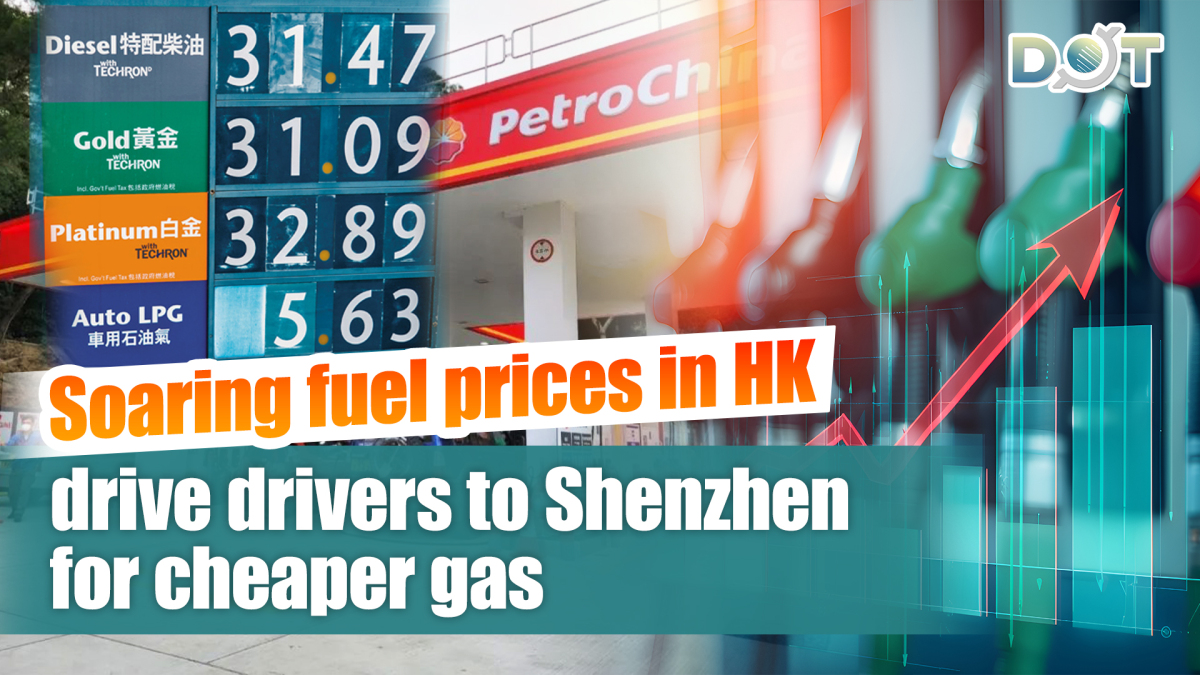
Amid escalating tensions in the Middle East, fuel prices in Hong Kong have surged dramatically, prompting many drivers to travel north to Shenzhen for cheaper refueling. Chief Executive John Lee, speaking to the media before the Executive Council meeting yesterday (March 17), emphasized the government's concern over the impact of rising fuel prices on daily life. He said that efforts are underway to stabilize energy supplies, improve transparency around fuel price fluctuations, and monitor market trends.
Reports from Wen Wei Po revealed that cross-boundary refueling has become increasingly popular, with Shenzhen gas stations attracting a large number of dual-plate vehicles. A driver of a seven-seater car with dual plates told reporters that gasoline prices in HK are more than double Shenzhen's, saying, "Even if it's out of the way, I'll drive to Shenzhen to refuel. A full tank can save me over HK$1,000!"
Rising global oil prices impact HK
John Lee noted that disruptions to crude oil supplies due to the Middle East conflict are affecting cities worldwide, including HK. He urged the public to remain vigilant about global developments and called for collective efforts to tackle the challenges.
He pointed out that the HKSAR government has been in contact with fuel suppliers to ensure adequate reserves and contingency plans. These include diversifying sources of supply and adjusting energy mixes—such as balancing the use of natural gas, coal, and nuclear power—to prepare for potential disruptions.
Lee stressed the need for greater market transparency, particularly in supply and pricing information. Relevant government departments, including the Competition Commission and Consumer Council, have been tasked with monitoring market operations, urging suppliers to consider the public's affordability and improve the availability of real-time price data.
The Transport and Logistics Bureau has also reached out to local airlines, emphasizing the importance of reasonable and transparent pricing adjustments. Additionally, the Environment and Ecology Bureau will meet with automotive fuel suppliers this week to enhance market transparency and address consumer concerns. The government has also vowed to crack down on illegal fuel smuggling operations. Customs and the Fire Services Department will step up enforcement to prevent illicit fuel transport from the Chinese Mainland to HK.
HK gasoline prices over three times higher than Shenzhen's
Last Friday (March 13), Wen Wei Po reporters visited the Huanggang Port area in Shenzhen to compare gasoline prices. Findings showed that premium unleaded gasoline in HK was priced at HK$32.89 per liter, while Shenzhen's equivalent 98-octane fuel was only RMB 10.29 per liter. Based on the official exchange rate of 1 HKD to 0.88163 RMB, HK's fuel price was about 3.2 times higher than Shenzhen's.
At gas stations near Huanggang Port operated by Sinopec, PetroChina, and Caltex, reporters observed a steady stream of dual-plate vehicles refueling during the morning hours. Many stations even offered "fuel and car wash" combo services to attract more cross-boundary drivers. At a Sinopec station, at least 20 dual-plate cars were seen refueling within an hour, accounting for about 30% of all vehicles entering the station.
The displayed price for "Sinopec Ai Pao 98" and "PetroChina CN98" was RMB 10.29 per liter. In contrast, on the same day, HK stations operated by Sinopec (HK), Shell, Esso, and Caltex uniformly priced premium unleaded gasoline at HK$32.89 per liter.
Drivers make special trips to Shenzhen for refueling
A cross-boundary truck driver surnamed Cheung, interviewed near a gas station on Huanggang Road, said, "With fuel prices this high, especially in HK, refueling in Shenzhen is a no-brainer. For us who frequently drive between the two places, we'll never wait until the tank is empty to refuel in HK. Even if I'm not in Shenzhen for other errands, I'll make a special trip to refuel when my tank is low."
Chiang Chi-wai, chairman of the Lok Ma Chau-Hong Kong Freight Association, told Wen Wei Po that the recent surge in international oil prices due to the war has widened the price gap between HK and the Chinese Mainland. "Previously, drivers would refuel in HK for emergencies, but now they'll definitely go to Shenzhen or Zhuhai to refuel. As long as they have time, they'll fill their tanks to the brim once they enter the mainland and keep their tanks full."
He added that the price gap, which used to be over two times, has now widened to three times. "Occasionally refueling in HK was acceptable before, but now the difference is just too outrageous. For vehicles like container trucks and tour buses, which have large fuel tanks and travel long distances, the savings are significant."
(Source: Wen Wei Po; Reporter: Guangji, Huang Zijin; English Editor: Zoey SUN)
Related News:
Oil price surge spurs price hikes on daily necessities in HK: Toilet paper costs soar 20%




Comment