






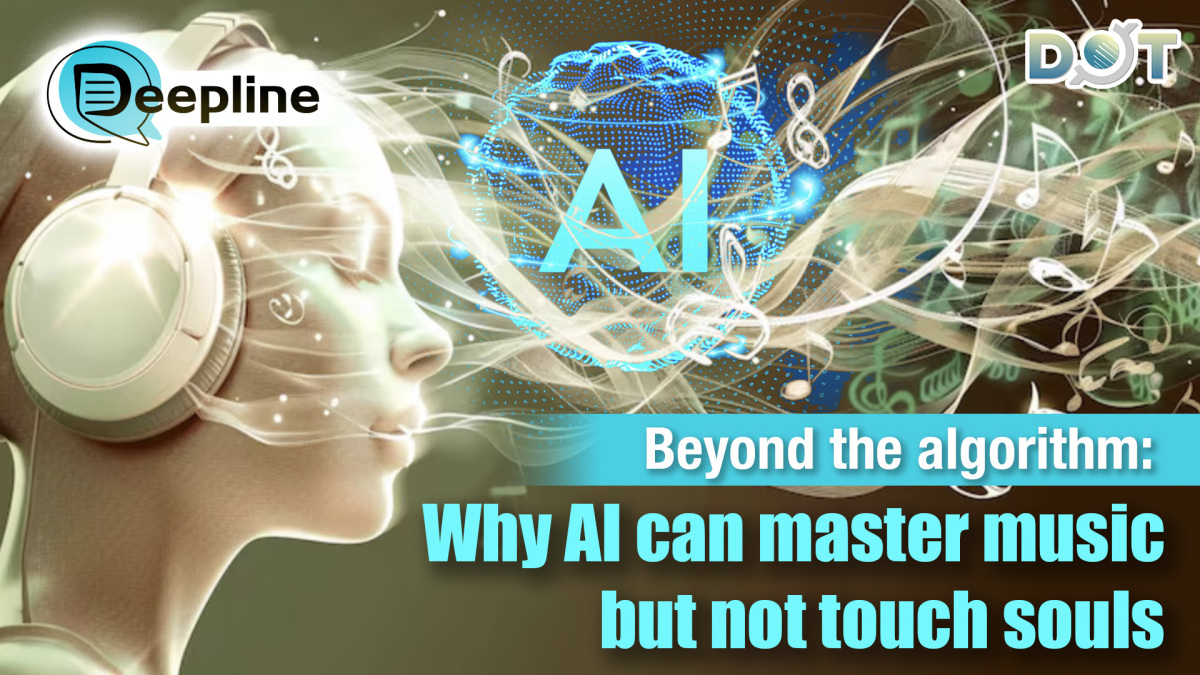
Recent advancements in generative AI in the music domain have been remarkably swift: With just a few stylistic prompts, the technology can produce a complete melody and clear structure in seconds. For the creative process, this efficiency presents unprecedented possibilities.
However, according to research published this year by Carnegie Mellon University, even though AI has demonstrated stable performance in melodic organization and basic harmonic arrangement, most listeners in blind tests still preferred human-composed works.
The reason is obvious. When it comes to elements like rhythmic tension, emotional depth, and phrasing nuances, the subtlety and transitional designs exhibited by human creators resonate more deeply with audiences. The research reminds us that there remains a subtle yet critical gap between technological advancement and the value of creativity.
AI's ability to generate music is built on training with vast datasets and pattern recognition. It can analyze the structural regularities of past works, predict the most probable melodic continuations, and complete arrangements in an extremely short time. This capability is indeed quite practical for advertising scores, background music, or standardized needs.
However, what makes music moving is not primarily about "getting the rules right." The research indicates that, when evaluating creativity, listeners subconsciously perceive elements such as rhythmic breathing and emotional layering within a piece. These details are intimately connected to the creator's life experiences, cultural memory, and contextual circumstances.
As AI rapidly produces a massive volume of work, whether people become more discerning of the difference stemming from genuine human experience becomes a noteworthy phenomenon. Perhaps it is precisely because of the explosion in the quantity of work that listeners' sensitivity to authenticity and depth will increase.
Music has never been merely an arrangement of notes; it also carries stories and emotions. In the creative process, human creators respond to the prevailing social atmosphere, their personal circumstances, and inner feelings. These factors intertwine to form a piece's unique character, giving it a vitality that is difficult to replicate.
Although AI can recombine elements from past data, its understanding of unrecorded experiences and real-time contexts remains limited. When a creator improvises a rhythmic adjustment on stage or alters their expression in response to a live audience, it is a dynamic process of interaction with the environment. This capacity for interaction makes creation an evolving act. The future of music creation may see more human-machine collaboration models, such as AI assisting with draft generation, followed by humans refining the emotional nuances and deepening the narrative. This kind of division of labor could open up new imaginative spaces for creativity.
As generative tools become increasingly accessible, lowering the barriers to creation, the quantity of work in the market is bound to multiply. In such an environment, the truly important question will shift to who can define the meaning and value of a piece. The tastes and cultural backgrounds of listeners will play a crucial role in this filtering process. Businesses and creative industries must also rethink their positioning strategies—whether to pursue volume and efficiency or to deepen the emotional connection with their brand. When tools become commonplace, the truly scarce resource often turns out to be the ability to imbue a work with meaning. If creators can integrate personal experience with social issues, their work will naturally possess greater distinctiveness.
The Carnegie Mellon University study offers a sober reflection for this discussion. AI's capabilities in music creation are indeed advancing rapidly, profoundly impacting industry structures and workflows. However, the evaluation of creativity remains deeply embedded in human experience and cultural context. After losing his son, Eric Clapton wrote "Tears in Heaven" to express his sorrow. Wishing for a world without boundaries, poverty, or wars, John Lennon created "Imagine." Their experiences, thoughts, and talent can't be replaced or imitated by AI; AI knows nothing about what it means for a person or even itself to gain or to lose.
When technology becomes the norm, the emotional connection between creator and listener paradoxically becomes even more important. The future direction of music may well find a new balance between efficiency and depth. As we listen to the next moving melody, it might be worth pondering whether that touch of emotion comes from an algorithm's calculation or from a fragment of a real human life.
(Source: JA, TechNews)
Related News:
Deepline | OpenClaw's tale: Two paths of AI diffusion in China and the US
OpenAI releases GPT-5.4 with enhanced reasoning, coding, AI agent capabilities




Comment