






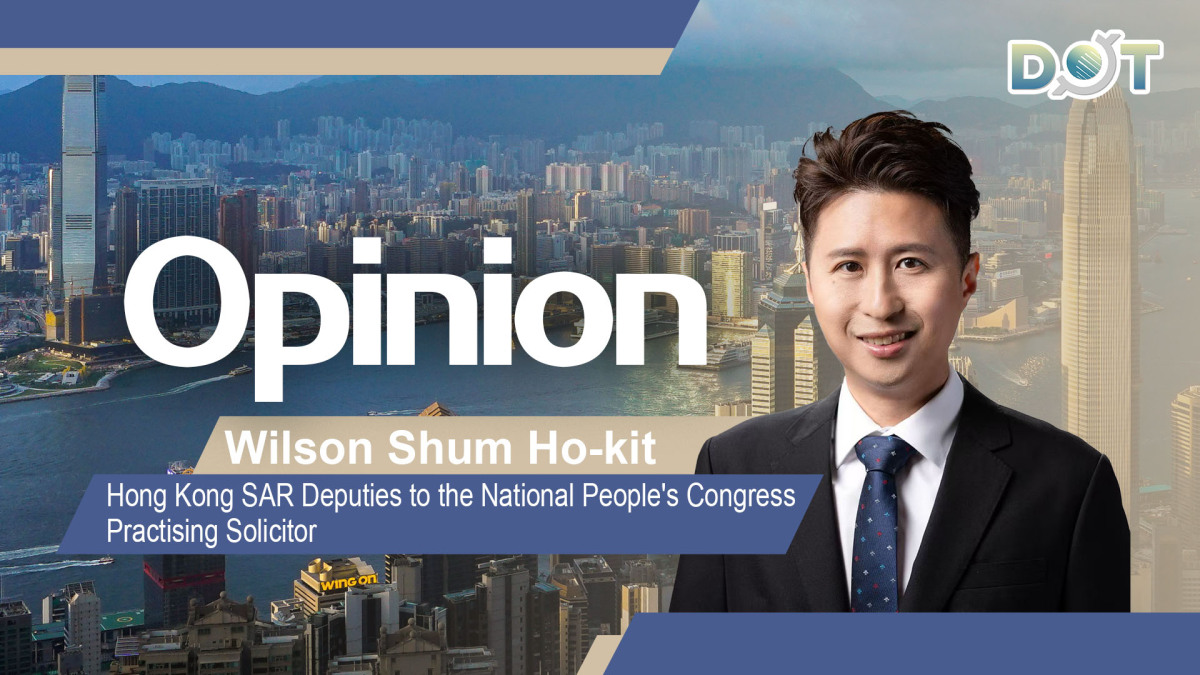
By Wilson Shum Ho-kit
Today, Hong Kong deputies to the National People's Congress and members of the Chinese People's Political Consultative Conference arrived in Beijing with enthusiasm and anticipation to take part in the upcoming Two Sessions. This year's meetings are of extraordinary significance, carrying the important mission of building on past achievements and forging ahead into the future.
The deputies' first activity today was a visit to the new building of the State Council's Hong Kong and Macao Affairs Office, where we were warmly received by Mr. Xia Baolong, Director of the Hong Kong and Macao Work Office of the Communist Party of China Central Committee and the Hong Kong and Macao Affairs Office of the State Council. This marked the first visit by Hong Kong deputies and members to the new premises since the office's relocation. Conveniently located and equipped with upgraded facilities within an independent courtyard, the new building provides an ideal setting for meetings with Hong Kong and Macao guests and visiting groups. Its opening symbolizes fresh momentum for the development of Hong Kong and Macao. The atmosphere was warm and engaging, and the exchanges were both in-depth and enlightening.
In his remarks, Mr. Xia emphasized the need for concerted efforts and unity to seize the valuable opportunities brought by the national "15th Five-Year Plan" and to further advance the development of Hong Kong and Macao. He highlighted the importance of fully leveraging the unique roles of both regions to better integrate with and contribute to the nation's overall development strategy.
The building's exterior design resembles an open, weighty book—a concept full of meaning. On the one hand, it represents the deep accumulation of knowledge, policies, and governance experience; on the other, it symbolizes "turning a new page," particularly following the institutional reforms of 2023 that established the Central Hong Kong and Macao Affairs Office. With enhanced authority, responsibilities, and a higher administrative level, the public display of the title "Central Hong Kong and Macao Affairs Office of the Communist Party of China" signifies a notable transformation—from a previously low-profile body to one with a more visible and proactive role.
What impressed me most were the thoughtful details, such as the Bauhinia and lotus carvings at the entrance and on the awnings, the specially designed Bauhinia and Lotus Halls, and even the reception room décor incorporating symbolic elements from Hong Kong and Macao. These design features reflect the central government's consistent approach to Hong Kong and Macao affairs and underscore the deep connection between the two regions.
From a broader perspective, this reflects the central government's growing emphasis on Hong Kong and Macao. From implementing the "One Country, Two Systems" principle to deepening integration into the national development strategy, and from safeguarding national security to exercising comprehensive governance, the new office and its environment embody an upgraded and modernized working system. For Hong Kong and Macao, this relocation represents far more than a change of address—it serves as a tangible expression of the central government's clearer approach and more efficient allocation of resources in governing both regions. I believe that future work relating to Hong Kong and Macao will advance more steadily and effectively from this new starting point.
The proposals submitted by Hong Kong deputies during the Two Sessions focus on three main areas: enhancing Hong Kong's integration into the national development strategy, developing the Northern Metropolis, and strengthening cooperation within the Guangdong–Hong Kong–Macao Greater Bay Area. These priorities are aligned with the central government's positioning of the two regions. The 15th Five-Year Plan specifically supports Hong Kong and Macao in participating more closely in the nation's overall development, consolidating Hong Kong's status as an international financial, shipping, and trade center, and building it into a global innovation and technology hub. I intend to leverage Hong Kong's unique strengths—including its international finance, legal, and professional services, as well as its innovation and technology sectors—to put forward concrete, actionable proposals that will help the country achieve high-quality development while driving Hong Kong's own economic transformation.
Related News:
Opinion | Charting the course: Advancing high-quality tourism in the Greater Bay Area




Comment