






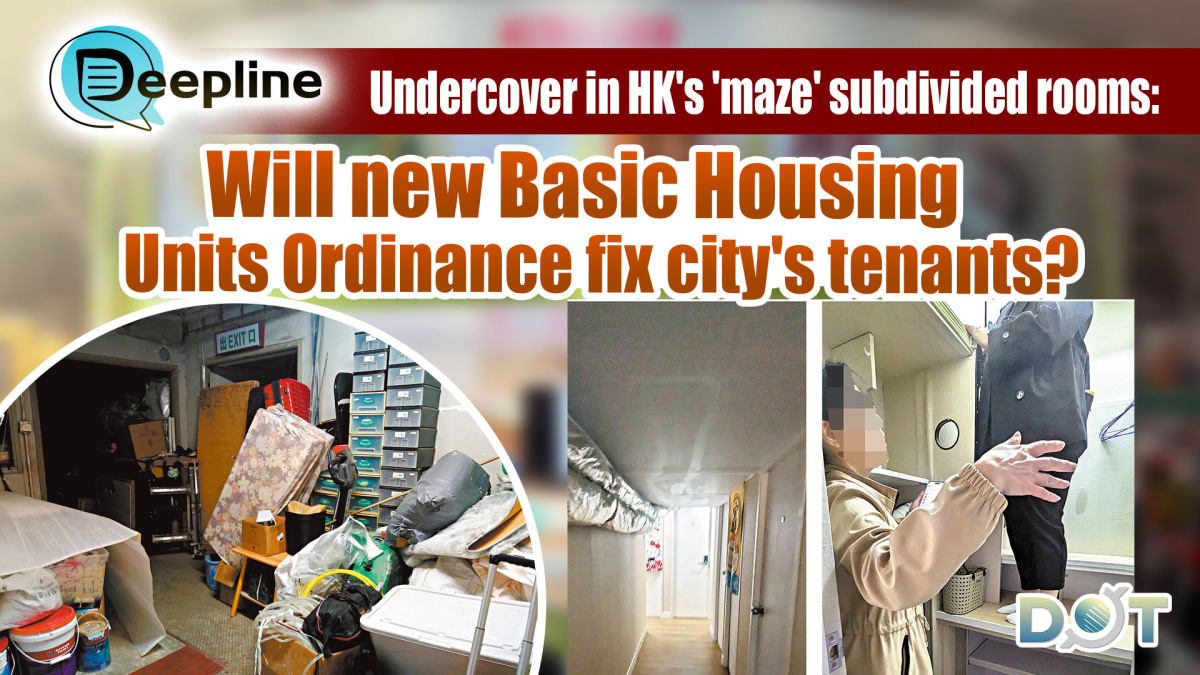
To bid farewell to substandard subdivided units, the Basic Housing Units Ordinance will come into effect next month. The ordinance includes a 12-month registration period and a 36-month grace period, meaning a total transition period of four years.
A Wen Wei Po reporter recently went undercover to inspect multiple subdivided units, encountering oddly shaped compartments. For instance, an industrial building unit of over a thousand square feet was divided into nearly 40 subdivided rooms, making the interior feel like a maze—a dangerous situation in the event of a fire. Some bed spaces were as small as coffins, making it extremely difficult for people to turn around, clearly failing to meet the architectural requirements for basic housing units.
According to the new Ordinance, it applies only to residential buildings and excludes specific types such as bedspace apartments, hotels, or guesthouses, and nursing homes. Structures that are already illegal, such as units in commercial or industrial buildings and exempted houses in the New Territories, are also not covered but are subject to government leases or the Buildings Ordinance.
As a specific type of accommodation, bedspaces must obtain a license under the Bedspace Apartments Ordinance only if they exceed 12 beds. Units with 11 or fewer beds do not require a license. If all tenants pay rent monthly rather than daily, such units are also not regulated by the Hotel and Guesthouse Accommodation Ordinance.
On one occasion, a Wen Wei Po reporter posed as prospective tenants to inspect a "one-divided-into-five" unit in a residential building in Ho Man Tin. Only one of the rooms had an en-suite toilet, while the other four shared a bathroom equipped with three sinks, a squat toilet, and a shower area. An open-plan shared kitchen was located near the entrance of the unit. After renovations, the unit featured a modern decor, a clean environment, and well-equipped facilities. The unit's manager reminded that, to protect tenant privacy and maintain order, parties were prohibited, and visitors of the opposite gender were not allowed in the rooms. The manager also promised that cleaning staff would visit weekly to maintain the common areas.
During the reporter's visit, young women who appeared to be students entered and left their rooms. The manager also noted that the tenants were primarily students and young professionals.
One of the subdivided rooms in the unit was available for rent. It measured only about 75 square feet, just enough to fit a single bed, a desk, and a wardrobe, with a monthly rent of HK$7,500. When the reporter questioned whether the room, which did not meet the minimum size requirement of 86.1 square feet for basic housing units and lacked an en-suite toilet, might force tenants to move out if the landlord later reclaimed the unit for renovations, the manager immediately responded that the room was not subject to the Basic Housing Units Ordinance.
She claimed, "This is not a subdivided unit; it's a student dormitory." She also described the unit as operating under a co-living space model tailored to young people's rental needs and insisted it should not be compared to subdivided units that are "windowless, oddly proportioned, or unsanitary."
"We've been operating for years, and there won't be any issues with violations, required renovations, or tenants being forced to move out." After the viewing, the manager proactively contacted the reporter to provide additional information about the Basic Housing Units Ordinance. She also pointed out that the new Ordinance includes a 12-month registration period and a 36-month grace period, "Actually there are four years before it takes full effect, so there's no need to worry."
Another landlord was even more "creative" in circumventing regulations. He claimed that the contracts signed with tenants were not rental agreements but "co-living contracts," meaning tenants share living expenses collectively, and there is no landlord-tenant relationship. As a result, he argued, there was no need to pay stamp duty, and the savings could be passed on to tenants through reduced rent.
Subdivided units in industrial buildings are illegal for residential use under the Buildings Ordinance"and also violate deed restrictions. Since these units have long been classified as illegal dwellings, the Basic Housing Units Ordinance did not include them in its regulatory scope. Reporters recently visited industrial building subdivided units in Tsuen Wan, spread across two floors of the building which had been divided into 36 and 39 rooms, respectively.
The manager noted that in recent months, many tenants who had been paying around HK$5,000 per month for subdivided units in residential buildings were opting to move into industrial building subdivided units to save money and avoid the risk of being forced out if landlords reclaimed units for conversion into basic housing units.
During the visit, the manager showed the reporters two units. One, estimated to be about 60 square feet, had no windows and was cramped, with a monthly rent of approximately HK$2,800. The other, slightly larger but still under 80 square feet, was also windowless and rented for about HK$3,500 per month. When asked whether the lack of windows posed fire safety risks or might make tenants feel claustrophobic, the manager simply replied, "It's fine; you'll get used to it." When questioned about the actual size of the rooms, he vaguely responded, seemingly avoiding the issue of standardized measurements.
The manager further explained that compared to subdivided units in residential buildings, even in the same area and of similar size, industrial building subdivided units are about half the price. This is because industrial buildings can accommodate more subdivided rooms, and the lower land costs reduce the overall cost per room, making them attractive to budget-conscious tenants.
Under the Basic Housing Units Ordinance, some landlords may need to reclaim units to renovate them into compliant basic housing units or revert them to undivided units for rent. Fearful of being forced out, tenants in subdivided units are increasingly seeking alternatives in industrial buildings.
(Source: Wen Wei Po; Journalist: Lin Quan, Jiang Yun)
Related News:
Deepline | Frustrated: New Sham Shui Po murder-suicide case highlights caregiver crisis in HK




Comment