






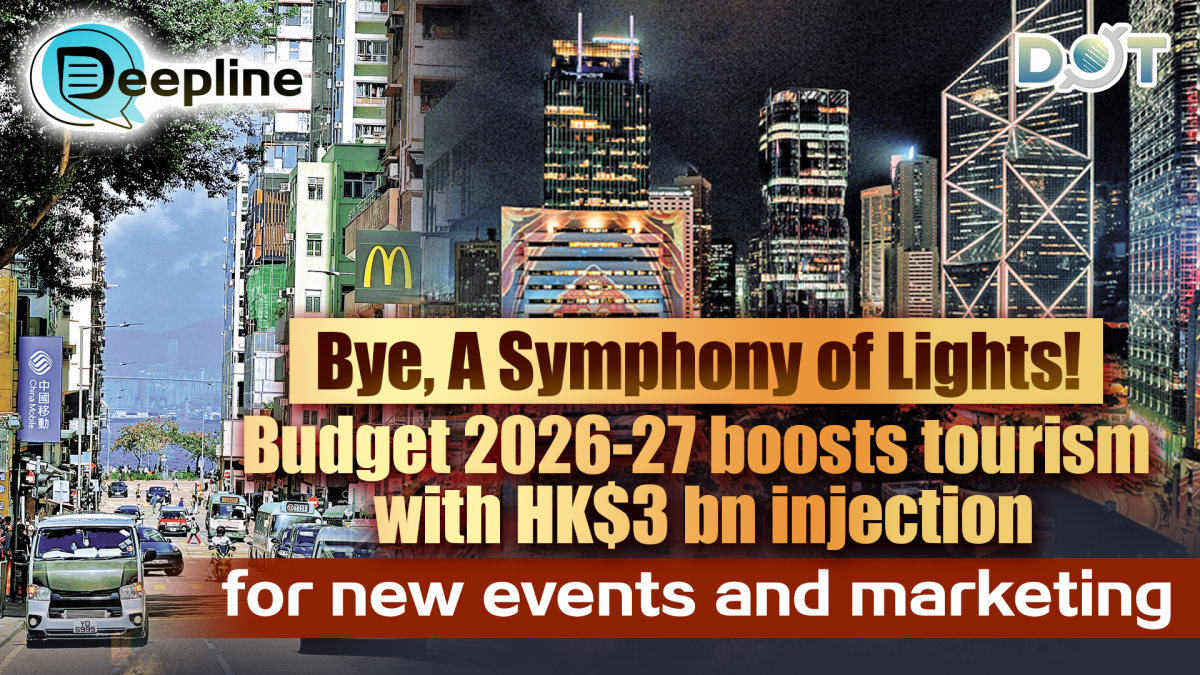
Hong Kong's mega events attract visitors to the city, with nearly 50 million tourist arrivals last year, a 12% increase compared to 2024, creating business opportunities and employment for various industries. To further attract tourists, extend their length of stay, and stimulate consumption, the new Budget has allocated around HK$3 billion to promote tourism-related industries.
Among this, the Hong Kong Tourism Board (HKTB) will receive a HK$1.66 billion allocation, an increase of nearly 35% from last year's HK$1.23 billion, to expand the scale and promotion of flagship events. It will launch a brand new show with the theme of light festivals across various locations to replace the 22-year-old "A Symphony of Lights." Sources indicate that "A Symphony of Lights" is expected to conclude as early as this year, with the new performances being held year-round to boost local economies across districts.
Government sources revealed that after listening to public feedback on "A Symphony of Lights," the new light show will draw inspiration from "Immersive Light Show in Central" and be tailored to major festivals. These shows will be staged at distinctive locations, aiming to attract tourists while boosting business for merchants in various districts. Once the new light performances are fully launched, "A Symphony of Lights" may gracefully exit later.
Yesterday (Feb. 25), Financial Secretary Paul Chan noted that the HKTB will enhance the scale and promotion of flagship events, introduce new elements, extend event durations, and roll out more "signature festive activities" to underscore Hong Kong's East-meets-West uniqueness. Future events like the Wine & Dine Festival, for instance, will not only feature the original event days but also extend the celebratory atmosphere throughout the entire month, with restaurants offering promotions.
Chan expressed hopes of attracting more high-end overnight visitors to Hong Kong. The HKTB will intensify promotions in potential source markets, including mainland cities outside Guangdong Province, such as long-haul cities like Beijing and Shanghai, as well as emerging markets like ASEAN and the Middle East.
"We will collaborate with industry players to further develop the ASEAN and Middle East markets, and explore the potential of Central Asia, South Asia, and North Africa markets," said Chan.
Last year, a total of 92,000 visitors from the Middle East came to Hong Kong, a 37% increase year-on-year. In January alone, 9,700 Middle Eastern visitors arrived, marking a 78% year-on-year increase. The per capita spending of Middle Eastern visitors was HK$11,300, more than double the HK$5,400 spent by general overnight visitors.
The SAR government will also actively promote the exhibition industry and the branding of Hong Kong as an international convention and exhibition hub. The Budget proposes setting aside HK$100 million to pilot collaborations with relevant organizations to attract large-scale international exhibitions with innovative elements to Hong Kong. Sources revealed that last year, Hong Kong welcomed 2.51 million convention and exhibition visitors, a 7% increase from the previous year. Among them, 57% (1.43 million visitors) stayed overnight, contributing HK$10.7 billion in total consumer spending.
Chan further mentioned historic buildings that embody Hong Kong's urban culture. "We have also provided subsidies for maintenance works of more than 80 private historic buildings. We will earmark an additional funding of HK$1 billion for the Built Heritage Conservation Fund to continue taking forward the relevant work."
Since its establishment, the fund has supported 24 conservation projects, four of which have received international awards, and has provided subsidies for the maintenance of over 80 private historic buildings.
Sources noted that 97% of the HK$3.6 billion previously allocated to the fund has been utilized. Therefore, the government plans to inject an additional HK$1 billion, with HK$700 million allocated to advancing the Revitalising Historic Buildings Through Partnership Scheme. In the coming years, the government will continue identifying historic building partners under the existing mechanism. It is expected that the fastest application this year could invite non-profit organizations to submit revitalization proposals.
(Source: Wen Wei Po, Ta Kung Po; Journalist: Lee Tsz-shan, Wang Yamao)
Related News:
Budget 2026-27 | HK's economy to grow 2.5 to 3.5 pct in 2026: Paul Chan
Budget 2026-27 | HK hikes stamp duty on luxury properties over HK$100 mn to 6.5%




Comment