






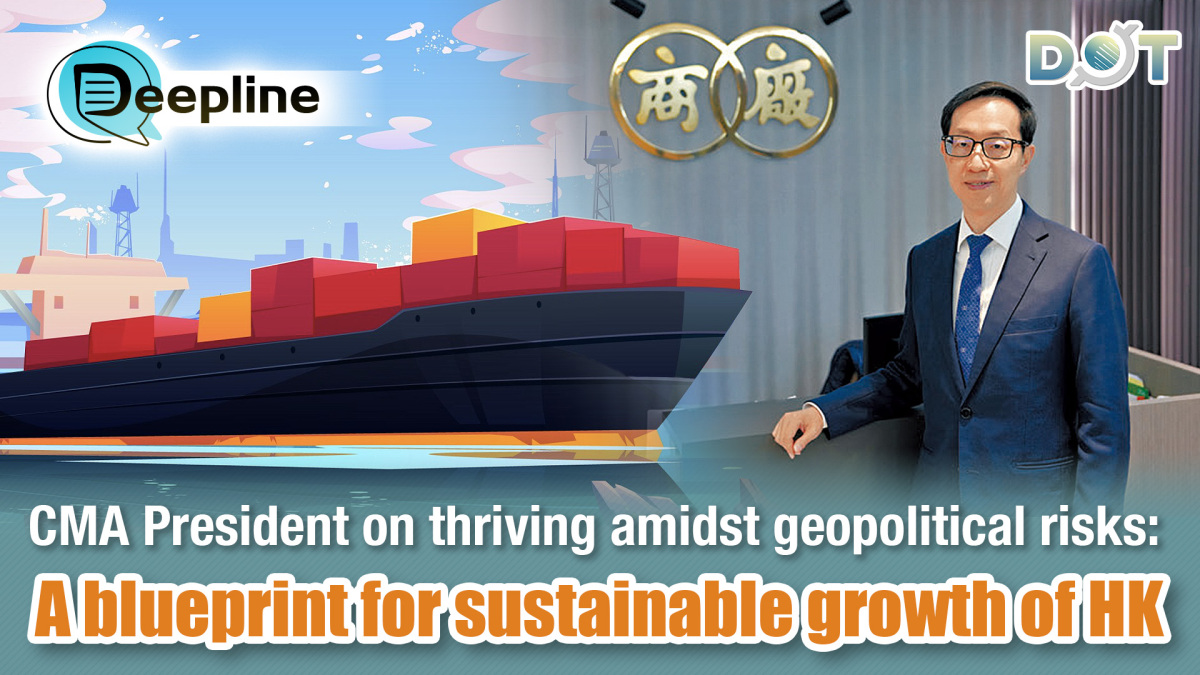
Amid the realignment of the global economic and trade landscape, coupled with the challenges of rising trade protectionism and geopolitical risks, how enterprises can break through has become a focal point. Wingco Lo, President of the Chinese Manufacturers' Association of Hong Kong (CMA), said in an exclusive interview with Wen Wei Po that, facing the pressure of international supply chain restructuring, "going global" has become a key strategy for enterprises to maintain their competitive edge.
In alignment with the nation's Belt and Road Initiative (BRI) and the Global South strategic layout, the CMA will assist its member enterprises in expanding into emerging markets, according to Lo. This will be achieved by driving digital transformation through new quality productive forces, supported by ESG (Environmental, Social, and Governance) principles and quality testing certifications, thereby helping enterprises seize opportunities in the new phase of globalization.
Lo noted that the rapid advancement of technology is fostering the rise of emerging and future industries, a trend that has become a prominent feature of global economic development.
"Hong Kong, as an international business hub, must keep pace with the times and respond to this trend... For local enterprises built on a foundation of traditional manufacturing, such as our CMA members, there is an urgent need to accelerate digital, intelligent, green, and brand-oriented transformations based on their existing foundations to achieve sustainable development."
To assist Hong Kong businesses in uncovering potential opportunities in overseas markets, the CMA has been actively organizing inspection tours in recent years, with visits spanning multiple countries in Southeast Asia. Lo mentioned that last year, when the SAR government led a delegation, including mainland enterprises, to the Middle East, the CMA simultaneously organized members to participate, enabling them to conduct on-the-ground assessments of the local business environment and collaboration potential.
Regarding support for enterprises expanding into international markets, Lo said that the CMA, through its various professional platforms, provides comprehensive support to mainland enterprises, fully leveraging Hong Kong's unique role as a "super-connector" and "super value-adder." This not only facilitates the export of mainland products but also promotes the complementary advantages of Hong Kong and mainland enterprises, encouraging them to join forces and "go global together."
Lo believes that Hong Kong, as a core hub of the Guangdong-Hong Kong-Macao Greater Bay Area (GBA), must continuously strengthen its "eight centers" positioning. While consolidating traditional advantageous industries like international finance, shipping, and trade centers, it must also accelerate the development of an international innovation and technology (I&T) hub, cultivating emerging fields such as biomedicine, new energy, and the green economy. To this end, the CMA advocates a three-pronged development strategy: promoting the upgrading and transformation of traditional industries, supporting the accelerated growth of emerging industries, and making forward-looking arrangements for future industries.
"To achieve this, the CMA has established a 'pilot conversion center' and shared laboratories, providing research and development space and related services for enterprises, particularly large-scale mainland ones, intending to develop new products." Lo mentioned his initiative aims to attract enterprises to its technology commercialization platform, leveraging Hong Kong's advantages to advance product development and commercialization, thereby bridging the "last mile" from the laboratory to the market.
Discussing Hong Kong's progress in promoting new industrialization, Lo admitted that an ample supply of specialized talent is the primary condition. He acknowledged the SAR government's active efforts in recent years to attract various types of professionals, especially in emerging technology fields. At the same time, he emphasized the importance of cultivating local talent, believing that STEM education implemented from primary and secondary school levels provides valuable talent reserves for Hong Kong's future development as an international I&T center and a functionally diverse international city.
Lo also said that realizing the implementation of I&T achievements needs a comprehensive ecosystem. The CMA has consistently advocated for close "government-industry-academia-research-investment" collaboration, meaning that under the guidance of government policies, industry demands, academic research, R&D resources, and financial capital should be integrated to create synergistic effects.
Besides being a "second-generation factory owner" managing his family's electronic products business, Lo, driven by his passion for science, also founded an information technology company after obtaining a master's degree in computer science from the University of Southern California. He is also committed to the upgrading and transformation of the family business, investing resources in R&D and innovative design, such as producing suitcases equipped with anti-theft technology, personal data protection features, and refrigeration capabilities.
"In terms of management, first and foremost, one must stay closely attuned to technological developments... As a manager, one must have a forward-looking vision, not just looking three to five years ahead, but even considering development directions for ten years or more. Pondering the overall direction the enterprise should take and how to formulate and prepare medium- to long-term strategies is absolutely critical."
Regarding Hong Kong's development prospects, Lo is full of confidence. "What investors value most is, first, safety and stability, and second, whether assets can be effectively protected. Hong Kong's legal system is very well-established, which is a major reason for our strong confidence."
He added that Hong Kong benefits from the institutional advantages of "one country, two systems," along with its multiple international designations, such as an international financial center and a free port. These factors make Hong Kong a highly suitable region for business and fill us with confidence in its future development.
(Source: Wen Wei Po; Journalist: Ivy Chong)
Related News:
Deepline | Compassion first: Govt unveils detailed resettlement plan for Wang Fuk Court fire victims




Comment