






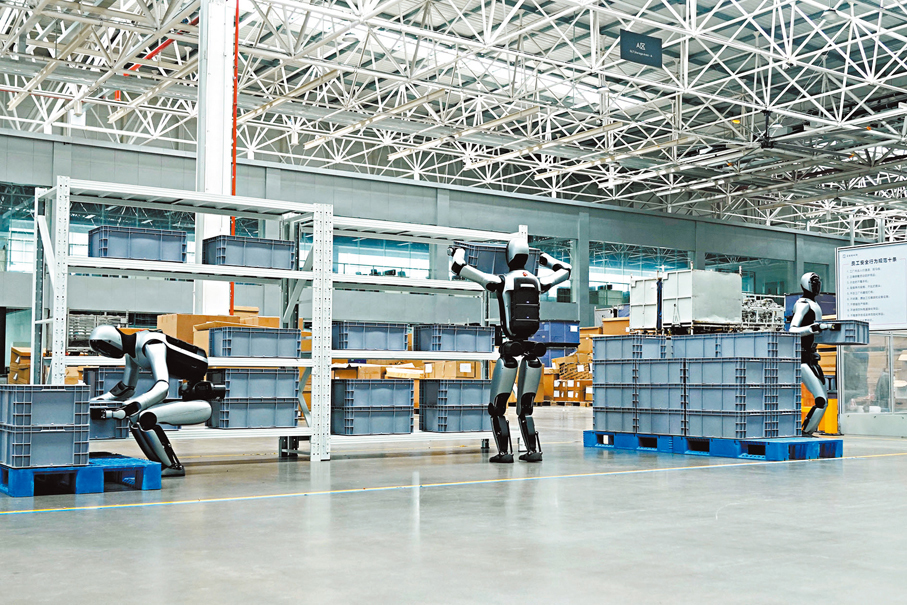
When dozens of humanoid robots took to the stage at CCTV's Spring Festival Gala, performing collective backflips, boxing, and wielding nunchucks, they became an international talking point. Behind the spectacle lies a more significant trend: China has emerged as a net exporter of industrial robots for the first time, with exports surging 48.7% year-on-year in 2025, according to data from the General Administration of Customs. The milestone marks a leap in the global competitiveness of "Intelligent Manufacturing in China" in the high-end equipment market.
China is transitioning from the world's largest user of industrial robots to a major exporter, having secured the second-largest global market share and rapidly closing the gap with Japan, which currently ranks first. Interviews conducted by Hong Kong Wen Wei Po with several Shenzhen-based robotics companies reveal that the industrial robotics sector is extending beyond traditional manufacturing into fields such as healthcare, logistics, and services, opening up broader market opportunities. The rapid growth in exports signals China's ascent in the global value chain, driven by policy guidance, breakthroughs in core technology localization, and support from a complete industrial chain.
For years, China has been the world's largest market for industrial robot applications and manufacturing, yet the high-end segment relied heavily on imports. Critical components such as precision reducers, high-performance servo drives, and intelligent controllers were long dominated by overseas brands, constraining the competitiveness of domestic robots. The net export breakthrough in 2025 reflects significant progress. The 48.7% export growth rate far exceeds that of specialized equipment (20.6%) and high-end machine tools (21.5%). Domestically manufactured industrial robots now account for over 50% of the domestic market. Companies like Leader Harmonious Drive Systems and Shuanghuan Transmission have achieved import substitution in reducers and entered global supply chains, while Inovance Technology has built core advantages in controllers and servo systems, forming a complete industrial chain from core components to robot bodies and system integration.
Industry Moving Toward High-End Applications
In terms of export destinations, the main markets for Chinese industrial robots in 2025 were Vietnam, Mexico, and Thailand. Export products have also shifted from low-end handling robots to high-end applications, with breakthroughs in core sectors such as automotive manufacturing (accounting for 34%) and electronics (28%), including body welding solutions for European companies like BMW.
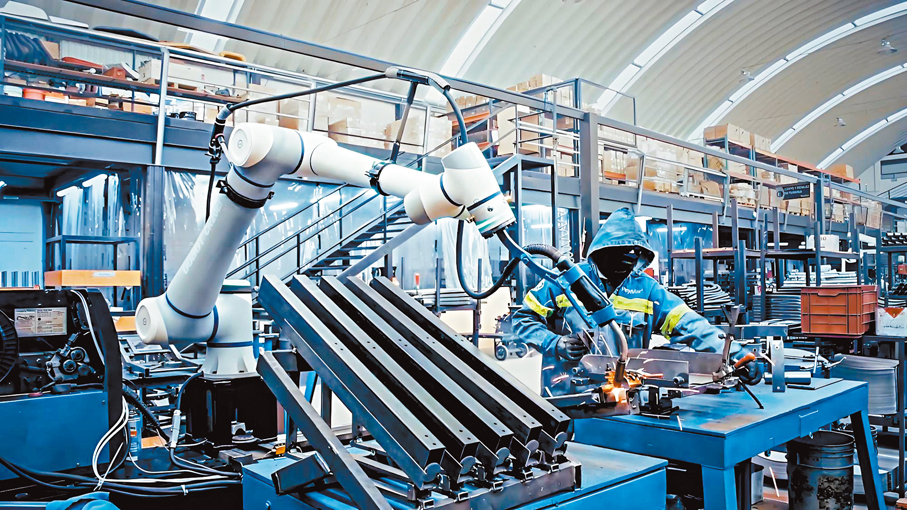
Shenzhen-based Dobot, the world's second-largest collaborative robot manufacturer, told Hong Kong Wen Wei Po that its robots occupy an important position in the global collaborative robot market. Collaborative robots are designed to interact directly with humans within a shared workspace. Exports account for half of Dobot's industrial robot business, primarily collaborative robots used in advanced manufacturing, exported to around 100 countries and regions, including Europe, North America, and Asia-Pacific, covering more than 15 industries such as 3C electronics, automotive, semiconductors, chemicals, healthcare, metal processing, food and beverage, and new retail. The company has established three R&D centers in Shenzhen, Shanghai, and Qingdao, creating an integrated industry chain encompassing research, production, and sales to serve smart manufacturing enterprises in production line upgrades.
UBTECH Products Procured by Airbus
Industrial robots developed by UBTech are steadily entering numerous renowned factories worldwide, contributing to advanced manufacturing. Global aviation giant Airbus recently announced that it has procured UBTech's latest industrial humanoid robot, the Walker S2, currently in the early concept testing phase. The two parties plan to "jointly expand the application of humanoid robots in aerospace manufacturing scenarios" in the future. Last year, UBTech also signed a cooperation agreement with Texas Instruments, a U.S. semiconductor manufacturer. UBTech revealed that its total humanoid robot orders exceeded RMB 1.4 billion last year, and its industrial humanoid robot production capacity is expected to surpass 10,000 units this year.
(Source: Wen Wei Po | Reporter: Li Changhong | Editor: Liu Yu)




Comment