






Today (Feb. 16) is Chinese New Year's Eve, the perfect day to put up Spring Festival couplets! While it may seem simple, there's actually an art to it. How do you tell which is the upper line and which is the lower line? Do you put the left one first or the right one first? This article explains it all.
Choosing the Best Spot for Your Couplets
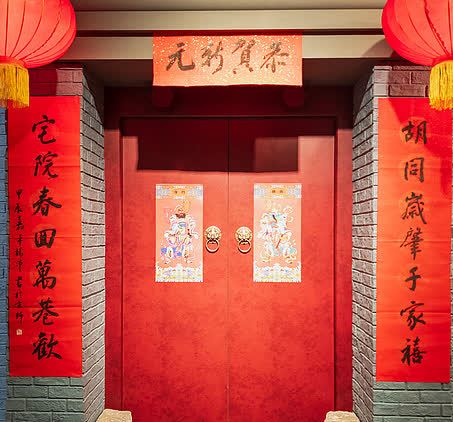
Spring Festival couplets are traditionally pasted on either side of the door, with the horizontal banner placed across the top of the door frame. When pasting the couplets, ensure they are smooth, flat, and straight, avoiding any tilting or wrinkles.
This is not only a sign of respect for traditional culture but also an expression of hope for a beautiful life in the new year.
A Simple Trick: Using Tones to Distinguish the Upper and Lower Lines
Many people get confused when putting up couplets, unsure how to tell which line is which. Actually, there's a very simple method: look at the tone of the last character.
Generally speaking, the last character of the upper line is in a oblique (falling) tone (tones 3 and 4 in Mandarin). The last character of the lower line is in a level tone (tones 1 and 2). A common tonal pattern is "level-oblique-level-oblique-level-level-oblique, oblique-level-oblique-level-oblique-oblique-level".
If you can't distinguish between level and oblique tones, a simpler rule is that the upper line usually sounds more "heavy" or "dropping", while the lower line sounds more "rising" or "lifting". Using this distinction, telling them apart becomes easy. For creative couplets, the reading method may differ.
Left or Right First? The Correct Placement for Couplets
Traditionally, when facing the door, the upper line is pasted on the right side and the lower line on the left side. This is because traditional couplets were written from right to left, and the horizontal banner was also read from right to left.
(Source: CCTV News)
Related News:




Comment