






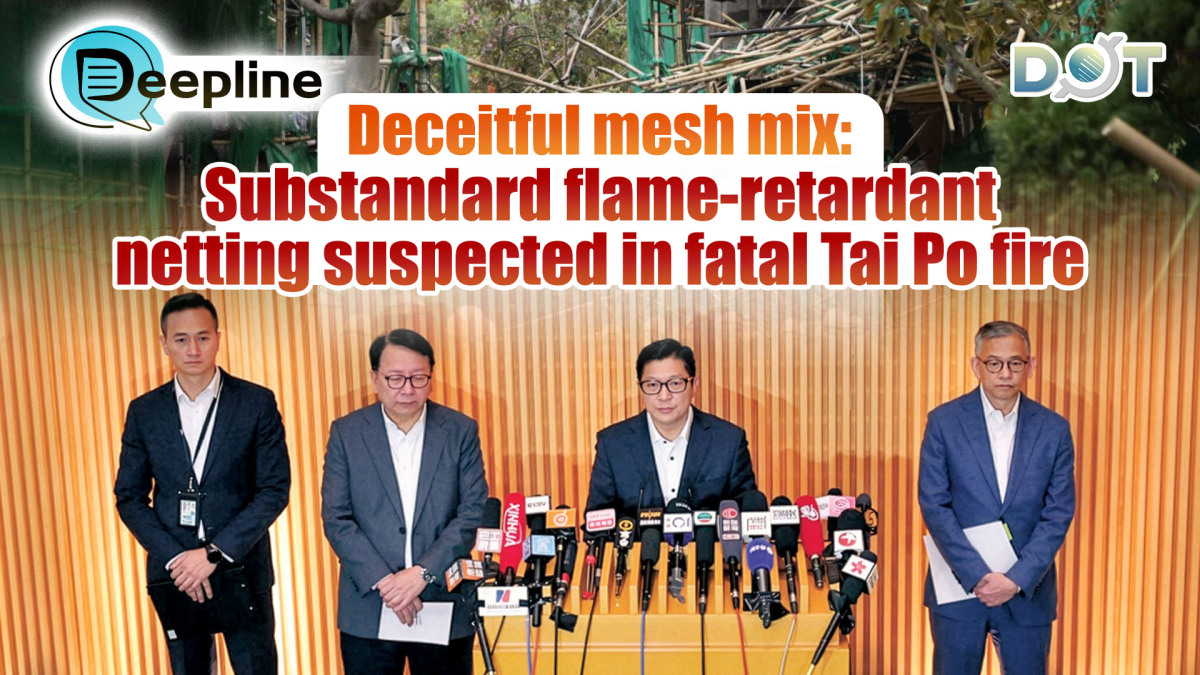
The investigation into the No. 5 alarm fire at Wang Fuk Court in Tai Po has reached a breakthrough. Out of 20 scaffolding mesh samples collected, seven failed to meet flame-retardant standards. It is suspected that substandard protective mesh was mixed with compliant mesh, which costs twice as much, in an attempt to pass off inferior materials. Eric Chan, Chief Secretary for Administration, criticized the suspects for their deliberate and deceitful methods in carrying out the crime.
"This can be described as a premeditated crime, utterly shameful."
Chan, along with Secretary for Security Tang Ping-keung, Commissioner of the Independent Commission Against Corruption (ICAC) Danny Woo, and Director of Crime and Security of the Hong Kong Police Force Joe Chan, announced the progress of the follow-up investigation into the Wang Fuk Court fire yesterday (Dec. 1).
Tang stated that while the fire was still ongoing, the police collected mesh samples from the lower floors of unaffected buildings for preliminary testing. The initial test results indicated compliance with fire safety standards, but this contradicted the extent of burning observed at the fire scene.
Therefore, after the fire was somewhat brought under control, 20 samples were taken from various high-, middle-, and low-level locations across eight buildings, including areas difficult to access, some of which required firefighters to climb out onto exterior walls to obtain samples.
Testing revealed that seven samples did not meet flame-retardant standards. It was found that the mesh at the bottom of the scaffolding had a higher probability of being compliant, while the mesh from hard-to-reach sampling areas had a higher probability of being non-compliant. Consequently, more samples will be collected for further in-depth investigation.
Tang pointed out that it is suspected that non-compliant protective mesh was mixed in with compliant mesh. When substandard mesh encountered fire, coupled with the flammability of foam boards, it led to the rapid spread of the blaze. Additionally, the foam boards caused glass windows to shatter, allowing the fire to enter the buildings. The joint investigation team established by the police and ICAC has arrested 14 individuals so far.
Woo noted that last Thursday (Nov. 27), ICAC set up a dedicated task force to conduct a comprehensive investigation into possible corruption related to the Wang Fuk Court renovation project. Engineers, contractors, and scaffolding subcontractors have been among the 12 people arrested so far.
In July of this year, a typhoon damaged the originally installed protective mesh on the scaffold. The suspects then purchased 2,300 rolls (approximately 75,000 square meters) of substandard protective mesh at HK$54 per roll for repairs. However, following a fire involving scaffolding protective mesh in Central at the end of October this year, the suspects became concerned that the mesh at Wang Fuk Court might be subject to spot checks. They then purchased a batch of mesh meeting flame-retardant standards.
Woo said, "They installed this compliant protective mesh at the base of the scaffolding on each building, attempting to pass off the inferior material. This allowed them to achieve passing results in subsequent tests."
Chan described the suspects as "deceitful," installing non-compliant mesh in locations generally inaccessible for sampling to evade government detection. He condemned this as premeditated, planned criminal activity, calling it "utterly shameful" and "despicable." He strongly condemned the suspects for endangering multiple lives for mere petty profits, vowing that the government will pursue legal accountability to the fullest extent to deliver justice for the victims.
"This is a grave illegal act. If similar mesh issues exist in other buildings, we will also investigate thoroughly," he said. He stated that one of the future directions for the task force is to strengthen regulations and oversight regarding such violations to prevent similar incidents.
As of 11 a.m. yesterday, the Buildings Department had inspected 359 buildings reported to be undergoing major external renovations. The Buildings Department confirmed the presence of scaffolding mesh in 300 buildings, immediately taking samples and sending them for testing in batches. On-site inspections and sampling will continue to complete related work in batches by Dec. 7. The Housing Bureau's Independent Checking Unit (ICU) has already collected mesh samples from various locations in four Home Ownership Scheme estates that have received mandatory building inspection notices. These samples have been sent to the government laboratory for testing.
Additionally, during inspections, the Buildings Department and the Housing Bureau's ICU are also checking for the presence of plastic or foam boards covering windows. Previously, such boards were found covering windows at three projects: Fortress Garden in North Point, China Travel Building in Central, and Yee Kok Court in Sham Shui Po. Related inspections are ongoing. If further instances are discovered, immediate removal will be demanded, with follow-up actions.
(Source: Wen Wei Po; Journalist: Zhang Xian)
Related News:



































Comment