






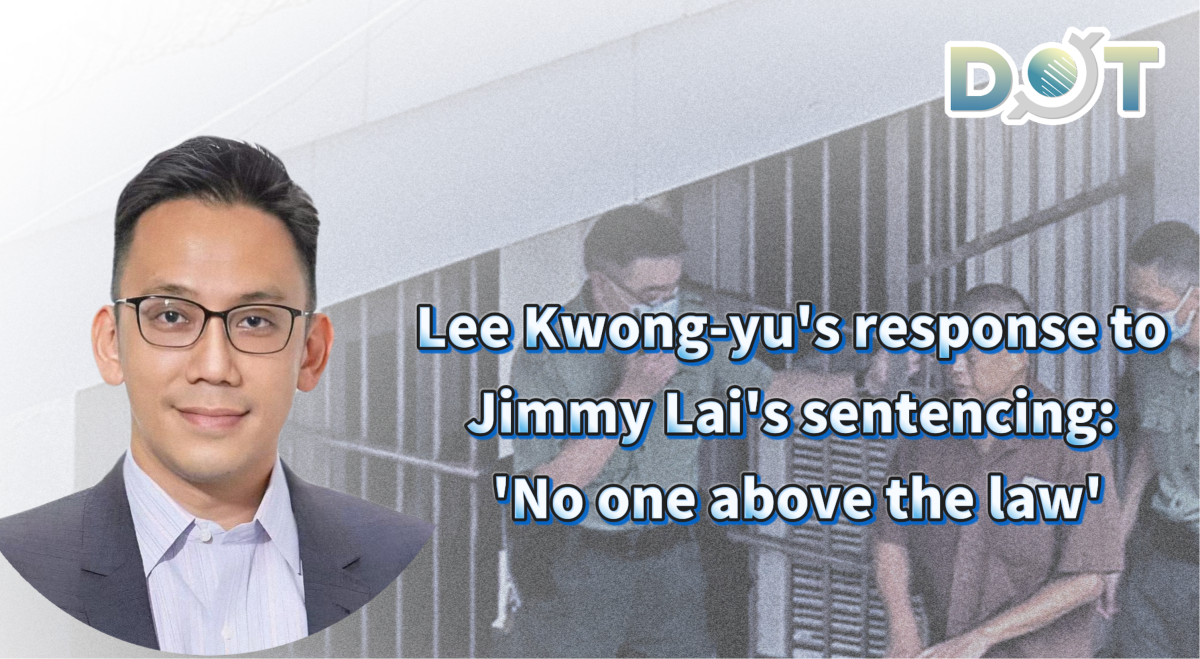
Following the landmark conviction of Jimmy Lai under the National Security Law, Hong Kong Legislative Council Member Lee Kwong-yu strongly supported the court's 20-year prison sentence. In an interview, Lee emphasized the case's implications for media accountability, national security enforcement, and the rule of law in post-NSL Hong Kong.
"We fully support the court's ruling," Lee stated. "(The sentence) was well-deserved. The court conducted a rigorous, 150-day trial backed by solid evidence and legal reasoning."
Citing testimony from former executives at Apple Daily, Lee said Jimmy Lai had played a direct and active role in manipulating editorial content to incite hatred and unrest, thereby abusing media freedoms.
"He wasn't just a passive owner—he was the instigator. This verdict is both fair and necessary."
Lee also pointed out the historical significance of the case as the first trial involving collusion with foreign forces under the National Security Law. He noted that it sends a clear legal message: "With the National Security Law in place, no act endangering sovereignty—directly or through foreign influence—can escape justice."
The law, he added, strengthens Hong Kong's status as a fair and orderly society and preserves its role as an international hub for finance, trade, and innovation.
Addressing concerns abroad that the case is a blow to press freedom, Lee said such claims are misleading. He explained that Jimmy Lai weaponized his media identity, steering editorial decisions to incite unrest.
"It was precisely because there was no National Security Law before that he was able to do so unchecked."
Lee emphasized that freedom of the press remains, but that freedom is not immunity from accountability when journalism is used as a cover for subversive action.
In response to a question about future regulation, Lee said, "The NSL has laid a strong foundation, but further refinement is necessary. Cases like this act as a deterrent to those who think they can exploit media platforms for foreign-backed agendas."
Lee closed the interview by encouraging both media professionals and the public to study the 855-page sentencing judgment, stressing that it is based on evidence—not politics.
"The court took into account Lai's advanced age and health when deciding the sentence. Critics should base their judgments on facts, not speculation."
(Reporters: Felicia Li, Liu Yu, Ian Lau)
Related News:
Wilson Shum: No one allowed to use human rights and freedoms to endanger national security




Comment