






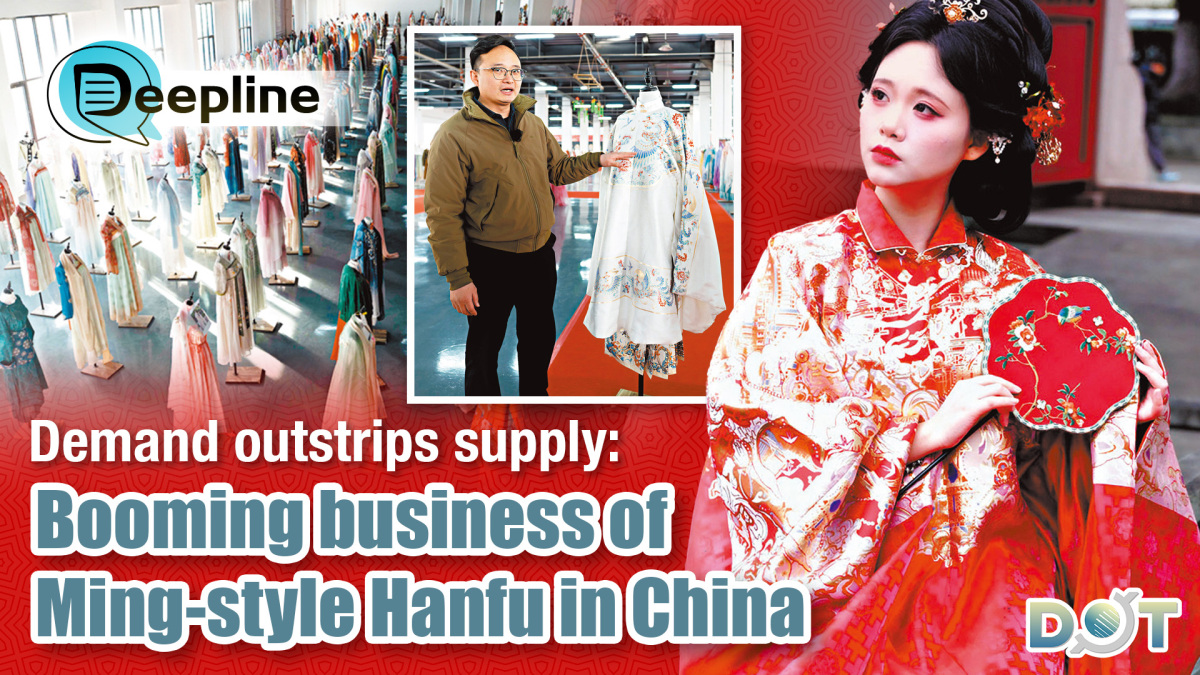
"This 'Princess Pingyang' Ming-style Hanfu is this year's hit item. Even the sample garment on the model was 'snatched away,' and customers have paid deposits to join the waiting list for stock," said Li Zilei, founder of Luoruyan Guofeng Fashion in Caoxian County, Heze City, Shandong Province, who is currently "swamped with work."
At the same time, over 80 looms at a textile factory in the County are working overtime to produce fabrics for Ming-style Hanfu. The factory manager told Wen Wei Po that to secure fabric, clients have waited in the workshop until midnight and even offered cash premiums.
On mainland social media, Ming-style Hanfu has been a trending topic in recent months. In Caoxian County, Heze City, Shandong Province—a major production hub for Hanfu in the Chinese mainland—sample Ming-style Hanfu garments have been snapped up from models, with the longest online pre-sale wait times stretching to 80–90 days.
A Ming-style Hanfu upper garment requires about 6 meters of fabric, and when paired with a mamianqun (horse-face skirt), the total reaches nearly 10 meters. However, a single loom can only produce just over 80 meters of Ming-style Hanfu fabric per day. Hu Chunqing, president of the Caoxian Hanfu Association, explained that, unlike other Hanfu styles that use universal fabric (referring to fabric cut and tailored for different styles), Ming-style Hanfu fabrics often feature original patterns and are woven to order. With only over 100 looms locally in Caoxian, current market demand exceeds capacity, and the fabric shortage directly limits production of Ming-style Hanfu.
"The shortest online pre-sale cycle is 7–10 days, while the longest extends to 80–90 days," Hu said. To break the production bottleneck, local enterprises have taken the initiative to seek external resources, "renting out" looms in Keqiao, Shaoxing, Zhejiang—a key textile hub in southern China. His own company, for instance, rented over 40 looms.
"We rented 80 looms in Keqiao, operating at full capacity and working overtime to produce fabric," said Wang Peng, head of Caoxian Xietang Yizhuang Garments. He admitted that even this could not keep up with order demand, with orders already scheduled half a month in advance.
Wang recalled that during the peak of the mamianqun trend in 2024, looms in Keqiao originally used for curtain fabric were repurposed to produce fabric for mamianquins. Although the current production scale for Ming-style Hanfu fabric is not as "crazy" as the mamianqun boom, Caoxian's Hanfu enterprises are still leveraging every possible means, traveling far to Jiangnan to seek loom manufacturers.
With nearly 20 years of experience in Hanfu production, Wang's company now offers over 200 Hanfu designs, including more than a dozen Ming-style styles. Despite producing Ming-style Hanfu for six to seven years, business had remained modest until now. From the mamianqun trend to this year's Ming-style Hanfu boom, Wang has successfully captured wave after wave of demand. Recent monthly sales have surged from 300,000 yuan to 800,000 yuan, with nearly 2,000 Hanfu garments sold per month.
"I remain optimistic about Ming-style Hanfu and have already started working on spring and summer designs," Wang said.
Fabrics for spring and summer styles are thinner, and colors are brighter. In Li's view, Ming-style Hanfu will peak before the Spring Festival, and this trend is likely to continue until April or May.
Discussing the popularity of Ming-style Hanfu, Li pointed to the hit designs, noting that traditional Chinese auspicious patterns such as phoenixes, magpies, and peonies symbolize wealth and reunion. With features like diagonal closures, standing collars, and long robes, traditional Ming-style Hanfu is meticulously crafted, elegant in pattern, and dignified in style, making it a representative traditional garment that aligns with the Chinese cultural temperament.
From the promotion of Hanfu to the breakout popularity of mamianquns and now the widespread craze for Ming-style Hanfu, the revival of traditional clothing is becoming increasingly evident.
"Ming-style Hanfu reflects the gentle essence of the Chinese nation and the continuity of cultural heritage," Hu believes the current popularity of Ming-style Hanfu stems from its dignified form and auspicious patterns, which carry a profound historical sense that resonates with young people's desire for identity and cultural belonging amid the Guofeng (national style) trend.
According to Li's consumer profile, the main force driving Ming-style Hanfu purchases is young people under 35.
Traditional festivals like the Spring Festival provide a natural context for Hanfu consumption, and Ming-style Hanfu, with its dignified and elegant appearance, is particularly meeting young people's needs for ceremonial wear and social sharing. Data from JD.com shows that searches for Ming-style Hanfu have increased tenfold year-on-year over the past month, directly reflecting this trend.
(Source: Wen Wei Po; Journalist: Ding Chunli, Hu Wolong, Zhao Hang)
Related News:




Comment