






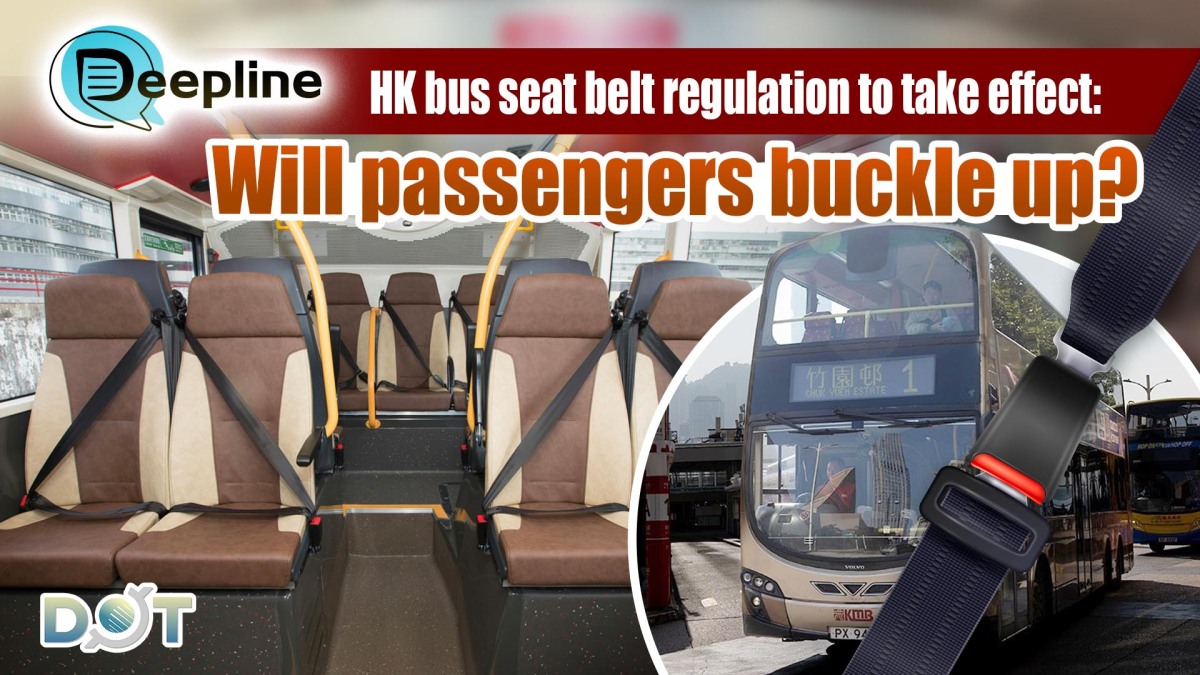
A new regulation mandating seat belt usage on buses will come into effect this Sunday (Jan. 25). During on-site tests, a Ta Kung Pao reporter checked around 300 seat belts across over 10 trips on KMB and Citybus services, finding that some could not be pulled out. Currently, bus compartments have few reminder notices about fastening seat belts.
Passengers generally agree that the new regulation will enhance travel safety, but concerns still exist.
In response to inquiries, the Transport Department (TD) stated that, following recommendations from the Independent Review Committee on Hong Kong's Franchised Bus Service and the Working Group on the Enhancement of Safety of Franchised Buses established after the fatal traffic accident on Tai Po Road in February 2018, all seats of newly purchased franchised buses since July 2018 have been equipped with seat belts.
Franchised bus operators, with government funding, have also retrofitted seat belts to the upper-deck seats of some existing double-decker buses. Approximately 3,500 franchised buses, or about 60% of all franchised buses in Hong Kong, have received seat belts to date.
Recently, a reporter traveled on over 10 trips on KMB and Citybus services in areas such as Hong Kong Island and Kowloon, testing all seat belts on the lower deck and some on the upper deck—approximately 300 in total. The tests revealed that the vast majority of seat belts functioned normally, although the reporter couldn't pull out three seat belts on one Citybus vehicle.
After the reporter reported the issue to the driver, he said that he would "inform the station supervisor upon arrival" to arrange repairs as soon as possible.
The TD noted that the government has briefed operators on the new regulations and provided guidance on handling various practical situations. Operators have also issued circulars to frontline staff and will conduct comprehensive inspections of their fleets to ensure all seat belts are functioning.
During the tests, the reporter also observed that there were no announcements inside the bus compartments reminding passengers to fasten their seat belts. Only a few buses had electronic screens displaying reminders or posted signs with the message "remember to fasten your seat belt."
A rough count by the reporter across more than 10 buses showed that only six passengers had fastened their seat belts.
Passenger Mr. Chan mentioned that he usually carries a bag when going out for shopping at nearby malls. As his trips are short—just a few bus stops—and bus seats are relatively narrow, by the time he places his bag and fastens his seat belt, he is almost there. Still, he believes that wearing a seat belt can provide added safety for travel.
Another passenger, Ms. Yip, expressed that the bus seats are quite cramped.
"I need to shift my body to fasten the seat belt, which is not convenient."
She also worried that fastening the seat belt might lead to physical contact with other passengers, causing misunderstandings. To avoid that, she plans to choose seats without seat belts after the regulation takes effect.
"Elderly family members usually only travel two bus stops when going out. Their reactions are slower, and they might be preoccupied with fastening the seat belt, which could cause them to miss their stop or forget to wear it and face penalties," she added.
Mr. Chung said he often takes his daughter to the park, where the bus provides a direct route. He expressed concern that after the new regulation takes effect, if he needs to unfasten his seat belt to attend to his daughter under special circumstances during the bus ride, he might face severe penalties.
The TD said in response that franchised buses are equipped with multiple safety features, such as continuous handrails, handrails near exit doors, and non-slip flooring, to ensure the safety of standing passengers. For seated passengers, wearing seat belts provides critical protection in the event of an accident.
"When drivers and seated passengers wear seat belts, the chances of fatalities and serious injuries in head-on collisions can be reduced by 40% and 70%, respectively... If an adult is traveling with a child, the adult should fasten their own seat belt first and then hold the child securely on their lap if the child cannot sit steadily, and children who can sit steadily should wear a seat belt."
The reporter also interviewed eight mainland tourists in areas such as Kennedy Town and Tsim Sha Tsui, none of whom were aware of the upcoming regulation.
Some tourists suggested that the SAR government and bus companies broaden their publicity channels and increase efforts to inform the public.
Mr. Cheng, a mainland tourist visiting Hong Kong for the third time, admitted that he was still unaware of the new seat belt regulation.
"There are limited channels for me, a tourist, to learn about the new regulations," he said. "During my visit, I took two short bus trips and did not notice any announcements reminding passengers to fasten seat belts."
He suggested that bus companies could increase the frequency of reminders during trips, such as making announcements every two stops, and the SAR government should also step up publicity at boundary crossings (customs) so that arriving tourists would know to wear seat belts when taking buses.
Mr. Zeng, a tourist from Shenzhen who visits Hong Kong for shopping once or twice a month, said he was unaware of the new seat belt regulation. He recalled "vaguely" noticing signs reminding passengers to wear seat belts while on the bus.
After being informed by the reporter, Mr. Zeng felt that the maximum fine of HK$5,000 for non-compliance was "quite steep."
"I'm afraid that uninformed tourists might be more than confused if fined."
He hopes that both bus companies and the government can emphasize the penalties to raise awareness among tourists and encourage voluntary compliance.
(Source: Ta Kung Pao; Journalist: Xiao)
Related News:
Connecting Dots | Unbuckled and unaware? What expats think of HK's bus seatbelt law




Comment