






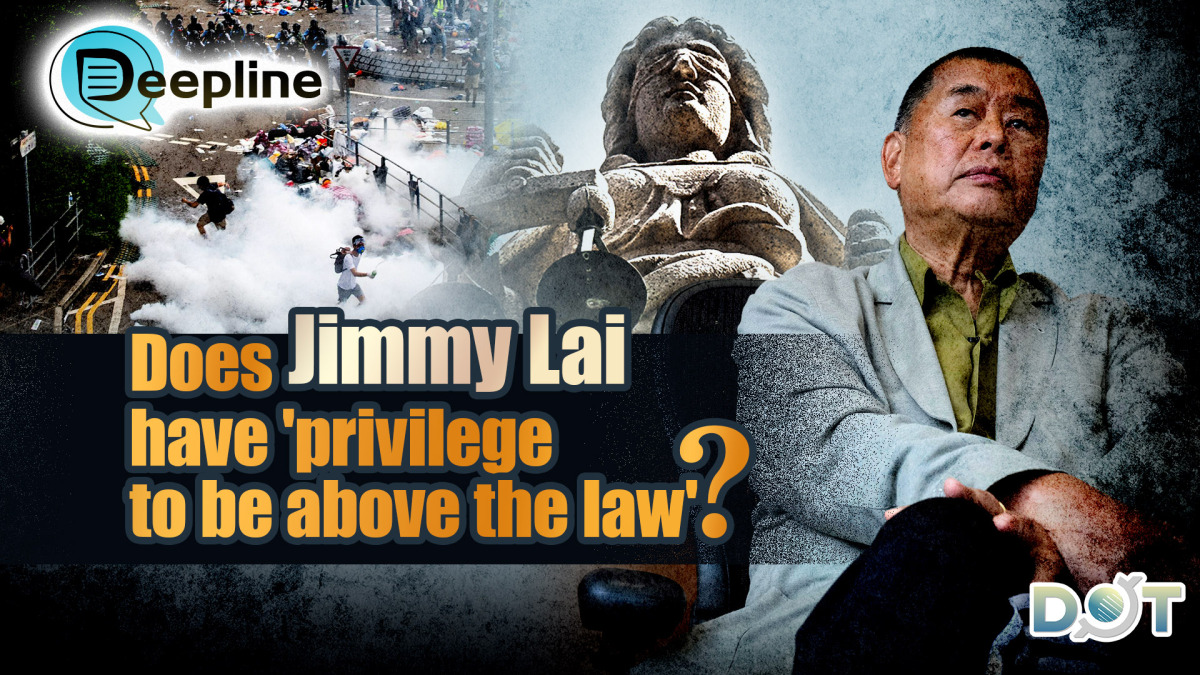
At the recent opening ceremony of the legal year, Chief Justice Andrew Cheung made a rare response to the case of Jimmy Lai, strongly rebutting attacks and smear tactics from external forces. He exposed how certain individuals, while proclaiming human rights and the rule of law, are actually attempting to destroy judicial justice in Hong Kong through various means. The Lai case is not only a significant national security case but also a mirror of the West's lies. Furthermore, it serves as a valuable lesson highlighting the principle that "no one is above the law."
When the Lai case first began, external forces used every tactic possible, from threatening and intimidating judges to media "interviews" with Lai's children, claiming that Lai's "life is in danger" and that he is being "subjected to inhumane treatment." They employed methods such as "sanction cards," "martyr cards," and "sympathy cards" to pressure the government to release Lai and to pressure the court to ignore substantive evidence in his favor.
No Amount of Excuses Can Evade Legal Punishment
However, when they saw that Hong Kong's judiciary did not yield, they turned and sought leniency for Lai. As Chief Justice Cheung pointed out, "One of the fundamental beliefs of the rule of law is that no one is above the law, and there will be no discrimination based on an individual's status, profession, title, political connections, personal beliefs, reputation, wealth, network, or other characteristics. The law applies equally to everyone, without fear or favoritism." The serious objective crimes committed by Lai will not be affected by subjective factors such as age, health, political stance, or background. His actions as an instigator of violence, colluding with foreign forces, have pushed Hong Kong into a violent abyss and caused irreparable harm to both the macro social economy and the micro personal families.
External forces have gone to great lengths to portray Lai as a "democracy fighter" and demand leniency in his release, essentially an attempt to evade established legal procedures for accountability. This stands in stark contrast to the so-called "spirit of maintaining the rule of law" that some individuals tout. If anyone were truly able to be "automatically released" due to political reasons or background, that would genuinely undermine the core of the rule of law. It is precisely because no one can be above the law in Hong Kong and because "everyone is equal before the law" that the rule of law in Hong Kong remains resilient and unwavering.
The phrase "the rule of law is dead" is a label frequently applied to Hong Kong by foreign anti-China politicians and media. Even before the Lai case officially began with police enforcement actions, some individuals were eager to declare the "death of Hong Kong's rule of law" and frame Lai as a "politically oppressed democracy fighter." Following the judgment last month, certain individuals continued to selectively ignore the 855-page judgment, 2,220 pieces of evidence, over 80,000 pages of documents, and testimonies from 14 prosecution witnesses, as if Lai could not possibly be found guilty, otherwise it would be "inconsistent with the rule of law."
But what is the so-called "rule of law" these individuals speak of? As Chief Justice Cheung stated, "The rule of law cannot be established or destroyed based on a court's decision on a particular day in favor of the government or the other party. Such claims are easily recognizable as untenable." The rule of law is a state of social order that accumulates over time; its existence does not depend solely on case outcomes. The processes of trials, the protection of human rights, and how the judicial system handles cases all contribute to forming the overall concept of the rule of law.
Moreover, the SAR government does not necessarily win in national security cases. For example, in the "Project 35+," two defendants were acquitted after trial, and the prosecution decided not to appeal one of the acquittals. This case clearly demonstrates that the judiciary has indeed exercised independent judicial power in national security cases. What foreign anti-China politicians and media refer to as "the rule of law is dead" is essentially the "kidnapping" of the entire concept of the rule of law, purely judging its existence based on personal preferences, which is fundamentally unrelated to the rule of law.
In fact, it is the United States where the concept of "the rule of law is dead."
In fact, the entire trial process in the Lai case has been open and transparent, conducted in accordance with established criminal procedure and the rules of evidence. The public, media, and even foreign consulates were able to attend the hearings without arbitrary restrictions. Both the prosecution and the defense had the right to summon witnesses, submit documents or other evidence, and make legal arguments. Lai self-represented for a record 52 days. All his needs or medical requirements while in custody or in court were fully met and appropriately arranged. After the case was adjudicated, the three judges issued a comprehensive 855-page explanation detailing the charges, summarizing the prosecution's case and the defense's arguments, describing the evidence, and outlining the reasons for the court's ruling and conclusions.
If, in the eyes of external forces, the Hong Kong SAR court's following procedures are considered unfair, then is the US invasion of Venezuela, the seizure of Greenland, the shooting of citizens by ICE, and the launch of tariff wars worldwide viewed as rightful actions? Is the real "rule of law is dead" occurring in the current United States? These Western media outlets often apply labels indiscriminately, seemingly overlooking the fact that they bear the brunt of the criticism.
Hong Kong will never succumb to the threats of the West. In the Lai case, we see Hong Kong's judges, judicial personnel, and prosecutors fearlessly bearing the immense pressure and continuing to fulfill their duties with professionalism and dedication. Hong Kong will not easily defeat the spirit of the rule of law. In today's complex and intertwined global context, the rule of law in Hong Kong will continue to shine, demonstrating the core values of law and judicial systems.
(Source: Ta Kung Pao)
Related News:
Deepline | Closing the trade office? A desperate political stunt by US over the Jimmy Lai case
Deepline | One year of chaos: Trump's return has shattered the global order




Comment