






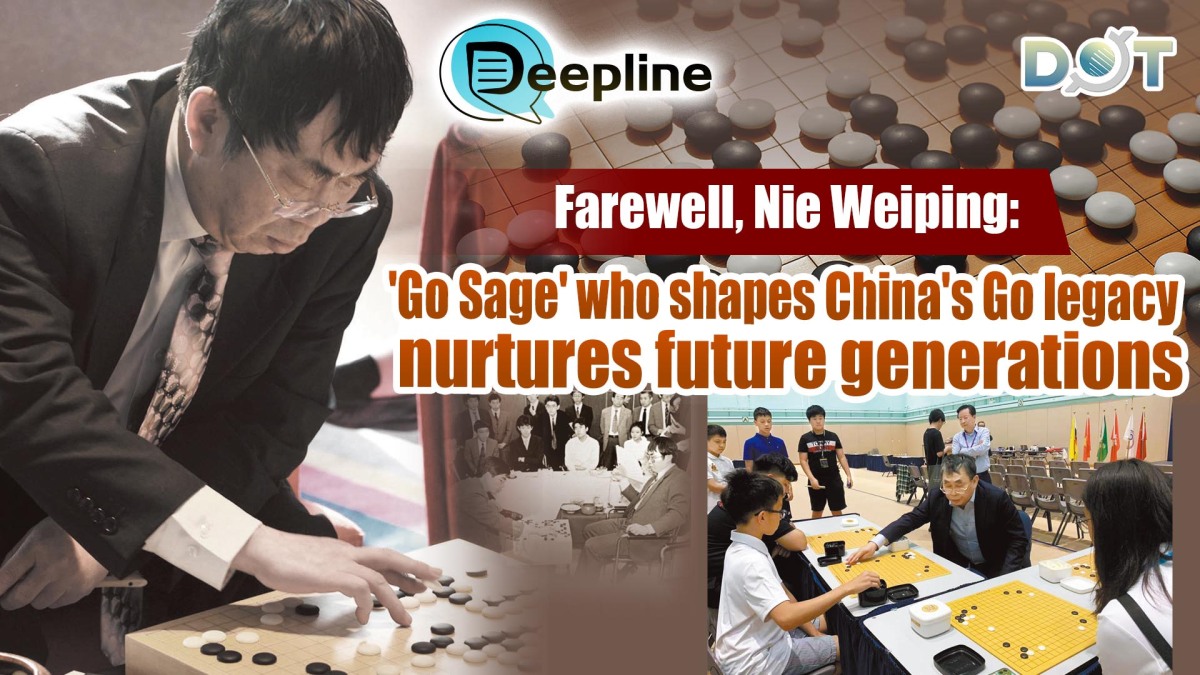
On Jan. 14, renowned Chinese Go master Nie Weiping passed away in Beijing. Although he never won a world championship, Nie is the only player in the history of Go in the PRC to receive the title of "Qisheng (Go Sage)." Having played against the times throughout his life, Nie's love and commitment to the game of Go have already woven themselves into the fabric of the board, becoming an everlasting "spirit of Go."
Nie was born in 1952 and showed remarkable talent from a young age while learning Go from his father. In 1973, he was selected for the national Go training team and began to stand out in domestic competitions, becoming one of the leading figures in Chinese Go.
Originating in China, Go is considered a gem of Chinese traditional culture. However, during the 1970s and 1980s, the Chinese Go scene was long dominated by Japanese players, with few victories for Chinese players against Japan's top talents. In this prolonged period of dormancy, Nie emerged as a ray of light. In 1976, at the age of 24, he made his first visit to Japan, where he achieved 6 wins out of 7 matches, defeating four 9-dan players.
In a past interview with the Wen Wei Po, Nie recalled that during China's reform and opening-up period, the Chinese people had a strong desire for the country to develop, especially to catch up with neighboring Japan. Despite facing the situation of having never won a match, under pressure, Nie tapped into his potential.
"When playing, you change completely," he noted.
The first China-Japan Supermatches began in 1984, and few expected Nie's emergence against the powerful Japanese team. The formidable Koichi Kobayashi led the Japanese team, leaving only Nie as the main player for the Chinese team.
In a crucial moment, Nie triumphed over three Japanese players in a row, turning the seemingly unachievable situation into a victory for China. In the following two supermatches, Nie continued to show top-tier performance, achieving a personal nine-game winning streak while helping the Chinese team win three matches against Japan.
At the celebration for China's consecutive victories in the China-Japan Supermatches, Nie was awarded the title of "Qisheng (Go Sage)."
Having dominated the Go scene for many years, Nie frankly stated that he felt a bit "apprehensive" about the title "Go Sage." In an interview in 2024, he recalled that the day after he was awarded the title, Chinese leader Deng Xiaoping said to him, "Being a sage is challenging; being an ordinary person is better."
Nearly four decades later, Nie expressed that Deng's words became prophetic; looking back, he found that being a "sage" was indeed difficult. This title brought him pride for many years but also unease throughout the decades.
Beyond competitive play, Nie has dedicated several decades to nurturing Go talent. In 1989, at the inaugural Ing's Cup founded by patriotic entrepreneur Ing Chang-ki in Taiwan, Nie narrowly lost to South Korean player Cho Hun-hyun, missing out on the world champion trophy.
According to Nie, his biggest regret was never winning a world championship, but he believed his students would undoubtedly win one.
From serving as the head coach of the national Go team to becoming the vice president and honorary president of the Chinese Weiqi (Go) Association, he has nurtured several world champions, including Ma Xiaochun, Gu Li, and Chang Hao, sustaining the brilliance of Chinese Go.
As an ancient intellectual competition, Go is recognized as a representation of humanity's highest level of intelligence. In 2016, the match between AlphaGo and South Korean Go champion Lee Se-dol marked the beginning of a confrontation between artificial intelligence and Go, profoundly rewriting the trajectory of the game.
Nie possesses clear insights and understanding, believing that in the age of AI, humanity still needs Go.
"Some theories of Go have indeed been overturned by AI. However, humans create AI and ultimately control it. So even if AI has disrupted many Go theories and reached high levels, the greatest still remains humanity. Learning Go nurtures principles that guide daily life, studies, and work."
For Nie, Go also serves as a bridge for cultural exchange between China and other countries. At the 35th anniversary of the China-Japan Supermatches in 2019, he faced off against old rivals and friends, including Masaki Takemiya and Koichi Kobayashi, once again. Veteran players teamed up with young players, symbolizing the passing of the Go torch through generations.
Nie has expressed that Go plays a significant role in promoting friendship and hopes to enhance exchanges through Go, fostering better development of relations between the two countries.
Eventually, all games must come to an end. On Jan. 15, Nie's daughter expressed her condolences, saying that her father's life was legendary and filled with passion.
"He had a straightforward personality and an open heart; regardless of whether he faced good or bad circumstances, he always maintained an optimistic and open-minded attitude toward life."
The departure of the "Go Sage," who spent his life for Go, illuminates the legacy on the board and inspires others.
In 2023, Nie was invited to attend the first "Four Seas Cup" held at the Hong Kong University of Science and Technology (HKUST). During an interview with Wen Wei Po, he notably expressed the hope that both the mainland and Hong Kong would strengthen the promotion of Go culture to enhance the spiritual civilization of the nation.
Nie emphasized the need to introduce related courses in elementary schools, believing the conditions are already mature, as sufficient teaching resources are available. In some areas, such as Shenzhen, Go has been included as a compulsory subject in elementary schools.
He noted that representatives in some regions of the mainland have proposed legislation regarding Go education, stating, "Go has experienced a revival in the Chinese mainland."
In 2024, during another trip to Hong Kong, Nie once again called for Go to be introduced into schools. He noted that some education departments in the mainland have made Go courses mandatory for elementary school students, expressing confidence that Go will soon enter the classrooms of Hong Kong students as well.
When addressing the relationship between AI and Go education, Nie believes that young children should still learn face-to-face with others. He asserted that Go provides an excellent form of "education through setbacks."
"For most Go enthusiasts, their level is usually average, not particularly high. So during the game, losing often exceeds winning. It's a beneficial education for these children to have experiences of setbacks."
(With input from Wen Wei Po; English Editor: Darius)
Related News:




Comment