





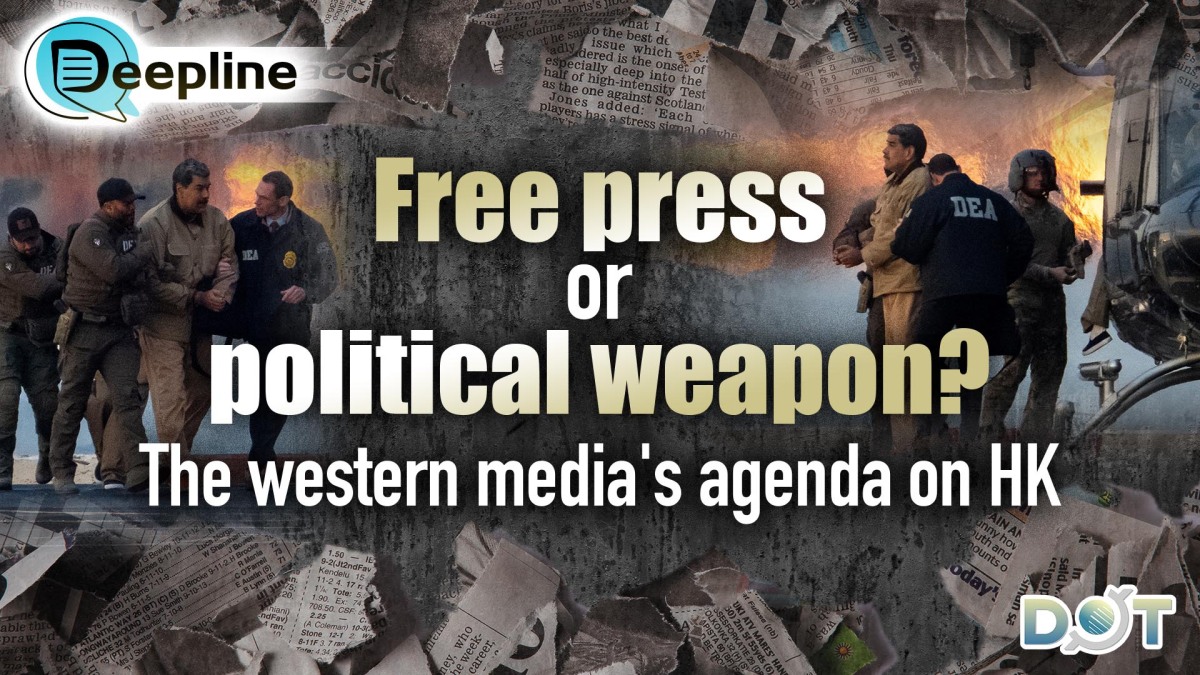
Regarding the case of Jimmy Lai, the long-standing narrative of anti-China politicians and media in the US and the West has been to disguise the serious crime of endangering national security as so-called "universal values" such as press freedom. This narrative does not rely on legal or logical reasoning but rather uses irrational and "sympathy-seeking" methods to try to exonerate Lai. However, with recent revelations by Western media about the US invasion of Venezuela, from the BBC's internal guidelines banning the use of the word "kidnapping" to the collective "silence" of mainstream American media, the world has noticed that there is no such thing as the "press freedom" claimed by the US and the West. Western media has no right to interfere in Hong Kong's judiciary.
1. Why did mainstream American media dare not report on the invasion of Venezuela in advance?
Although the US invasion of Venezuela shocked the world, according to foreign media reports, American media such as The New York Times and The Washington Post were aware of the news in advance but did not report it immediately due to "avoiding putting American troops in danger." While The New York Times and The Washington Post did not respond to inquiries afterward, US Secretary of State Marco Rubio admitted in an interview with ABC that "some media had already received leaked information but did not report it for security reasons. We are very grateful for this, as otherwise, Americans might have lost their lives," indirectly confirming the authenticity of the matter.
The question arises: Why is it that when The New York Times and The Washington Post engage in self-censorship under the guise of national security, no one in the US or the world finds it problematic, but when Lai uses his media to incite riots and endanger national security, a group of people jump out and call it "press freedom"? Both The New York Times and The Washington Post have also weighed in on Lai's case. The former asserted that the case illustrates the gradual deterioration of press freedom in Hong Kong, while the latter characterised the case as a trial of freedom of speech and asserted that "Lai and Apple Daily are not criminals."
The New York Times and The Washington Post have exhibited blatant hypocrisy. On one hand, they proclaim Lai's innocence and label Apple Daily's incitement of violence as press freedom; on the other hand, they strictly adhere to rules, not daring to cross the red line of US national security. No amount of whitewashing by The New York Times and The Washington Post regarding Lai can match the persuasiveness of this living example. The fact is that American media are fundamentally subservient to political power, where national interests are paramount, and such an arrangement is nothing new for American media. For example, during the Cold War era's Bay of Pigs in Cuba, The New York Times omitted details of US military operations in its reporting. As recently as last August, American media also delayed reporting on the US-Russia prisoner exchange for security reasons.
2. Why did the BBC and others cooperate with the US to issue "banned words" guidelines?
Even more intriguing is the recent disclosure by a BBC employee of an internal email outlining the BBC's reporting guidelines for the US invasion of Venezuela, emphasizing specific distinctions in wording. For example, it reminded journalists that the US description of the operation was "captured" and that "seized" could be used in appropriate contexts, but the key point was to avoid using "kidnapped." Moreover, journalists were required to "keep this distinction in mind."
While the choice of words in the letter may seem minor, the language used by media reflects their attitude and stance toward an event. According to the authoritative Oxford Dictionary, "kidnap" means "to take someone away illegally using force." Thus, the BBC's instruction to avoid using the word is clear: to omit the "illegality" of the US invasion of Venezuela and the abduction of President Maduro and his wife, avoiding the essence of the US openly violating international law, and attempting to "whitewash" the US's illegal actions or "brainwash" readers and viewers.
It is not surprising for media to have political stances. British Prime Minister Keir Starmer avoided publicly stating whether the US invasion complied with international law. As a British public broadcaster, it is understandable for the BBC to follow the government's line. However, the BBC's reporting guidelines on Venezuela raise a more important question: Does the BBC apply the same standards to all news related to the US? After all, it is well-known that the US government provides substantial funding to the BBC.
The world observes that the BBC ignores the serious crimes committed in the US while aggressively targeting Hong Kong's efforts to protect national security. Setting aside its severely biased reporting during the 2019 riots, the BBC recently used an interview with Lai's daughter as a pretext to openly spread seriously false statements, significantly interfering with ongoing court proceedings. One cannot help but ask: Does the BBC also have a "banned words" guideline for Lai's case? For example, does the BBC only use terms like "news warrior" or "media mogul," while banning terms such as "Western agent" or "Western spy"? Additionally, does it use phrases like "authoritarian oppression" or "Hong Kong people's resistance," while banning "conclusive evidence" or "fair judgment"?
The fact that Western media downplay the US's violations of international law due to political stances indicates that they will similarly use Lai's case to smear Hong Kong for political reasons. The so-called "concern for press freedom" is actually driven by political calculations. The news in the US and the West is not more noble, nor is their speech freer. National interests remain the highest principle that all media should follow. Anyone trying to exploit Lai's case to interfere in Hong Kong's judiciary only exposes their hypocrisy and double standards. By adjudicating Lai's case in accordance with the law and making a fair, just, and open ruling, the Hong Kong Special Administrative Region is fulfilling its responsibility and authority to safeguard national security, preventing, stopping, and punishing acts and activities that endanger national security in accordance with the law, and protecting the rights and freedoms of Hong Kong citizens in accordance with the law.
Related News:
Deepline | 'Wu Sangui' bringing US predation to HK: Jimmy Lai reveals he fights for US



Comment