






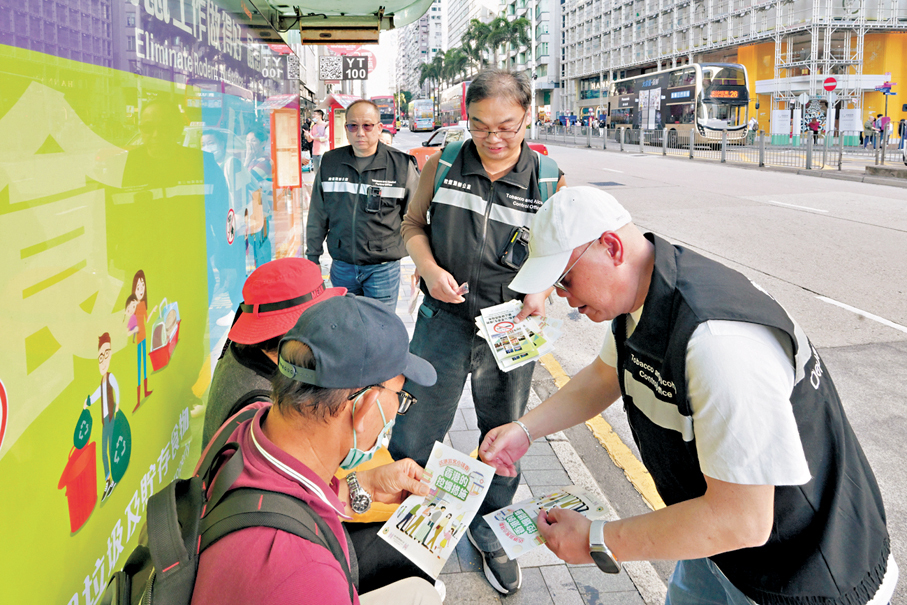
Three new provisions under Hong Kong's smoking control regulations came into force today (Jan. 1), including a ban on smoking within three meters of designated venue entrances and exits, while queuing for public transport, and when entering premises. Dr. Lam Man-chung, Head of the Tobacco and Alcohol Control Office of the Department of Health, stated in a radio interview yesterday that the law does not include a grace period, and clear violators will be issued fixed penalty tickets without prior warning. However, if smokers are found smoking in ambiguous zones near restricted areas without awareness of the rules, they may first receive a verbal warning before facing penalties.
Dr. Lam further elaborated on enforcement details. For example, even if certain bus stops lack marked queues, railings, or shelters, smoking will be prohibited as long as more than one person is queuing. He emphasized that the public has a clear understanding of queuing for transport and expects enforcement to be straightforward.
Targeted Inspections to Enhance Deterrence
As some restricted areas are located in narrow streets or public spaces, the government has not required venues to mark the three-meter no-smoking zones. Dr. Lam expressed confidence that publicity efforts would make smokers aware of the restricted areas. However, during the initial implementation phase, if inspections find individuals smoking in ambiguous zones or passing through restricted areas unknowingly, verbal advice or warnings may be issued first. Those clearly smoking within restricted areas will face immediate fines. He explained, "Three meters is roughly equivalent to six or seven steps for an adult. Moving a bit farther essentially takes you out of the restricted zone. Regardless of the law, we advise smokers to keep their distance to avoid affecting others."
Dr. Lam also revealed that the government will adopt a "risk-based" approach, prioritizing inspections at high-risk locations, such as transport hubs, tourist areas, and other areas with a history of frequent offenses. He stated, "We aim to enhance public awareness of the new regulations through these enforcement inspections. As the law is now in effect, effective enforcement is necessary to maintain deterrence." He acknowledged that even with public reports, it is often challenging to dispatch personnel promptly. Thus, he believes the success of smoking control legislation hinges on societal consensus and voluntary compliance.
(Source: Wen Wei Po)
Related News:
Lo Chung-mau: Submit third medical school recommendation before Policy Address




Comment