






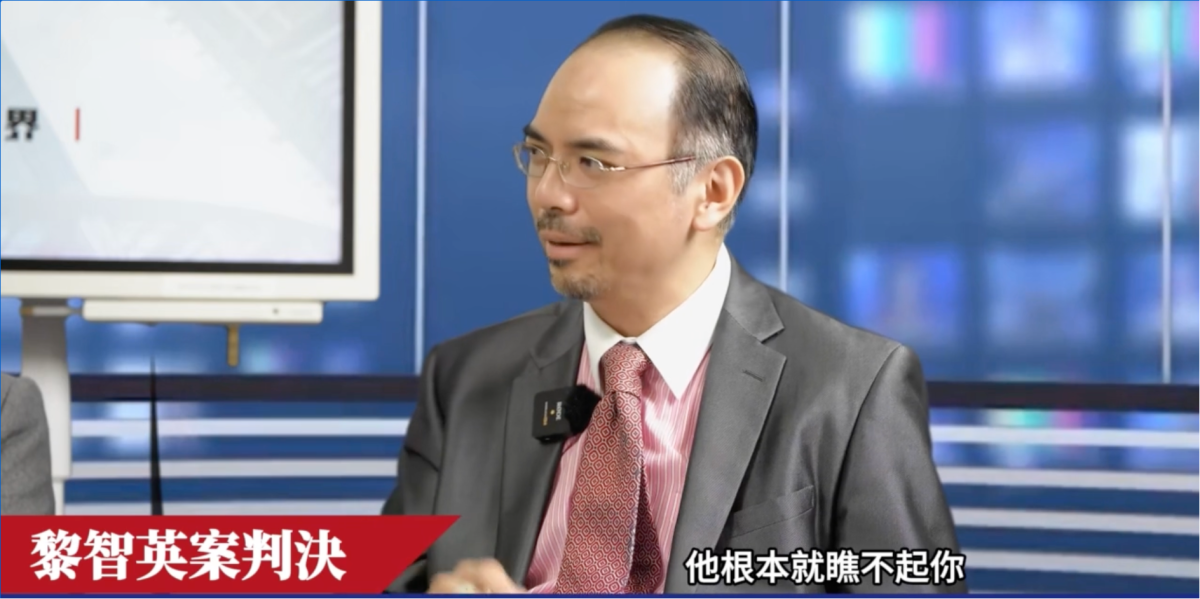
On December 15, Hong Kong's High Court handed down a verdict in the national security case involving Jimmy Lai and three affiliated companies of Apple Daily, convicting them on three counts related to endangering national security. We invited Dr. Raymond Cheng, a commentator on current affairs and international strategic advisor, to analyze the ruling and its broader implications.
Dr. Cheng outlined the full legal trajectory of the case, which began with Lai's initial arrest in August 2020 under the Hong Kong National Security Law. Over several years, the case progressed through multiple hearings and legal challenges, culminating in the final judgment this month.
He emphasized that Jimmy Lai's actions—including repeated appeals to foreign governments for sanctions against the Chinese Mainland and Hong Kong—were not isolated incidents. According to Dr. Cheng, these were sustained efforts to leverage foreign influence to interfere in China's internal affairs, a clear violation of the national security law.
"From the Occupy Movement to the black-clad violence, Lai's acts of incitement and collusion with foreign forces were consistently backed by the U.S. government," said Dr. Cheng.
He noted that during Donald Trump's first presidential term, the U.S. strategically utilized Jimmy Lai to stir unrest in Hong Kong as part of a broader geopolitical agenda aimed at containing China.
When asked about the so-called "national security red line," Dr. Cheng offered a philosophical perspective:
"Crossing the red line is not easy for an ordinary citizen. Instead of obsessing over how to avoid it, we should ask ourselves, 'How can we contribute to the strength of our nation and our people?'"
"Those with hidden agendas are the ones who persistently challenge the boundaries." But if your intentions are sincere, you won't ever cross it."
He reiterated that national security is not a vague or arbitrary concept but a necessary safeguard in the face of external attempts to destabilize Hong Kong.
Dr. Cheng criticized the West's reaction to the case as superficial. He pointed out that while certain governments issued verbal condemnations, they did not take any real diplomatic or political action on Jimmy Lai's behalf—a sign of shifting global power dynamics and China's rising influence.
"Jimmy Lai has become a disposable pawn. The West's support was always conditional and self-serving. Now that it's inconvenient, they've moved on."
He further likened the West's attention to the case to spectators gathering to watch a father discipline a disobedient child:
"Even if you disagree with the father's methods, it doesn't justify inviting outsiders to attack him. After all, the bond between a parent and their child is strong.
Dr. Cheng concluded that this case is not just a legal landmark but also a moral lesson for Hong Kong society:
"It shows that Hong Kong, under the support of the state and the rule of law, will not tolerate external manipulation. The case clearly conveys that national security is a crucial boundary that cannot be breached.
Related News:
Opinion | The high priest of China-bashing sinks to a new low




Comment