






When website traffic and algorithms become the core logic for resource allocation on today's internet platforms—and the primary asset that platforms compete to monopolize—the structural dilemma of "alienation" is reactivated: consumers, merchants, and products themselves are forced to conform to platform rules, gradually losing autonomy and their status as independent value agents. This deep-seated "alienation" turns market participants into mere tools and undermines the healthy order of market development.
Huang, a longtime user of Xiaohongshu, recently kept encountering an advertisement from a beauty influencer promoting the "Pinduoduo 2025 Wish Red Packet," claiming that winners could directly withdraw 2,025 RMB (all currency references are in Chinese yuan unless otherwise specified). Out of curiosity, Huang clicked the link and followed the instructions. The screen immediately displayed celebratory messages such as "Great!" and "Only 1% of users win." However, after completing a series of cumbersome steps—downloading, installing, and registering—the page informed her she had "won" 2,025 yuan in shopping credits, accompanied by a countdown warning stating the credit would expire in ten minutes. When she attempted to use it, she discovered the credit could only be used for purchases on Pinduoduo, with each transaction allowing only a negligible deduction—sometimes just a few cents.
Monetizing traffic through "strategic platform partnerships"
It turned out that Huang was never truly among the "1% lucky winners." Wen Wei Po invited several colleagues to randomly search "red packet" on Xiaohongshu. All colleagues, except for one who had already installed the Pinduoduo app, appeared as "winners." The "winning" message continued to appear even after users left and returned to the page. This indicates that the so-called "prize" links are actually designed to lure unregistered users into downloading and registering on Pinduoduo—an essential step in cross-platform user acquisition.
Faced with the dwindling countdown, Huang reluctantly used less than one yuan of the shopping credit to place an order for the foundation recommended by the influencer—a product she had long wanted. At that moment, her decision was driven by the "sunk cost" of time: after spending so much time registering, browsing, and navigating the process, walking away felt like a waste. Yet, she failed to realize that this seemingly trivial purchase had already completed a cross-platform traffic conversion.
In 2025, Pinduoduo and Xiaohongshu launched a strategic partnership and began beta-testing a new function. The function uses algorithms to precisely recommend products mentioned in influencers' posts to users, enabling one-click redirection to the purchase page. Platforms like Douyin (TikTok) are also advancing similar cross-platform collaborations and commercial alliances, further enhancing traffic conversion and monetization of user value.
According to the 56th Statistical Report on Internet Development in China released by the China Internet Network Information Center (CNNIC), by the first half of 2025, the number of internet users in mainland China reached 1.123 billion, with 99.4% accessing the internet via mobile devices. The usage rates for online social networking and online shopping stood at 98.6% and 86.9%, respectively. The China Internet Development Report 2025, released at the World Internet Conference in November of the same year, noted that China's digital economy is transitioning from scale expansion to quality and efficiency improvements. Platform competition is shifting from "traffic-driven" models toward "precise supply" and "deep cultivation of user value." This trend shows that simply getting more users is becoming less effective, leading platforms to work together and focus on traffic as a key resource.
Last drop of blood from the real economy
Due to income structure constraints among Chinese internet users, the most direct method for platforms to deepen traffic monetization remains low prices and subsidies. However, merchants' hopes of boosting transaction volume and profitability through traffic often prove elusive.
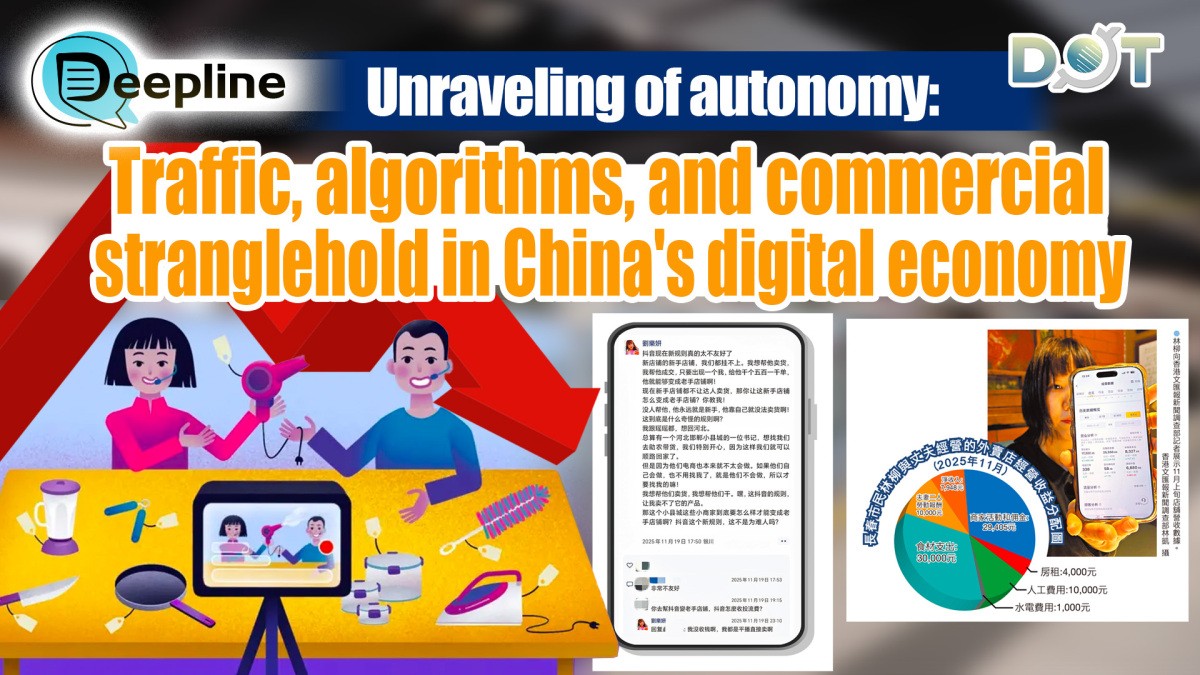
Lin and her husband, who run a takeout restaurant in Changchun, Jilin province, are facing such challenges. Although their daily order volume is stable, they are heavily reliant on platform promotions and subsidies. Order numbers instantly decline as soon as they cease to participate. Their store filled 338 orders in early November 2025, bringing in 25,550 yuan in sales. They only got 17,222.35 yuan after platform commissions and subsidy deductions—a commission rate as high as 32.6%. After deducting labor, rent, utilities, and other costs, the couple earns an average monthly income of only about 13,000 to 15,000 yuan, which includes their labor compensation.
Mr. He, who is from Sichuan, has had a similar experience. His takeout store generated 206,300 yuan in revenue in October, but platform fees consumed 48.5% of that amount. After expenses, he was left with only about 15,000 yuan per month, with an average net profit of less than 3.8 yuan per order—sometimes even running at a loss.
Taiwan-born streamer Fanny told Wen Wei Po that Douyin recently changed its rules, prohibiting "influencers" from live-streaming to promote new stores, which means new stores must pay for official traffic promotion to gain visibility now. Backend data provided by a Douyin e-commerce practitioner in Hebei shows that for a newly launched account, the September settlement was 23,150 yuan with a traffic promotion cost of 17,812 yuan; in October, the settlement was 25,320 yuan with promotion costs of 19,783 yuan. Over two months, total transaction volume approached 48,500 yuan, but actual net income was only over 5,000 yuan per month. After deducting personnel and office expenses, profits were even negative.
Experts: Loss of merchant autonomy undermines fair distribution
In 2024, the European Union formally implemented the Digital Services Act (DSA), which specifically requires large platforms to disclose their algorithmic mechanisms and restrict monopolistic practices. In contrast, while China has a series of relevant laws and regulations, it lacks targeted provisions, leaving the allocation of platform traffic unclear and making merchants and consumers more vulnerable to information asymmetry.
According to Professor Jiang Chuanyue from the School of Marxism at Jinan University, platforms, traffic, and technology are neutral in themselves and can bring convenience and efficiency.
"The problem arises from information asymmetry and traffic monopolization once platforms gain dominant positions."
He emphasized that traffic possesses both private and public attributes, and the key lies in redefining the rights and responsibilities of platforms, enterprises, and society through tiered governance, transparent regulation, and institutional restructuring to achieve fair distribution and sustainable development.
Using the metaphor of landlords and tenant farmers, Professor Jiang explained that platforms, by controlling traffic, effectively control the means of production. Merchants lose autonomy under the guise of cooperation, becoming dependent, while profit distribution remains unresolved. Therefore, to clearly define profit-sharing ratios and responsibility boundaries, a tripartite negotiation mechanism involving the government, platforms, and merchants is necessary.
Clarifying the ownership of website traffic rights
From a macro perspective, Professor Jiang frames the traffic issue within the context of distributive justice. He reminds us that while the early stages of reform and opening-up prioritized "getting rich first" to boost efficiency, China is now entering an era of shared prosperity, necessitating a re-examination of the distribution ratios among the state, enterprises, individuals, and between labor and capital. If platform monopolies erode employment and income in the real economy, policies aimed at expanding domestic demand and internal circulation will be constrained: the poor have demand but lack purchasing power, while the rich approach consumption saturation, making traffic-driven growth unsustainable.
To address this, he proposes institutional solutions:
- Acknowledge the public nature of certain types of traffic and, referencing public data authorization frameworks, implement tiered authorization and regulation for traffic serving public interests.
- Learn from the EU experience by promoting transparency and limitations in platform algorithms and traffic allocation.
- Advance structural divestitures to prevent platforms from forming long-term monopolistic alliances.
- When necessary, have the government or public-interest organizations establish non-profit traffic platforms to ensure public information dissemination is not held hostage by commercial algorithms.
(Source: Wen Wei Po; Journalist: Lu Zhi, Lin Kai, Wenzheng; English Editor: Darius)
Related News:
Deepline | New frontier of innovation: How data drives HK's tech revolution
Deepline | New attraction: How HK's 'racecourse tourism' strategy pays off




Comment