






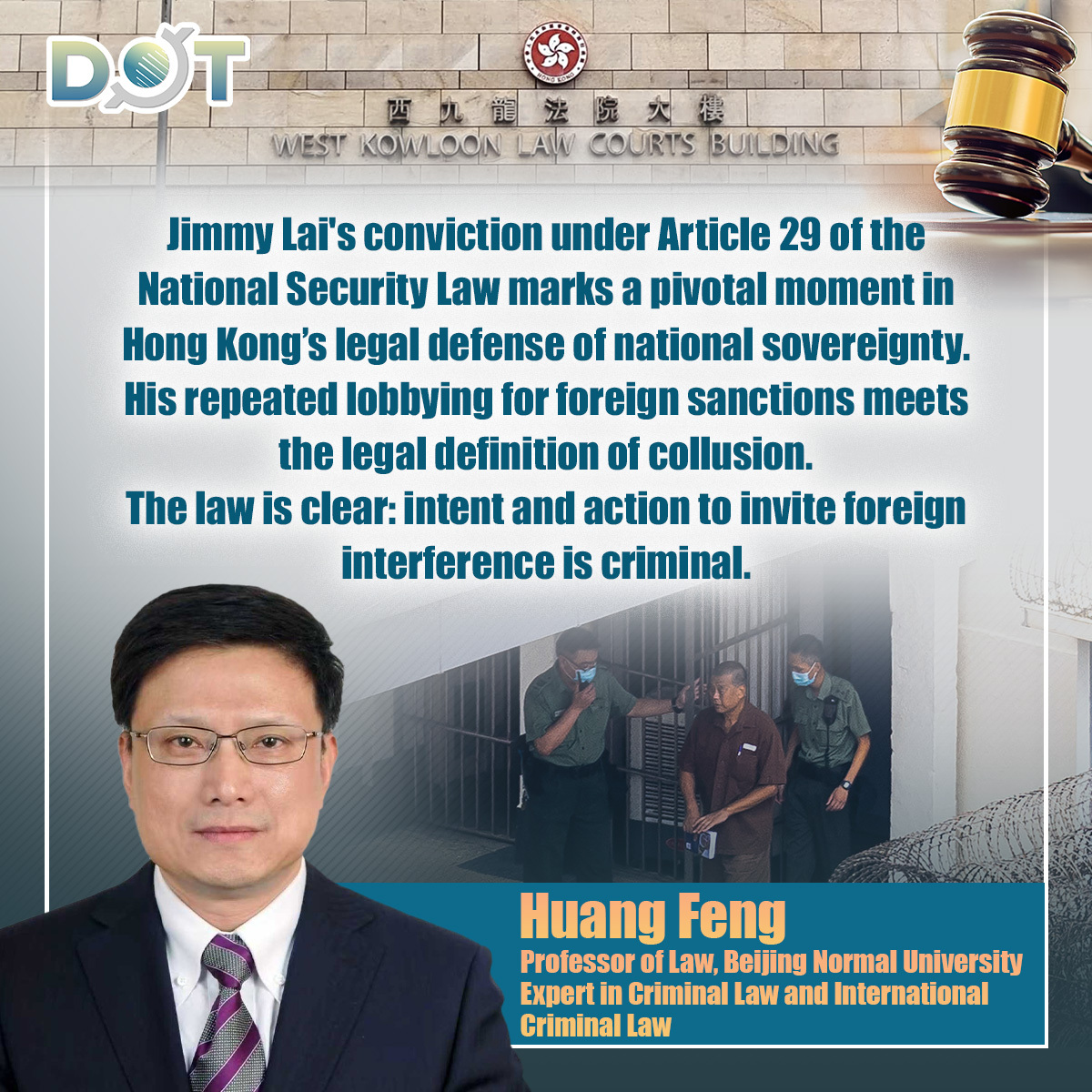
By Huang Feng
On December 15, the Hong Kong High Court found Jimmy Lai guilty of two counts of conspiracy to collude with foreign or external forces to endanger national security, as well as one count of conspiracy to publish seditious publications. This case is regarded as a landmark in the enforcement of the Hong Kong National Security Law (NSL) and reflects the SAR's determination to safeguard national security through legal mechanisms. One of the central charges—collusion with foreign forces—falls under Article 29 of the NSL, a provision that is both concise and precise in its legislative language. When compared to similar treason or collusion laws in other jurisdictions, Article 29 stands out for its clarity, adhering to the principle of legal certainty in modern criminal law.
Article 29 targets acts that threaten China's external security and international standing. In criminal law systems worldwide, national security offenses are generally categorized into those that threaten internal security, such as insurrection or subversion, and those that threaten external security, such as espionage or treason. The offense of collusion under Article 29 fits squarely into the latter category. It concerns behaviors that involve soliciting, assisting, or cooperating with foreign forces in ways that harm China's sovereignty, security, unity, or constitutional order. These actions are viewed as serious betrayals of the nation and are treated with particular gravity due to the foundational nature of national security as a legal interest.
Legal systems globally, as well as international legal instruments such as the International Covenant on Civil and Political Rights (ICCPR), recognize that the protection of national security may warrant lawful limitations on individual rights, including freedom of expression. In this context, no individual may use claims of personal liberty to justify or excuse acts that endanger national security, particularly those involving foreign collusion. The NSL's provisions are therefore aligned with international norms that prioritize the state's right to defend itself against external threats.
The NSL provides a clear definition of what constitutes foreign interference. Article 29 identifies several forms of collusive behavior, including acts that support or enable foreign powers to wage war, interfere with Hong Kong's legislative or policy processes, manipulate local elections, impose sanctions or blockades, or incite public hatred against the central or SAR governments. Any person may be deemed guilty of collusion if they request, conspire with, or accept instructions, funding, or support from foreign or external actors to carry out such acts. The law's scope includes not only official foreign agencies but also unofficial organizations and individuals operating outside of Hong Kong, including those in Taiwan.
Collusion can be carried out through both covert and overt means. It may involve secret meetings, encrypted communications, or submission of materials, but it can also include public speeches, published articles, or interviews that call for foreign sanctions or hostile actions. The law does not rely on the method of transmission but rather the intent and effect of the action.
Importantly, the offense of collusion requires specific intent. It must be shown that the person knew their actions could invite foreign interference and that they wanted it to happen. This mental state can be inferred from surrounding facts, such as the political environment, the nature of the foreign entities involved, and the language used in public appeals. Repeated behavior, especially following official warnings, may further demonstrate intentionality.
In the case of Jimmy Lai, the facts presented in court revealed that he had repeatedly lobbied Western politicians and openly called for sanctions against China and the Hong Kong SAR. Even after the NSL came into force, he continued to maintain his anti-China stance and engaged in activities that encouraged foreign interference. These actions represent a direct threat to China's external security and international status and satisfy the legal elements required for a conviction under Article 29.
The Hong Kong judiciary delivered a judgement based on factual evidence and legal reasoning. It reflects a lawful and justified application of the National Security Law. The case emphasizes the value of upholding state security and the rule of law, and it sends a clear message that collusion with foreign forces will not be tolerated in Hong Kong.
(Professor Huang Feng is a distinguished legal scholar at the Law School of Beijing Normal University (BNU). He holds the title of professor and doctoral supervisor, specializing in International Criminal Law, Foreign Criminal Law, and Roman Law, known for his expertise in criminal law and his contributions to legal forums and publications in China.)
Related News:
Opinion | Jimmy Lai's convicted: National security safeguarded




Comment