







A significant climate study conducted by The Hong Kong University of Science and Technology (HKUST) and an international team has found that under high-emission scenarios, the Northern Hemisphere summer monsoon region will experience extreme weather events starting in 2064. Asia and surrounding tropical areas are expected to face frequent "subseasonal whiplash" events, characterized by alternating heavy rain and dry spells every 30 to 90 days, severely disrupting food production, water management, and clean energy systems.
Published in "Science Advances", the study was co-led by Prof. Lu Mengqian of HKUST and Dr. Cheng Tat-fan, a postdoctoral fellow, along with collaborators from various universities.
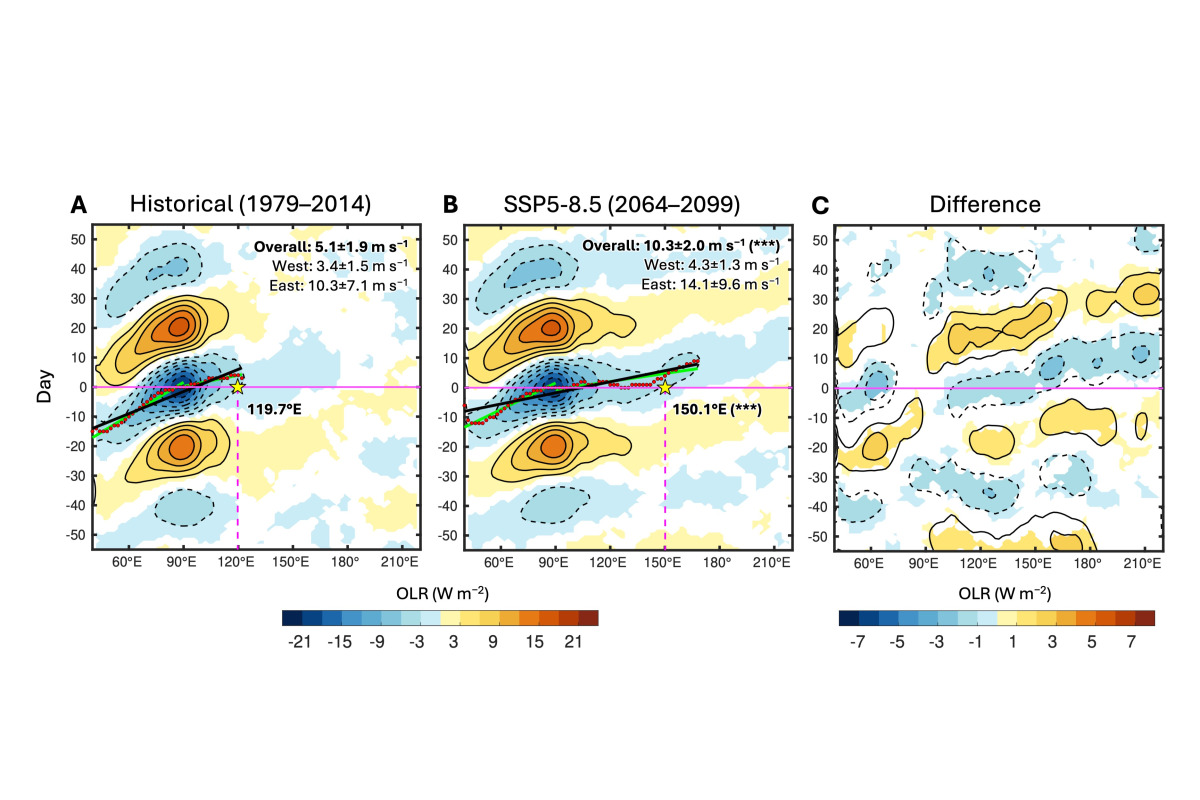
Using 28 coupled general circulation models from CMIP6, the research focused on the Boreal Summer Intraseasonal Oscillation (BSISO), which influences summer precipitation patterns. It identified three BSISO propagation patterns, predicting that both the canonical northeastward and northward dipole modes will intensify, leading to more extreme rains and droughts in South and East Asia. Importantly, the study highlights that the eastward expansion mode will double in propagation speed by the century's end, pushing further into the West Pacific.
The research also points to increasing risks outside Asia, such as amplified precipitation swings in the Arctic and altered Saharan dust dynamics affecting Atlantic hurricane formation.
Prof. Lu emphasized the urgent need to enhance subseasonal-to-seasonal (S2S) forecasting models to address these evolving challenges and protect food production, water resources, and public health. This research is part of HKUST's "Seamless Prediction and Services for Sustainable Natural and Built Environments" (SEPRESS) program, recognized by UNESCO as a key initiative for sustainable development.
Related News:
Tiiny AI reveals world's smallest personal AI supercomputer, verified by Guinness World Records
Deepline | HK$3 mn per entrant: How HK's tevamped visa scheme channels capital into tech




Comment