






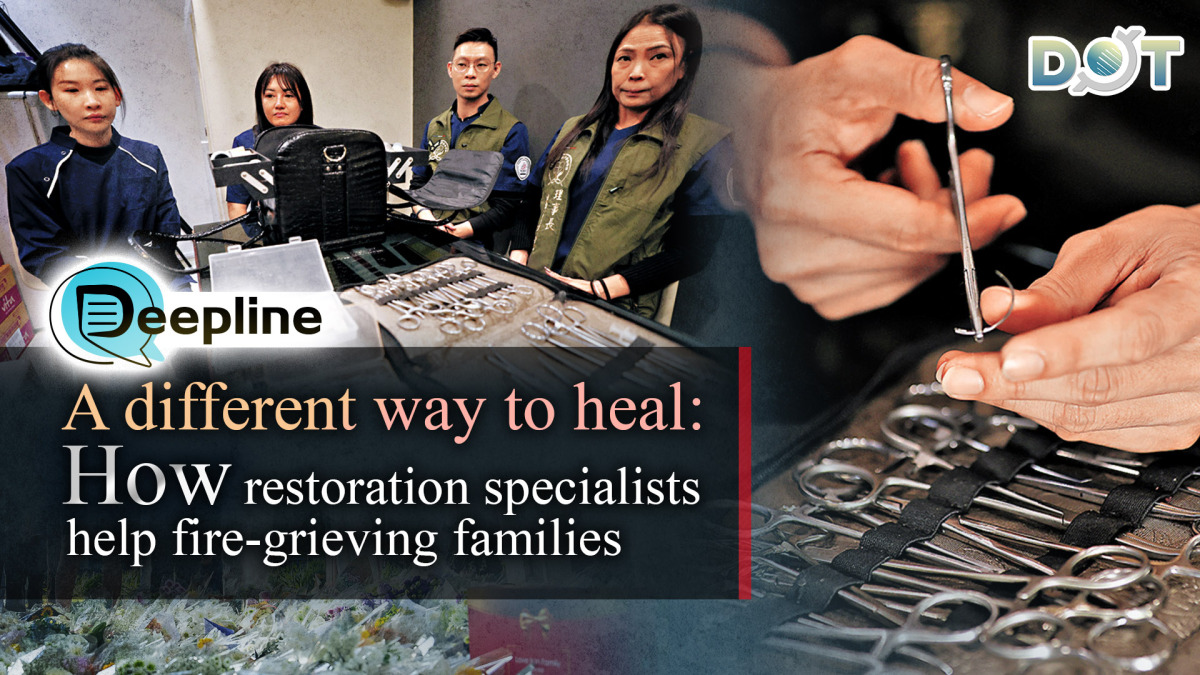
To alleviate the regrets of the families affected by the devastating fire at Wang Fuk Court in Tai Po, Hong Kong's funeral services industry has collaborated with volunteer body restoration specialists from the Charity Restorers Association (NCRA) in Taiwan, who have come to Hong Kong to provide free restoration services for the victims' remains.
The fire claimed 160 lives, leaving countless families in unspeakable grief. As the flames severely damaged loved ones, the survivors find themselves burdened with the question of how to bid a proper farewell.
In an exclusive interview with Wen Wei Po, several members of the association shared that each specialist contributes their expertise, using materials such as silicone to reconstruct missing parts of the remains "from scratch" or restore damaged areas to their original state. To date, they have completed the restoration of one victim from the Wang Fuk Court tragedy.
The NCRA primarily focuses on providing body restoration services in the aftermath of large-scale disasters. The desire to contribute to society with their professional skills drives its members, many of whom come from related professions. Whenever possible, they spare no effort to assist.
A director of the NCRA explained that if most of the body's skin and facial features remain intact after a fire, extensive stitching or filling may not be necessary. However, bodies tend to shrink after a fire, with features like the nose and ears potentially becoming smaller. In such cases, silicone is applied to the skin and carefully shaped using tools like a hairdryer and water to resemble the individual's appearance in photographs as closely as possible.
In cases where limbs or organs are severely missing—such as burned or unrecovered hands—restoration specialists can also use silicone as a substitute. Huang, chairperson of the NCRA, explained that they pre-make replicas of the missing parts and attach them to the remains. Material selection takes into account subsequent arrangements. "In Taiwan, most remains are cremated, so we ensure the materials are fully combustible and will not leave residue that could affect the ashes," she said.
She added that since Hong Kong's primary burial methods include cremation and interment, materials like silicone are suitable for both.
Furthermore, some families of the victims believe their loved ones' remains have been reduced to ashes and cannot be recovered. However, Huang noted that even if only scattered bones remain, if the family wishes for a complete form for a final viewing, they will do their utmost to fulfill this request. Such cases are undoubtedly more challenging, as features like fingers and toes must be meticulously recreated, requiring more time.
She also admitted that while body restoration aims to achieve as much completeness as possible, it cannot achieve 100% accuracy. Still, a resemblance of 70-80% can often be achieved.
Regarding the application of 3D printing technology in recent years, a Hong Kong veteran funeral planner mentioned that the technology is currently "more commonly used for facial restoration" in mainland China. In essence, it resembles a "mask" placed over the remains, which may appear unnatural and differ little from simply placing a photograph.
He emphasized that, regardless of the technology used, the core purpose of body restoration is to suture, clean, and disinfect wounds caused by accidents, allowing the deceased to bid a dignified farewell to their families. When asked whether Hong Kong should develop its body restoration capabilities, he acknowledged that if the public can accept it, it is indeed a worthwhile endeavor. After all, many families are unable to see their loved ones one last time before they pass away, which is "deeply regrettable."
Additionally, body restoration is not merely a technical task but also a form of respect for the deceased. It aims to ensure the departed are dressed neatly and pass away with dignity in the presence of their families. The funeral planner believes that local society still has limited awareness of body restoration, and promoting related services faces many challenges.
The planner once handled a particularly challenging case where the remains were from a non-natural death and had to be stored in a public mortuary. Funeral service providers repeatedly faced refusals when attempting to assess the condition beforehand. However, body restoration requires significant time, and the difficulty lies in the tight schedule.
"If the wake is on the 14th and the funeral on the 15th, we need to retrieve the remains on the 14th, assess the condition immediately, and begin restoration. In one case, the damage was so severe that the process took an exceptionally long time," he recalled.
In contrast, in Taiwan, remains are often stored in privately operated funeral homes, making communication between families and funeral homes more convenient. Restoration specialists can also assess the remains earlier, allowing for better planning of the restoration process.
The planner hopes that the SAR government can adopt special measures to allow industry professionals to assess remains in advance, ensuring smoother restoration work and providing closure for the bereaved.
(Source: Wen Wei Po; Journalist: Lee Tsz-shan; English Editor: Darius)
Related News:
(Photos) Memorial night for Wang Fuk Court fire victims: Relatives of missing seek assistance onsite




Comment