






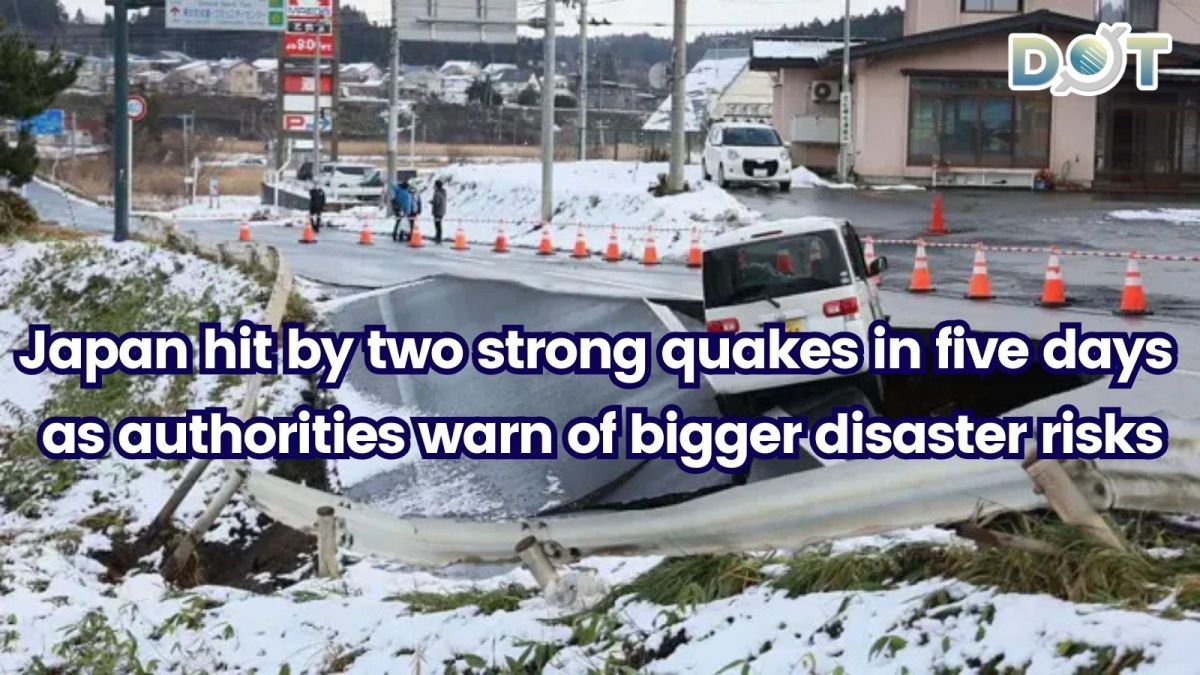
Japan has been shaken by two powerful earthquakes within just five days, prompting authorities to issue warnings of a potential larger earthquake in the near future.
On December 8, a magnitude 7.5 earthquake struck off the eastern coast of Aomori Prefecture. Then, on December 12 at 11:44 a.m. local time, another magnitude 6.9 quake followed in the same region. The Japan Meteorological Agency (JMA) initially recorded the December 12 quake as 6.7 magnitude at a depth of 20 km but later revised it to 6.9 magnitude and 17 km depth.
Tsunami advisories were issued for coastal areas along the Pacific Ocean in Aomori, Hokkaido, Iwate, and Miyagi, with tsunami waves of up to 20 cm observed. As of now, no casualties have been reported, and nuclear facilities in Aomori and Miyagi remain unaffected.
The JMA has urged residents to stay alert, emphasizing that seismic activity in the region has increased significantly since the December 8 quake. On the evening of December 12, a separate magnitude 4.9 quake was also recorded in southern Ibaraki Prefecture, with noticeable shaking in Tokyo. This event did not trigger a tsunami warning.
In response to the heightened seismic activity, Japanese authorities on December 9 issued a rare "Seismic Activity Advisory" for the Hokkaido–Sanriku coastal area, warning of an increased risk of a magnitude 8 or greater earthquake within the coming week. A JMA official stated that the December 12 quake was not the anticipated follow-up quake, and the advisory remains in effect.
Chinese nationals in Japan have expressed concern. A Chinese student in Tokyo told reporters she felt severe shaking while on a call with her family and immediately took cover under a table. "This was the strongest tremor I've felt since arriving in Japan," she said. Many students are reportedly anxious and hoping to return home once their studies conclude.
China's Ministry of Foreign Affairs and its embassy in Japan have advised Chinese citizens to avoid travel to Japan during this period and to stay informed about local disaster alerts. Citizens are urged to follow official evacuation instructions, stay away from coastal areas, and prioritize personal safety.
NHK reports that northern Japan, including Aomori and Hokkaido, is also experiencing heavy snow and strong winds. Experts warn that winter evacuations can take longer due to icy stairs and snow-covered routes. Residents are advised to familiarize themselves with evacuation routes and keep emergency kits near their doorways for quick access.
Related News:




Comment