






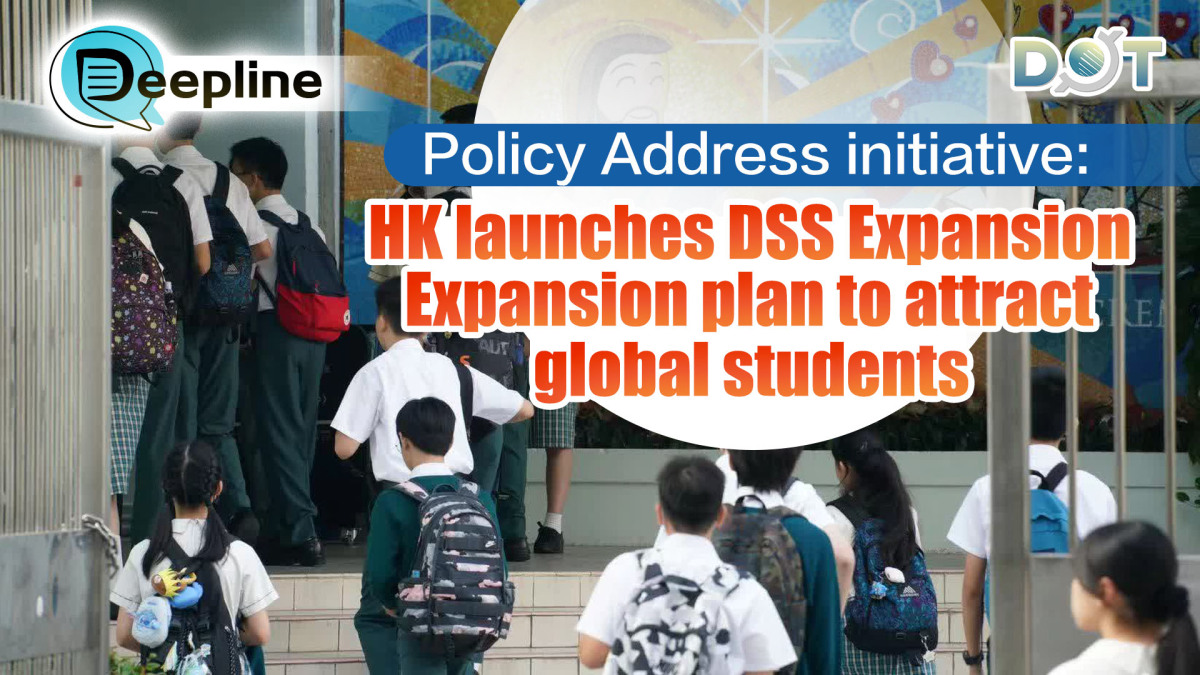
To further extend the development of Hong Kong into an international education hub to the basic education sector, Chief Executive John Lee proposed in his Policy Address to allow Direct Subsidy Scheme (DSS) schools, on a trial basis, to apply to increase the number and size of classes, enabling them to expand their intake of non-local students with student visas or entry permits to study in a self-financing mode.
The Education Bureau (EDB) wrote to all DSS schools in Hong Kong yesterday, inviting DSS schools with sufficient resources and conditions to apply for the DSS Expansion, to be implemented in the 2026/27 school year. Under the scheme, the maximum class size for participating DSS secondary and primary schools may increase by up to four students compared to the current limits, and the cap on the proportion of students enrolled in non-local curricula may be raised to 49%.
The EDB emphasized that the DSS Expansion provides additional school places and will not affect the opportunities for local students to enroll in their preferred DSS schools. Instead, it will help local students deepen their understanding of different customs, cultures, and geographical environments; broaden their international perspectives; enrich cross-cultural understanding; and increase opportunities for cross-cultural exchange, thereby promoting cultural integration and enhancing the learning experiences of all students. Furthermore, the bureau will advance the plan in a "step-by-step" manner and promote study in Hong Kong.
Regarding the details and application procedures of the DSS Expansion, the EDB stated in the letter that DSS schools may apply to increase class size or add classes in the new school year to admit more non-local students. Currently, the maximum class sizes for DSS secondary and primary schools are 41 and 33 students, respectively. Schools may raise the limits to 45 and 37 students, respectively, if they apply to increase the maximum class size. If schools opt to apply for additional classes, the class size will remain unchanged. Additionally, DSS schools under the scheme may adjust the proportion of students enrolled in non-local curricula (such as the International Baccalaureate, GCE/GCSE, etc.) to a maximum of 49% of the total student population in the 2026/27 school year. They may also apply to transfer more than 10% of tuition fee income into reserves for purposes such as construction projects, maintenance, and facility upgrades.
The letter reminded schools to self-assess their readiness and capabilities before submitting applications, including whether resources and conditions are sufficient to ensure that educational standards are not compromised due to expansion. DSS schools with boarding facilities must also reserve at least 50% of their boarding places for non-local students holding student visas/entry permits. The application deadline is Jan. 16 next year, and results are generally announced within three months after the deadline.
Non-local students holding student visas/entry permits may choose to self-finance their studies in either local Diploma of Secondary Education (DSE) or non-local curricula offered by DSS schools under the scheme. Without government subsidies, their annual tuition fees are approximately HK$80,000 to HK$90,000 higher than those for local students.
Ida Lee, Deputy Secretary for Education, wrote in an EDB blog post yesterday (Dec. 11) that there are currently 78 DSS schools in Hong Kong. Among the 57 DSS secondary schools, 26 offer international curricula at the Secondary 5 and 6 levels. For example, according to available information, Creative Secondary School will offer four tuition fee options in 2025. For local students, the fees for Secondary 5 DSE and International Baccalaureate programs are HK$106,255 and HK$153,770, respectively, while for non-local students, the fees for the same programs are HK$196,041 and HK$243,556, respectively.
She noted that, on the one hand, international curricula are attractive to non-local students interested in studying such programs in Hong Kong. On the other hand, with Hong Kong's "biliterate and trilingual" policy in primary and secondary education, non-local students can also choose to study local curricula in DSS schools. Through studying various learning areas, they can build a solid foundation. Leveraging Hong Kong's unique geographical advantage and connectivity with mainland cities, they can participate in study tours, visits, and exchanges with mainland students to deepen their understanding of China's history, culture, and development. This helps cultivate a perspective and cultural literacy that blends Eastern and Western elements. They can also use DSE results to apply to local tertiary institutions, as well as over 1,100 universities worldwide and 165 higher education institutions in the Mainland.
Lee mentioned that the bureau is pleased to note that many DSS schools have expressed a positive attitude toward the DSS Expansion and are willing to contribute to Hong Kong's development as an international education hub.
"The EDB will maintain close contact and collaboration with DSS schools in the future, such as by participating in global education exhibitions and organizing duty visits to promote the scheme. We will also work with the Hong Kong Talent Engage and overseas Economic and Trade Offices to introduce the city's high-quality, diverse, and internationally recognized basic education to overseas parents, as well as promote its advantages as an international city that blends Eastern and Western cultures."
She emphasized that the DSS Expansion is the first step in extending the development of the international education hub to the basic education sector. The EDB will implement the plan gradually on a pilot basis and review future development directions promptly, enabling different sectors of the education community to participate in advancing the construction of the international education hub and contributing to the high-quality development of Hong Kong's education.
(Source: Wen Wei Po; Journalist: Keung Kar-hin; English Editor: Darius)
Related News:




Comment