






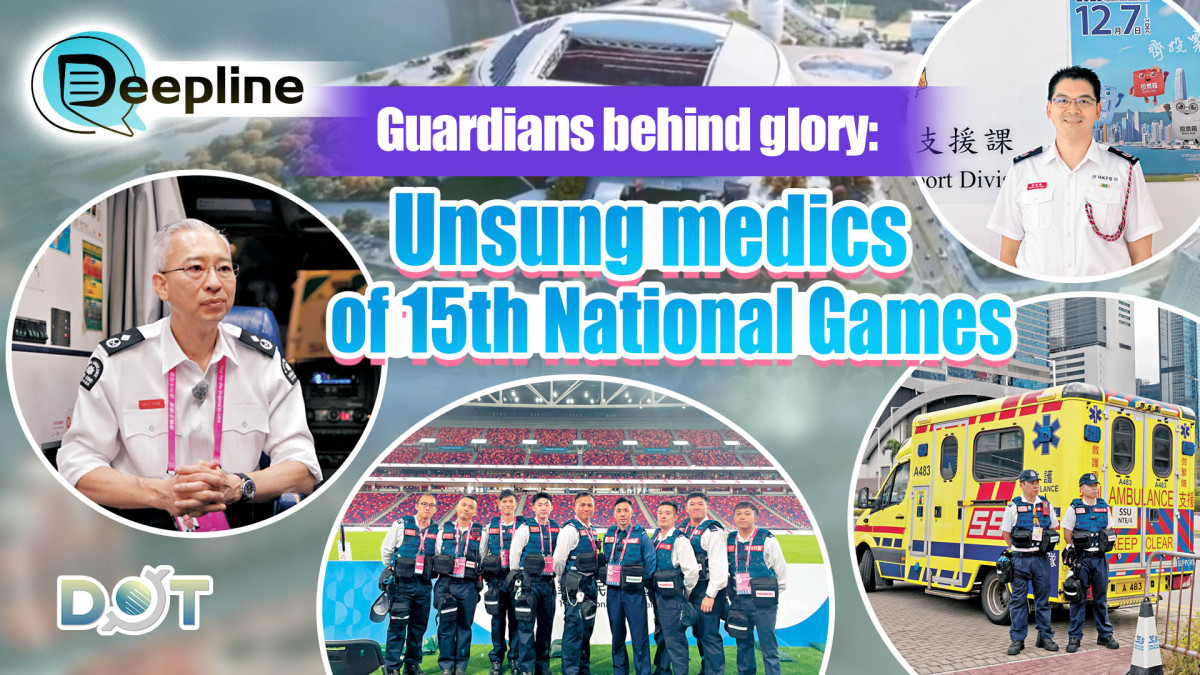
The 15th National Games concluded successfully. While the athletes' tenacity on the field was deeply moving, behind the scenes, a life-safety net woven by over a thousand paramedical personnel was also silently unfolding a story of "guardianship." Several frontline colleagues and senior officials from the Fire Services Department (FSD) and the Hong Kong St. John Ambulance Brigade recently gave an exclusive interview to Wen Wei Po, sharing their stories of safeguarding the Games from both on and off the field.
Up to now, covering events including test matches, the St. John Ambulance Brigade dispatched over 1,500 volunteers for the entire National Games. The FSD's special support team deployed nearly 400 personnel, cumulatively handling 390 cases.
Assistant Chief Ambulance Officer (National Games Support) of the FSD, Cheng Tsz-wing, stated that the department attached great importance to this national-level task, having established a "National Games support unit" as early as April last year for coordination. To ensure the Games' medical support system could simultaneously address different needs, various ambulance forces had specific divisions of responsibility. Among them, the FSD and the Hospital Authority were primarily responsible for treating athletes, while the St. John Ambulance Brigade and the Auxiliary Medical Service were mainly responsible for addressing spectators' medical needs.
He emphasized, "Although the primary duties differ, in emergencies, everyone works together without distinction, prioritizing the treatment of the injured."
Cheng explained that the FSD formed a nearly 200-strong special support team for the National Games, composed of personnel selected by various district commanders and flexibly deployed according to the characteristics of different events. Taking the Kai Tak Sports Park main stadium as an example, three "competition response teams" and three "rapid response teams" were deployed inside the venue. The "competition response teams" were stationed at medical posts beside the competition areas, specifically responsible for handling athletes' emergency injuries or illnesses. The "rapid response teams" primarily responded to sudden critical incidents in the spectator stands, such as spectator cardiac arrest or urgent medication needs. This deployment model constructed a comprehensive, seamless medical safety protection network covering both the field of play and the spectators.
For high-risk events like Rugby Sevens, the FSD further deepened specialized training, selecting nine team members to complete certification courses recognized by the Hong Kong Rugby Union. The training included skills such as spinal immobilization, head trauma management, and joint reduction, aiming to buy precious time for athletes. Cheng revealed that as of Nov. 20, during the test match period, the FSD's special support team handled 106 cases, and during the official competition period, they handled 284 cases. Among these, 244 involved athletes, with 44 cases involving more serious injuries requiring hospital transfer.
"The peak was on Nov. 15, with six events competing on the same day. We mobilized 43 ambulances within that single day, but all were additional resources and did not affect daily ambulance services," Cheng said. "To avoid impacting daily operations, we collaborated with the Electrical and Mechanical Services Department to arrange advanced maintenance for some vehicles and allocate reserve vehicles. We also coordinated across different stations to ensure every vehicle was fully equipped."
On the other end of the command chain was the selfless dedication of frontline personnel. Paul Lam Yuk-yee, Senior Assistant Commissioner (Operations) of the Hong Kong St. John Ambulance Brigade, stated that preparations for the National Games began early in 2024. Key tasks included providing medical services for athletes and others at hotels. The Ambulance Brigade cumulatively dispatched over 1,500 volunteers, many of whom served during their time off work.
"The toughest instance was rushing to a hotel for a 12-hour night shift after finishing my regular job, then going home to shower before taking on another shift," recalled a senior ambulance officer of the Ambulance Brigade. Despite this, she considered the opportunity rare and did not find the struggle for a common goal tiring. This dedication also received positive feedback.
Lam revealed that after the test matches, they received praise from teams from multiple provinces and cities. Furthermore, recent public inquiries and applications to join the Brigade had increased significantly: "Actually, we were all pleased participating in this service because it allowed more of the public to learn about the Ambulance Brigade. Our members also strengthened their sense of national identity through this duty. We have recently received many public inquiries and applications to join, greatly enhancing the image of the Ambulance Brigade."
(Source: Wen Wei Po; Journalist: Hu Tiantian, Lin Yongjun; English Editor: Darius)
Related News:
(Watch This) National Games | Changgu Dance performed at closing ceremony
Deepline | Giving paper limitless vitality: Art and soul of Joe Wong




Comment