






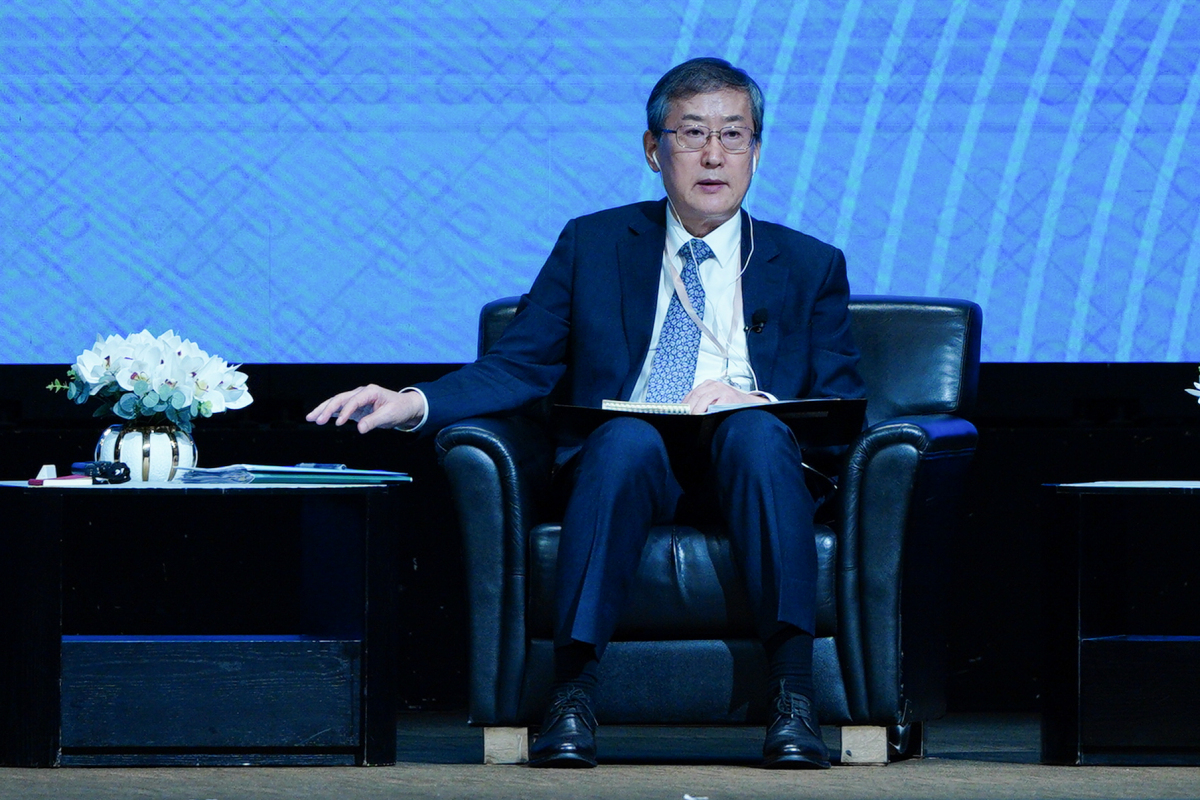
To promote public understanding of the constitutional foundations of the nation and the Hong Kong Special Administrative Region (HKSAR), the HKSAR Government, in collaboration with the Liaison Office of the Central People's Government in Hong Kong, held a symposium on Constitution Day on Dec. 4.
Professor Han Dayuan, a member of the Hong Kong Basic Law Committee and a law professor at Renmin University, gave the keynote speech. He expressed condolences for the victims of the Wang Fuk Court fire, praising the compassion shown by society and encouraging everyone to turn their grief into strength for rebuilding.
Han noted that this day marks the 12th National Constitution Day of the People's Republic of China, establishing a constitutional practice that fosters social consensus, patriotism, constitutional culture, and national identity. Under the theme "The Constitution and the Great Rejuvenation of the Chinese Nation," he discussed the historical context of the Chinese nation, the importance of integrating national rejuvenation into the Constitution, the connection between "one country, two systems" and national revitalization, and ways to achieve this through effective constitutional implementation.
The Concept of the Chinese Nation and the Exploration of Modern Chinese Constitutionalism
Han emphasized that the Preamble of China's Constitution declares China as one of the world's oldest nations, with its diverse ethnic groups contributing to a rich culture. He discussed the historical concept of the Chinese nation, highlighting that fostering national unity, preserving Chinese civilization against challenges, and building a modern state have been common goals throughout history, underscoring the deep historical significance of this concept.
He noted that history shows that in times of national crisis, both constitutional awareness and national consciousness awaken, indicating that the Constitution is vital for nation-building. The development of ideas like national rejuvenation has aligned with early constitutional efforts in China, marking the Chinese people's historical choice to pursue the great rejuvenation of their nation despite internal and external challenges.
Significance of Enshrining the Great Rejuvenation of the Chinese Nation into the Constitution
Han pointed out that the first half of the 20th century saw China undergoing significant revolutions and challenging anti-aggression wars, which forged a strong national character and shaped its identity. In 2018, the Constitution was amended to formally include the "great rejuvenation of the Chinese nation," giving this concept normative authority under the nation's fundamental law.
He emphasized that achieving this rejuvenation also involves the goal of national reunification. The Constitution clearly states that Taiwan is an inseparable part of China's territory, and completing its reunification is a sacred duty for all Chinese, including those in Taiwan. This is both a constitutional aim and a necessary step toward the great rejuvenation. The "14th Five-Year Plan" reaffirms the importance of fostering peaceful cross-strait relations, promoting national reunification, and firmly opposing "Taiwan independence" separatist activities.
One Country, Two Systems and the Great Rejuvenation of the Chinese Nation
Han remarked that "one country, two systems" has entered a new stage of development. He emphasized the importance of situating this framework within the broader goal of the great rejuvenation of the Chinese nation. Understanding the values of peace, inclusiveness, openness, and integration within "one country, two systems" requires a constitutional perspective on advancing Chinese modernization. He noted that this concept is not only a Chinese innovation but also a significant contribution to global civilization.
In conclusion, Han stated that the Constitution serves as a record of a nation's historical memory and an institutional framework for human life. National Constitution Day is more than just a ceremony; it reflects societal consensus on values, aspirations for the future, and the pursuit of a better life. He urged the promotion of the great spirit of the Chinese nation and the consolidation of social consensus through the Constitution to foster Hong Kong's prosperity and stability with a broader vision and principles.
(Reporter: Chen Zimeng | Editor: Liu Yu)
Related News:
CPC plenum concludes, adopting recommendations for China's 15th Five-Year Plan




Comment