






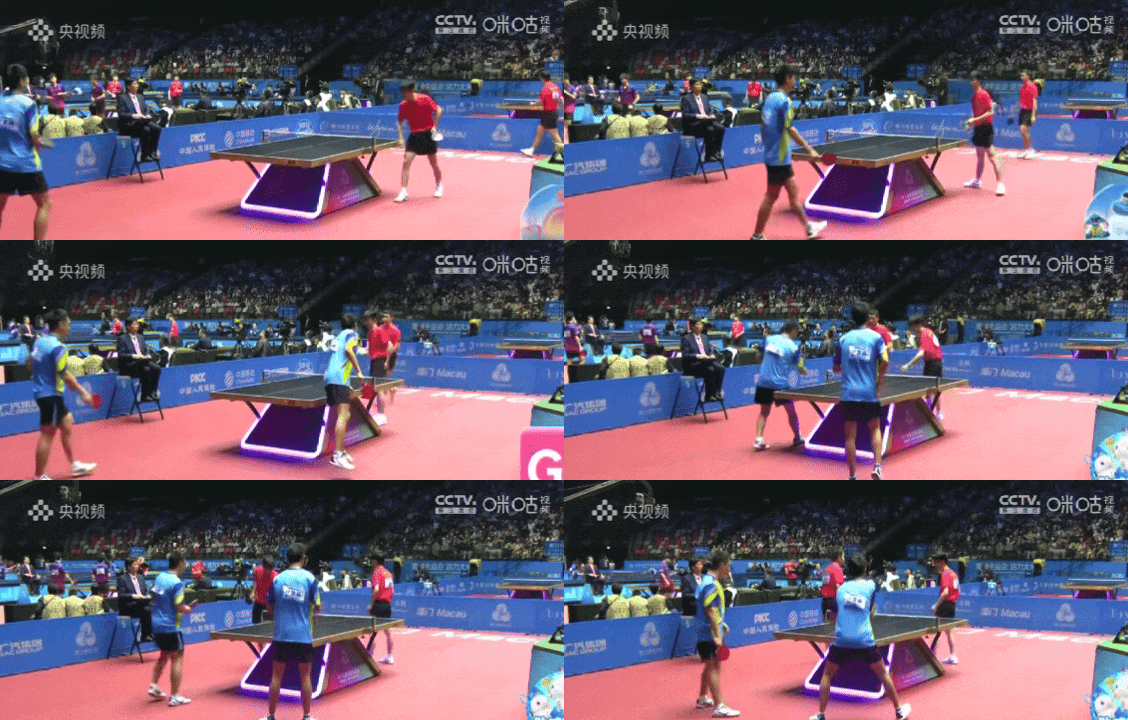
In the recently concluded 15th National Games, table tennis competitions sparked immense public interest. This premier national event, jointly hosted by Guangdong, Hong Kong, and Macao for the first time, brought together numerous beloved Olympic champions and rising stars. Whether veteran players or newcomers, all left fans deeply captivated.
Some observant fans noticed a peculiar behavior: many table tennis players tend to touch the table before serving, especially wiping near the area close to the net. Is this some sort of mysterious superstition or a secret winning strategy?
In fact, the reason players touch the table is to wipe off sweat. Some may wonder: why wipe sweat on the table instead of using a towel? The answer lies in the sport's rules.
According to table tennis regulations, players are only allowed to use towels to wipe sweat during specific moments: after every six points and during side switches in the deciding game. This rule is meant to maintain the continuity of the match. For example, players are not allowed to use towels when the score is 2-3, but they can when it reaches 2-4 or 3-3. At other times, players may resort to using their hands to wipe away sweat.
During a match, it is strictly prohibited to suddenly grab a towel to wipe sweat between rallies, while picking up the ball, or preparing to serve, as this would be considered a delay of play. Furthermore, players are only allowed to wipe sweat in designated areas, usually at the table ends or behind the barriers where their towels are placed.
Additionally, players cannot intentionally alter the playing conditions while wiping sweat. If sweat drips on the table, it must be immediately wiped dry with a towel, but players cannot use this as an opportunity to stall the game.
From a physics standpoint, the trajectory of a table tennis ball involves parameters like position, velocity, angular velocity, and so on. The collision between the ball and the table or racket depends on factors such as the ball's incoming velocity, spin rate, the table's friction coefficient, and vertical rebound parameters. Even a tiny amount of sweat can negatively affect the ball's behavior. The area close to the net typically has less influence on the ball's bounce or trajectory, which is why players often choose to "wipe" there.
When the ball contacts the table or the racket, friction and elasticity play a decisive role in the rebound process. Furthermore, the table's performance characteristics significantly impact the match. Experienced players can assess the table's material, condition, and performance through touch, which helps them formulate strategies.
For instance, high-bounce tables can increase the ball's rebound height by 20-30%, offering offensive players more space to generate powerful shots. Such tables are ideal for deploying strategies that use placement to manipulate opponents and exploit rebound height for precise attacks. On the other hand, tables with higher surface friction prolong the ball's sliding distance, creating an optimal platform for spin-based tactics. Players can use strong spins to force errors from their opponents.
According to relevant standards, a table tennis ball dropped from a height of 300 millimeters should rebound to a height between 230 and 260 millimeters. These standards ensure stable ball speed and bounce. Insufficient elasticity leads to lower rebounds, hindering offensive play, while excessive elasticity produces higher rebounds, disrupting the game's rhythm. Proper elasticity ensures fairness and smooth gameplay.
Moreover, the act of touching or wiping the table also serves as a form of "invisible psychological strategy" during matches. It is a common behavioral pattern for players to reestablish their rhythm. When matches reach critical moments, players may experience increased heart rates and nervousness, leading to fluctuations in performance. The instinctive act of touching the table, akin to taking a deep breath, helps calm their nerves, rediscover their focus, and regain control of the game's rhythm. Essentially, it is a psychological self-adjustment mechanism.
In summary, sweat on the racket or table can undoubtedly affect equipment performance, disrupt a player's feel for the ball, and ultimately impact their results. Therefore, while players must wipe sweat, they are constrained by the rules and cannot do so freely, making it convenient to "wipe" the table as a quick alternative. At the same time, this action provides a psychological advantage, helping players adjust their state of mind and strive for better performance.
(Source: CNS)
Related News:
(Watch This) 15th National Games | Sun Yingsha reflects on winning silver: 'It's all growth'




Comment