






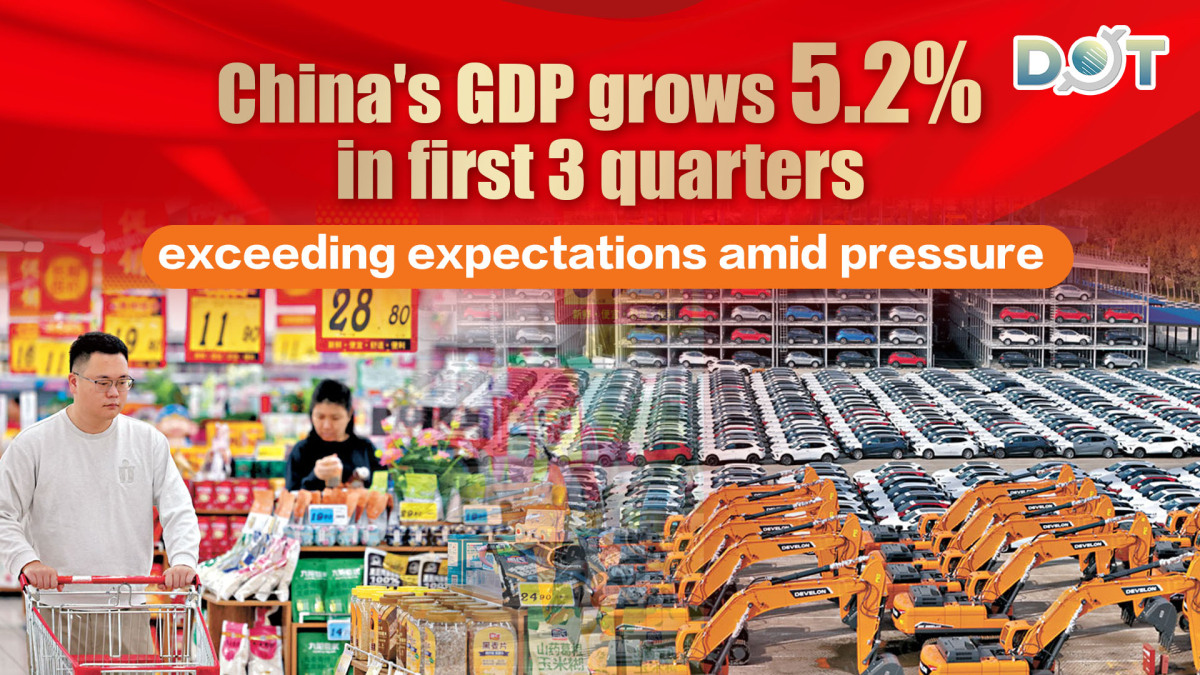
China's gross domestic product (GDP) reached RMB 101.5036 trillion in the first three quarters of 2025, a year-on-year increase of 5.2%, the National Bureau of Statistics (NBS) announced on Oct. 20.
Foreign trade delivered a strong performance, with total goods import and export value hitting RMB 33.61 trillion, up 4% year-on-year, setting a new historical record for the same period. Consumption also remained robust, with final consumption expenditure contributing 53.5% to economic growth, continuing to serve as the primary engine of economic expansion.
Despite a complex and evolving external environment and numerous economic pressures, the NBS spokesperson emphasized that the fundamental trends of stability, progress, and resilience in China's economy remain unchanged, supported by a solid foundation for sustained and stable development.
The spokesperson evaluated the first three quarters' data with "three unchanged" factors: the main foundation of stable economic operation remains unchanged; the momentum of solid high-quality development advancement remains unchanged; and the fundamental characteristics of strong economic resilience and vast potential remain unchanged. Economically, the GDP growth rate of 5.2% in the first three quarters accelerated by 0.2 and 0.4 percentage points compared to the full year and the same period last year, respectively, with an economic increment of RMB 3.9679 trillion, an increase of RMB 136.8 billion year-on-year.
"New Three" Exports See Double-Digit Growth
Against the backdrop of insufficient global economic growth momentum, prevalent trade protectionism, frequent geopolitical conflicts, and international trade frictions, China's 5.2% growth fully demonstrates its ability to navigate instability and uncertainty, alongside strong resilience under pressure. Globally, China remains the most stable and reliable source of growth power. The long-term stable development of China's economy is underpinned by a profound internal logic, resulting from the synergistic interaction and systematic integration of various factors such as institutional advantages, supply advantages, demand advantages, and talent advantages.
In terms of international balance of payments, foreign trade exhibited strong resilience, with the scale of goods import and export reaching a record high for the same period and growth rates increasing quarter by quarter. By the end of September, foreign exchange reserves remained above US$3.3 trillion, and the RMB exchange rate stabilized with an appreciating trend. Additionally, diversified markets became a strong support for export growth, and new foreign trade drivers expanded, with "new three" products achieving double-digit export growth.
Over 30,000 Daily Applications for Vehicle Replacements
Consumption performance was also notable. In the first three quarters, total retail sales of consumer goods reached 36.5877 trillion yuan, a year-on-year increase of 4.5%, while service retail sales grew by 5.2% year-on-year.
The spokesperson mentioned that this year, RMB 300 billion in ultra-long-term special government bonds were allocated in four batches to local governments to support and expand the scope of consumer goods replacement programs. In the first three quarters, final consumption expenditure contributed 53.5% to economic growth, an increase of 9.0 percentage points from the full previous year, continuing to act as the main engine of economic growth. Retail sales of categories involved in the replacement policy, including household appliances and audio-video equipment, cultural and office supplies, furniture, and communication equipment under above-designated-size enterprises, all maintained double-digit growth. As of Sept. 10, applications for automobile replacements nationwide this year exceeded 8.3 million, equivalent to over 30,000 daily applications for new vehicles.
Furthermore, in the first three quarters, the value-added of large-scale lithium-ion battery manufacturing increased by 29.8% year-on-year, and new energy vehicle production grew by 29.7%. Data show that during the steady growth of new drivers, the effects of policies focusing on "new types of urbanization and key projects" to expand domestic demand have continuously transmitted to the production side, boosting production in equipment manufacturing, consumer goods manufacturing, and related industries and products. This has also accelerated production expansion and technological iteration in areas such as smart manufacturing, green manufacturing, and digital technology, pressing the "fast-forward button" for industrial structure optimization and the transformation of old and new growth drivers.
Value-Added of High-Tech Manufacturing Up 9.6%
This year, driven by both policy and market forces, China's technological and industrial innovations have shown numerous highlights, with new quality productive forces gradually developing and strengthening in practice, continuously injecting new momentum into high-quality development. According to the latest report released by the World Intellectual Property Organization, China's innovation index entered the global top ten for the first time in 2025, with 24 innovation clusters ranking among the global top 100, maintaining the highest number for three consecutive years.
The spokesperson stated that all sectors have continued to increase innovation investment this year, promoting investment and production expansion in emerging fields and facilitating the formation of new quality productive forces. In the first three quarters, investment in automobile manufacturing and railway, ship, aerospace, and other transport equipment manufacturing maintained double-digit year-on-year growth. Driven by continuous increases in innovation investment, several general-purpose large models reaching international advanced levels have emerged domestically, the Tianwen-2 mission was successfully launched, the world's first in-situ variable-diameter shield machine "Variable Diameter No. 1" rolled off the production line, and breakthroughs were achieved in numerous technological fields.
Additionally, the integration of technology and industry innovation continues to deepen, with more innovative results moving from the "laboratory" to the "production line," continuously transforming innovation "potential energy" into economic "kinetic energy." In the first three quarters, the value-added of large-scale high-tech manufacturing increased by 9.6% year-on-year.
Smart UAV Manufacturing Soars 59.9%
"This year, forward-looking layouts in cutting-edge technologies such as artificial intelligence and brain-computer interfaces have brought many surprises with a sense of technology and futurism, driving rapid growth in the digital economy," the spokesperson said. In the first three quarters, the value-added of large-scale digital product manufacturing increased by 9.7% year-on-year, while the value-added of information transmission, software, and information technology services grew by 11.2%. In large-scale high-tech manufacturing, the value-added of smart unmanned aerial vehicle manufacturing and smart vehicle equipment manufacturing increased by 59.9% and 25.1%, respectively.
Against the backdrop of China's vigorous development of clean energy and efforts to build new growth points for green development, large-scale wind and solar power generation achieved double-digit year-on-year growth in the first three quarters.
The spokesperson emphasized that facing international changes, China responds to the uncertainties of a rapidly changing external environment with the certainty of high-quality development. This year, all regions have developed new quality productive forces according to local conditions, promoting continuous optimization of the economic structure and orderly transformation of old and new growth drivers. From AI large models to robot marathons, from aerospace to unmanned driving, the deep integration of "innovation chain + industrial chain," along with sustained scale effects and full industrial chain advantages, continuously injects vitality into economic development.
Related News:
Guangdong issues 3 types of bonds in HK, totaling RMB 7.5 bn




Comment