






The closure of Hong Kong's long-established bakery, Taipan, in June this year has sounded an alarm for the bread and catering industries, urging them to seek change, innovation, and survival. A Wen Wei Po reporter witnessed Hong Kong businesses thinking on their feet in the face of adversity. Some century-old bakeries have remained faithful to their origins, preserving traditional flavors by adhering to handmade production processes while also integrating social media for modern marketing. Others, like natural yeast bread shops, have introduced experiential classes, making bread not only delicious but also fun.
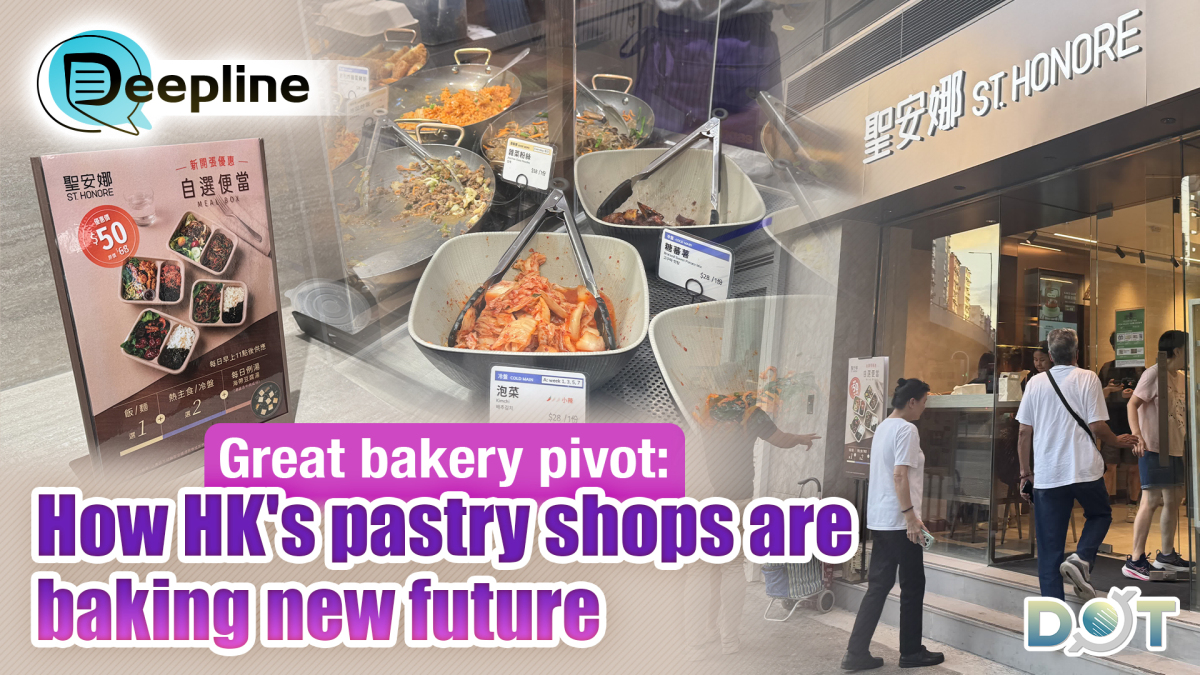
Even more strikingly, Saint Honore Cake Shop, a chain bakery established in Hong Kong over 50 years ago, has recently pivoted to enter the "two-dish rice" market. Its newly opened branch in Prince Edward offers high-end Korean-style two-dish rice meals, available daily from 11 a.m. Customers can choose rice or noodles as their staple, with dishes such as breaded chicken and pork cutlet and kimchi pancakes, accompanied by seaweed tofu soup. The shop also provides dine-in seating, offering customers a new culinary experience.
The new Saint Honore branch is located in OfficePlus @Prince Edward. In addition to selling bread and pastries, it has newly installed a two-dish rice counter. It is understood that the dishes offered include breaded chicken and pork cutlet, kimchi pancakes, kimchi fried rice, sweet and spicy pork, sauce-fried chicken pieces, pan-fried pork dumplings, and pumpkin pancakes. The opening promotion price is HK$50 for two dishes with rice or noodles, along with a daily soup, though it is unclear how long the promotion will last. Besides the two-dish rice meal, customers can also opt to purchase side dishes alone, with pan-fried pork dumplings, sauce-fried chicken pieces, and kimchi pancakes all priced at HK$38 for three pieces.
The shop is equipped with tables and chairs for dine-in. During an evening visit, a Wen Wei Po reporter observed five to six tables and chairs near the wall for customers to dine in.
Wait and see
However, based on observations, most customers were primarily there to purchase pastries. Many entered out of curiosity after seeing the shop's two-dish rice advertisements, while some only took photos with their phones outside.
Ms. Lee, a resident, mentioned that she rarely visits the bakery to buy pastries but acknowledged the pivot: "It's good! They know how to adapt." Compared to the HK$30-plus price for two-dish rice at other eateries, she found the HK$50 price at Saint Honore relatively expensive and admitted, "I'll only buy it if it suits my taste. Although I went in to check it out, I didn't think it suited... It felt average, so I'll hold off for now.
Some residents made a special trip to visit. Ms. Wong stated, "I came to take a look and try it out purely out of curiosity because I'm not sure if it's any good." She noted that if a small eatery suddenly pivoted, it wouldn't be surprising, but for a large company like Saint Honore to unexpectedly start selling two-dish rice, "I'm not even sure if they have their own kitchen." After trying the food, she said the taste was acceptable but found the price slightly high and the dish selection limited.
Saint Honore Cake Shop opened its first branch in Happy Valley, Hong Kong Island, in 1972. It offers a variety of bread, cakes, and pastries, with its oval-shaped egg tarts being a signature product. Currently, it has 110 branches across Hong Kong.
Journalist's View | Flexible thinking: How is the catering industry adapting to adversity?
By Darius
Although an old saying goes, "Food is the paramount necessity of the people," unexpected circumstances can still leave the catering industry scrambling.
Without delving too far into the past, let's consider the recent COVID-19 pandemic. As everyone knows, nothing could make McDonald's close during the day—except for COVID-19. When I saw an elderly woman during the pandemic staring incredulously at the closure notice on the door of a shuttered McDonald's in Tai Wai, her disbelief was both amusing and heartbreaking.
"This is the first time it's closed in ten years!"
But the reality was that McDonald's was even more helpless; the pandemic destroyed the possibility of dine-in, and infected employees brought entire restaurants to a complete halt. As a 24-hour operation, McDonald's did everything it could. Barring unexpected circumstances, McDonald's was one of the most reliable places to buy food during that period. Its fast service, convenient dining options, and lack of reliance on dine-in allowed it to remain stable and endure until the end.
Then, how did Chinese restaurants adapt?
At the beginning of the pandemic, I was living in Guangzhou. When I went out, I discovered that a restaurant specializing in Chaozhou beef hotpot had started selling breakfast, including but not limited to clay pot porridge and wontons. I joked with the staff: "My man, you know how to make these, too?" The staff member said, "Well...without dine-in, how can a hotpot restaurant operate? We had to switch to items that can be taken away."
I went to another restaurant and found that a Cantonese cuisine establishment had set up a stall at the entrance selling roasted meats, accompanied by sorrowful music playing from a speaker. When I recognized the erhu melody "Er Quan Ying Yue" by Abing, I couldn't help but laugh and cry at the same time: Why so bleak!
If mid-to-low-end catering was struggling, high-end establishments were even worse off. According to statistics from a mainland media outlet, at least one-third of high-end restaurants on Shanghai's Bund closed after the pandemic.
"Large ships are hard to turn around." These high-end restaurants, which heavily rely on dine-in ambiance, conceptual selling, and large capital turnover, found it difficult to change strategies like smaller eateries. Moreover, high-end dining is not a necessity, and the pandemic led to decreased incomes, making these establishments unfortunate pawns on the chessboard.
The challenges facing Hong Kong's bread and catering industry can be glimpsed from the above examples: they lack so-called "user stickiness" and a "fixed audience," meaning reasons for people to choose them among many dining options. Delicious bread is not ubiquitous but also not that uncommon; it is valuable but not indispensable. Saint Honore's adaptation may not necessarily succeed, but it is indeed an attempt to attract new demographics. Enhancing one's importance and finding unique value are key to long-lasting success in the catering industry.
(With input from Wen Wei Po)
Related News:
Deepline | Inclusive tourism vision: HK strengthens halal offerings and global cultural ties




Comment