






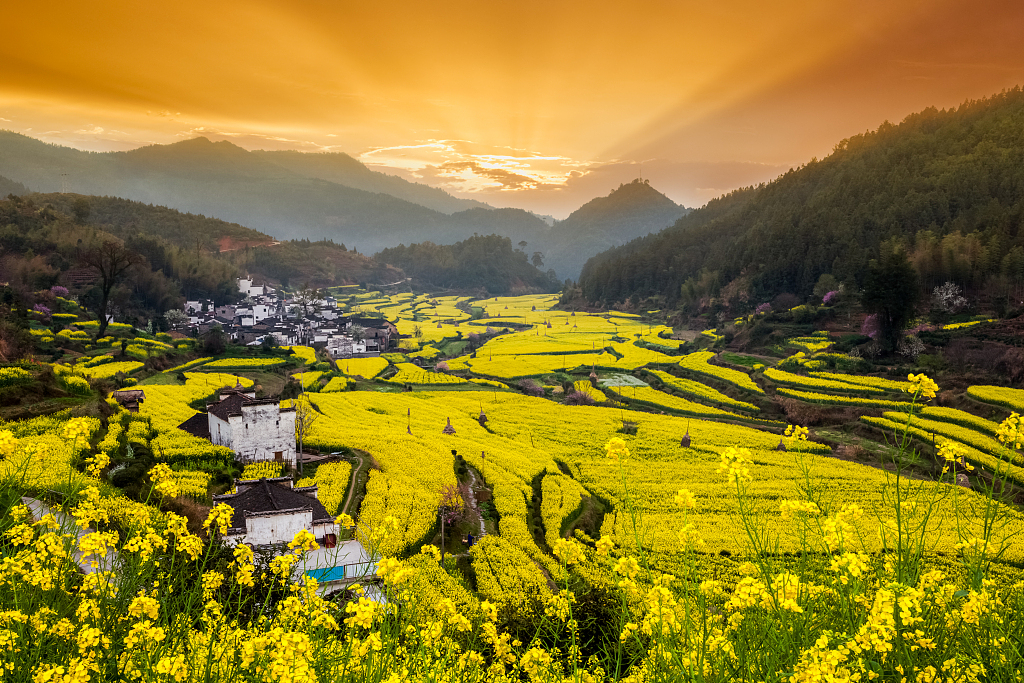
Wuyuan County, dubbed "the most beautiful countryside in China," was established during the Tang Dynasty (618-907) in the city of Shangrao, boasting a history of over 1,000 years.
Wuyuan has preserved its unique characteristics for decades, including its natural environment, traditional lifestyles, old customs, and typical Hui-style buildings, thanks to its distant location.
Hui is short for Huizhou, which is currently in Huangshan City in the province of Anhui and was historically in southeast China. Wuyuan was one of the six counties that made up Huizhou.
One of the main ancient Chinese architectural styles known as "Hui" is characterized by the use of black tiles, white walls, and creative ornamentation made of bricks, stones, and wood.
Extensive carvings that exemplify beauty and splendor can be seen on the beams, windows, pillars, doors, and even the walls of a wealthy residential home.
The ancient village is further enhanced by the spring's sea of blooming rapeseed flowers and endless terraced fields. At that time, a great deal of tourists visit the area to take in the peace and beauty of the terraced fields, lush hills, and karst caves scattered with flowing streams.
The East Line, North Line, and West Line are the three main tour routes.
Beautiful old towns may be found along the East Line, like Jiangling Village and Huangling Village, which provide stunning springtime views of rapeseed flowers.
The Rainbow Bridge and Wolong Valley are visible from Qinghua Town, which is reached by the North Line.
You can have a pot of freshly brewed tea from a local source at the Jinshan Ecological Tea Garden, which is located along the West Line and offers more isolated surroundings.




Comment