






By Felicia
For many Hong Kong people, Central Asia still feels distant—geographically, culturally, and commercially. Yet distance is often a matter of perception rather than reality. With a flight time of roughly six to seven hours from Hong Kong to Kazakhstan, the region is not "far away" in any meaningful business sense. What matters more is whether Hong Kong is prepared to treat Central Asia as a serious partner in the next phase of outward engagement, rather than as an abstract waypoint on an old Silk Road map.
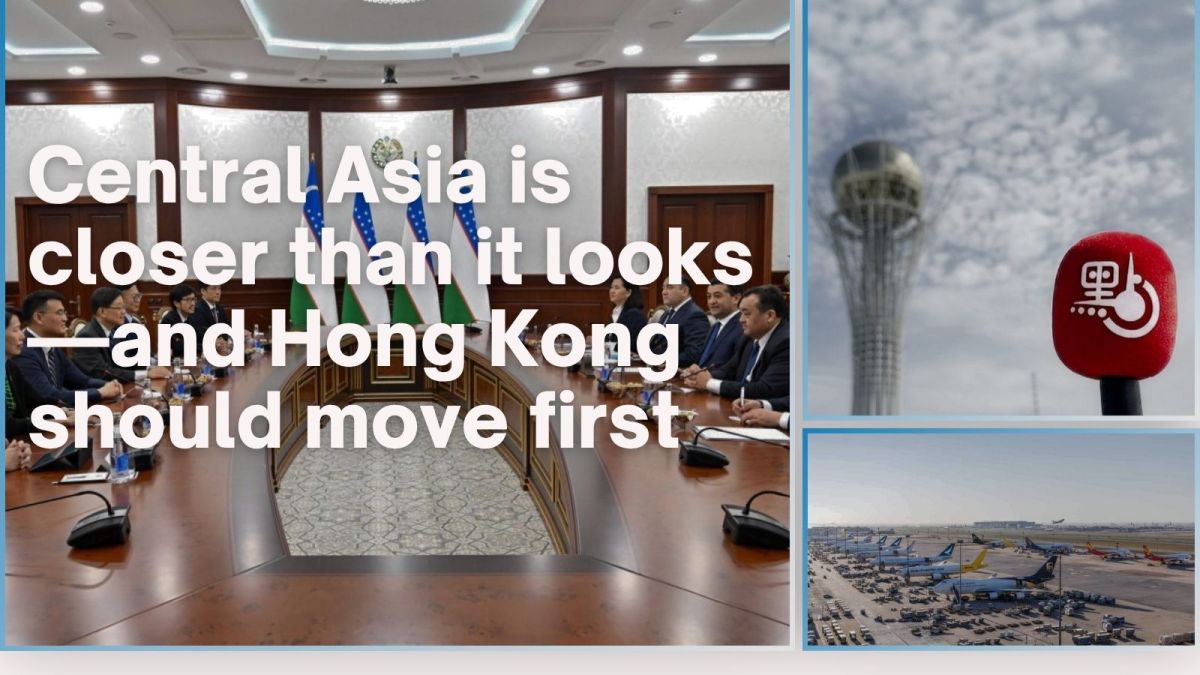
Chief Executive John Lee's visit to Kazakhstan and Uzbekistan, accompanied by a large, cross-sector business delegation, should be seen as more than a high-profile trade mission. It signals a deliberate attempt to reposition Hong Kong at a moment when global supply chains, capital flows, and geopolitical alignments are recalibrating. In such an environment, waiting for opportunities is a losing strategy. The more pragmatic approach is to create them—by showing up early, building institutional links, and translating political goodwill into bankable projects.
From "super-connector" to "super value-adder"
Hong Kong has long described itself as a "super-connector" between the mainland and the world. But the more compelling evolution is from connector to value-adder. Connectivity alone is no longer enough; the question is what Hong Kong can do inside the deal, not only point to it.
This is where Hong Kong's strongest differentiator remains institutional rather than geographical: a mature financial system, internationally recognized professional services, and a legal environment anchored in common law and bilingual practice. These features are not abstract slogans. They are practical tools that reduce transaction costs and uncertainty—especially for cross-border projects involving new markets, unfamiliar regulations, or politically sensitive sectors.
In concrete terms, Hong Kong's "value add" can mean due diligence that meets international expectations, structured financing and listing pathways, cross-border tax planning, compliance support, and credible dispute resolution through arbitration and mediation. For companies from the mainland "going global," these are risk-reduction mechanisms. For Central Asian resource and infrastructure players seeking capital, these are mechanisms that serve as ability multipliers.
The AIFC link shows how institutional compatibility creates momentum
One of the most significant—and often overlooked—highlights is the institutional alignment between Hong Kong and the Astana International Financial Centre (AIFC). Kazakhstan's wider legal system may follow civil law traditions, but the AIFC operates with common-law principles and a dedicated court structure. That kind of institutional compatibility matters because it lowers friction: fewer surprises, clearer enforcement expectations, and a smoother path from negotiation to execution.
Even in markets without a "common-law enclave," the international business community often relies on arbitration clauses and party autonomy to choose governing law and dispute settlement venues. This makes Hong Kong's arbitration and mediation ecosystem strategically relevant beyond any single country. In other words, Hong Kong can remain legally "close" to Central Asia even when geography and legal traditions differ.
"Hard connectivity" and "soft connectivity" must move together
If the legal and financial architecture is the skeleton, mobility is the bloodstream. The push toward a direct Hong Kong–Almaty route—planned for the first quarter of next year—and the reported progress on a mutual visa-free arrangement allowing 30-day stays represent more than travel conveniences. They are the operational prerequisites for sustained business development: site visits, relationship-building, project monitoring, and talent exchange.
This is where policy announcements should translate into measurable outcomes: flight frequency and affordability, streamlined visa processes, and promotion that targets not only tourists but also business, education, and professional communities. Connectivity becomes meaningful when it produces repeat traffic—executives, engineers, students, and investors—not just one-off delegations.
Central Asia doesn't need to be "mysterious" to be strategic
Central Asia's appeal extends beyond history, architecture, and landscapes—though these factors help build people-to-people interest and reduce the psychological distance. The more strategic point is that Central Asia is becoming a region where multiple economic corridors, energy and resource strategies, and emerging consumer markets intersect. For Hong Kong, engaging Central Asia is not a sentimental return to Silk Road imagery; it is a practical bet on new growth space at a time when traditional growth models are under pressure.
The real test: From MoUs to deliverables
Delegations and memoranda of understanding are useful—but only as a beginning. The real benchmark is whether Hong Kong can convert frameworks into deliverables: pilot investments, financing mandates, professional service contracts, dispute-resolution cooperation, and sustained two-way business pipelines.
Hong Kong should prioritize early wins—visible, financially sound, and replicable projects—while creating an ecosystem of institutional partnerships, business matchmaking, and a clear "Hong Kong package" for Central Asian counterparts.
Central Asia is not far. The question is whether Hong Kong is ready to act as if it is close.
Related News:
From trade to culture: Eight major outcomes of John Lee's Central Asia visit




Comment