






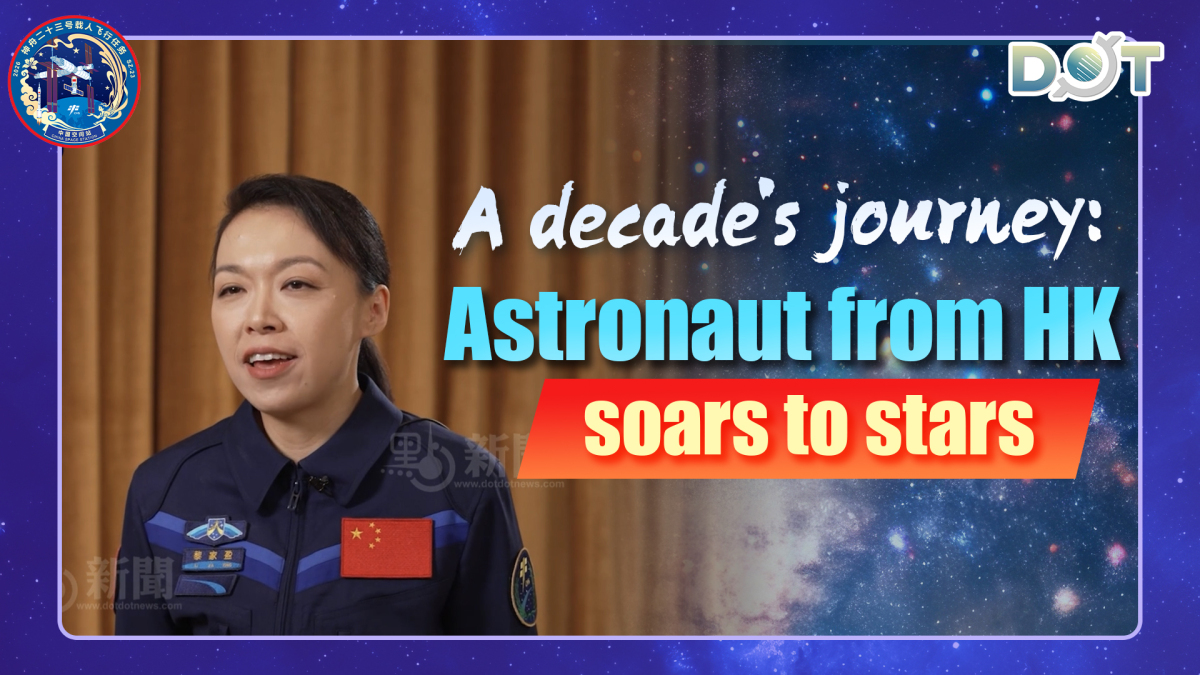
Before the launch of Shenzhou-23, what has drawn the most attention from the outside world is not only the mission itself but also Hong Kong astronaut Lai Ka-ying, who will go into space for the first time aboard Shenzhou-23.
This topic has generated such a strong response not merely because the phrase "Hong Kong-born astronaut" carries symbolic weight, but because it is intrinsically linked to the deepening relationship between Hong Kong and the nation's space development over the past decade. From space experiments designed by Hong Kong students being sent into orbit in 2016, to local research teams participating in the development of key equipment for lunar soil sampling and Mars cameras, and bringing back results from space, Hong Kong's relationship with space has evolved from "observing" to "participating" and finally to "taking on responsibility."
Ten years ago, discussions about space in Hong Kong were largely confined to science outreach and imagination. Before 2016, cross-regional space cooperation was still in its exploratory stages. Although there were initiatives such as a "young space explorers experience camp," visits by space delegations to Hong Kong, and the Polytechnic University's involvement in the Chang'e lunar exploration mission, these were still isolated sparks.
It was not until 2016, when three award-winning experiments designed by Hong Kong secondary school students traveled into space aboard the Shenzhou-11 manned spacecraft and were conducted in orbit by astronauts in the Tiangong-2 space laboratory, that many Hong Kong people truly felt for the first time that elements from Hong Kong could be brought into space.
For the students, it was not just the outcome of a competition, but a highly symbolic awakening: space is not that distant after all, and experiments designed by young people in Hong Kong can become part of the nation's space missions. This step was crucial because space exploration has never been merely an engineering contest; it is also a contest of talent and imagination. If Hong Kong is to enter the space arena, the first step is to convince the younger generation that they have a role to play.
If the student experiments marked the starting point of Hong Kong's close encounter with space, then the deep involvement of research teams signifies the true maturation of this path. The Hong Kong Polytechnic University has participated in the nation's lunar and deep space exploration missions for many years, providing space instruments and technical support for projects such as Chang'e-3 and Chang'e-4. Subsequently, it developed key devices for lunar soil sampling in Chang'e-5 and participated in the development of related equipment for the Tianwen-1 Mars mission.
These efforts are not nominal collaborations, but represent a solid integration of Hong Kong's research capabilities into the nation's major space engineering projects. Particularly in the Chang'e-5 mission, the surface sampling and execution device developed by Hong Kong successfully helped return approximately two kilograms of lunar soil samples, moving Hong Kong's research from the periphery of the mission to its core.
Subsequently, Hong Kong's research role has further deepened. PolyU developed the "Mars Landing Surveillance Camera" for the nation's first Mars exploration mission, Tianwen-1. The Hong Kong University of Science and Technology launched its "HKUST-FYBB#1" satellite, and PolyU further developed the "surface sampling and execution device" for Chang'e-6, completing a fully automated sampling and sealing mission and setting a world record for the first-ever sampling on the far side of the Moon. This demonstrates that Hong Kong can not only participate in mature missions but also tackle more challenging deep space exploration endeavors.
Sampling from the near side of the Moon is already extremely difficult, but sampling from the far side involves even more complex communication, control, and operational environments. The fact that Hong Kong teams can play a role in such missions indicates that the international standing and engineering capabilities of local research institutions have found a concrete niche within the national space framework.
This year, the lightweight, high-precision greenhouse gas detector "Tianyun Camera," developed by HKUST, was sent to the Tiangong space station aboard the Tianzhou-10 cargo spacecraft, becoming Hong Kong's first research payload to board the national space station and participate in a national scientific mission. For Hong Kong, this represents not only a technological achievement but also a transformation in identity: Hong Kong is no longer a bystander, but a partner.
What is even more noteworthy is that Hong Kong's relationship with space is moving from "hardware" to "people." Over the past decade, what Hong Kong sent into space were experiments, equipment, and research results. This year, what is being sent into space is a native-born Hong Kong person.
In 2022, when the national selection process for the fourth batch of reserve astronauts was officially launched, including the recruitment of payload specialists in Hong Kong and Macao for the first time, the outside world began to anticipate whether a Hong Kong-born astronaut would emerge. This anticipation reflects a new phase in Hong Kong's space development: moving from technological cooperation to talent integration.
For Hong Kong, a locally born astronaut is not merely a headline-grabbing topic; it is the result of accumulated institutional and educational efforts. What it ultimately represents is whether Hong Kong can continuously cultivate a new generation of space professionals who possess a solid research foundation, disciplined training, and a sense of commitment to national missions.
Hong Kong's space development over the past decade also illustrates one thing: Hong Kong's participation in the nation's space endeavors should not be understood merely as a display of achievements, but rather as a long-term process of capacity building. From student experiments sent into space, to university teams developing sophisticated equipment, to the appearance of a Hong Kong astronaut, this path has not been forged overnight. It has been driven collectively by education, research, institutional frameworks, and national needs. Hong Kong's strengths have always been its international outlook, fundamental research capabilities, engineering standards, and interdisciplinary talent. If these strengths can be continuously invested in the space sector, Hong Kong is well-positioned to become a significant node in the nation's deep space exploration.
Turning back the clock to 2016, the then Chief Executive, Leung Chun-ying, told the award-winning students that he hoped Hong Kong people would someday have a role in space, and that one of them would soon become the first astronaut from the city conducting experiments in the nation's space laboratory or space station. A decade later, that space dream has come true: Hong Kong-born payload specialist Lai is set to board the Tiangong space station to carry out scientific research, operating the Hong Kong-developed "Tianyun Camera" to analyze Earth's carbon emissions from space.
I had the privilege of covering the student experiments sent to Tiangong a decade ago, and also had the honor of interviewing Professor Yung Kai-leung of PolyU, who led the development of the surface sampling device for Chang'e-5 five years ago. Looking back over this decade, I have witnessed firsthand how Hong Kong has steadily integrated itself into the broader landscape of the nation's space development.
With the launch of Shenzhou-23 and a Hong Kong-born astronaut heading into space, what we should care about is not merely individual achievements or contributions. Rather, we should look beyond the surface to see where the city of Hong Kong stands within the nation's spatial landscape. The answer may lie not only on the launch pad, but also in every Hong Kong experiment sent into space over the past decade, in every research device calibrated late into the night, and in every young person who has ever looked up at the stars.
The story of Hong Kong and space is far from over; it continues, awaiting more Hongkongers to participate, to write its next chapters, and to soar toward the stars.
(Source: Akira)
Related News:
Finally! First astronaut from HK to embark on China's Shenzhou-23 spaceflight mission
Dreams are not distant, nor defined by background: Astronaut Lai Ka-ying sends message to HK youth




Comment