






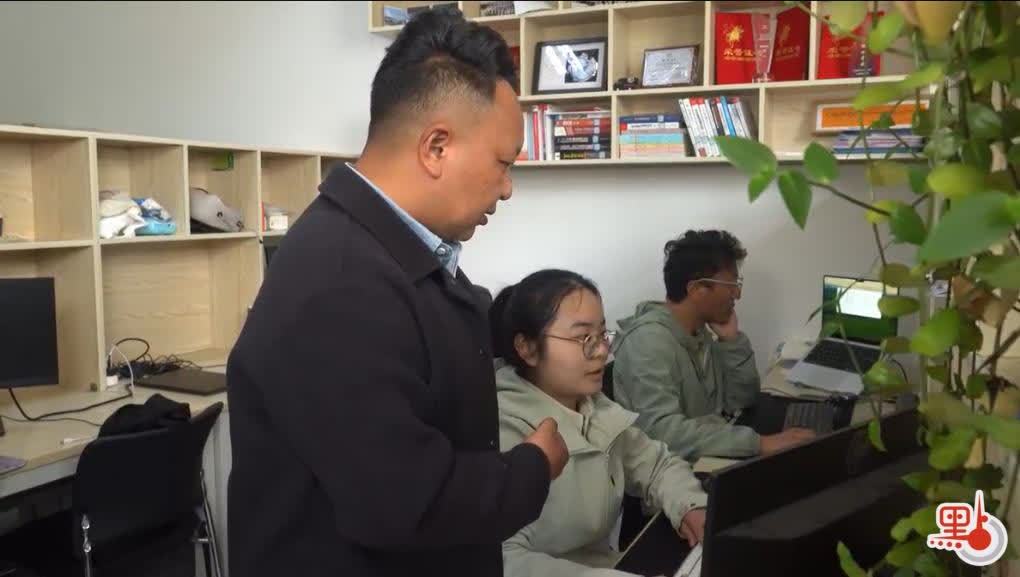
"A 95% recognition accuracy rate covering all three Tibetan major dialects means that Tibetan herders and farmers can chat and search for information in their mother tongue on their phones," said Lhakpa Dondrup, a 35-year-old Tibetan associate professor at the school of information science and technology, Xizang University.
Lhakpa Dondrup is among the talents contributing to the language's digitization on the plateau, with government backing to preserve and promote the Tibetan language. He leads a team in developing several computer programs of Tibetan voice recognition, synthesis and translation, which have been put into use in cooperation with three local information technology companies.
This year, Lhakpa Dondrup received the title of "New Era Youth Pioneer," a national honor for young Chinese who have made outstanding contributions in their fields.
Lhakpa Dondrup, one of the 57 faculty members engaged in information science and technology at Xizang University, has also helped record online coursework for Tibetan language information processing, the first of its kind in China, and traveled to more than 20 countries and regions for academic conferences.
China has been supporting Tibetan language informatization. At the end of 2015, the national standard "Information Technology -- Vocabulary" in Tibetan was officially released, becoming the country's first national standard vocabulary for information technology in an ethnic-minority language. In 2023, an online platform to deal with queries concerning Tibetan and Mandarin was launched, hosting a database of 300,000 standard terms, according to a white paper released last year. DeepZang, China's first Tibetan-language large language model, was introduced in Lhasa in March this year. It supports intelligent interaction in Tibetan, Mandarin and English, and integrates AI conversations, real-time translation and speech-to-text transcription.
Related News:
Deepline | Humanoid robotics divide: Why Western companies collapse while Chinese rivals surge




Comment