






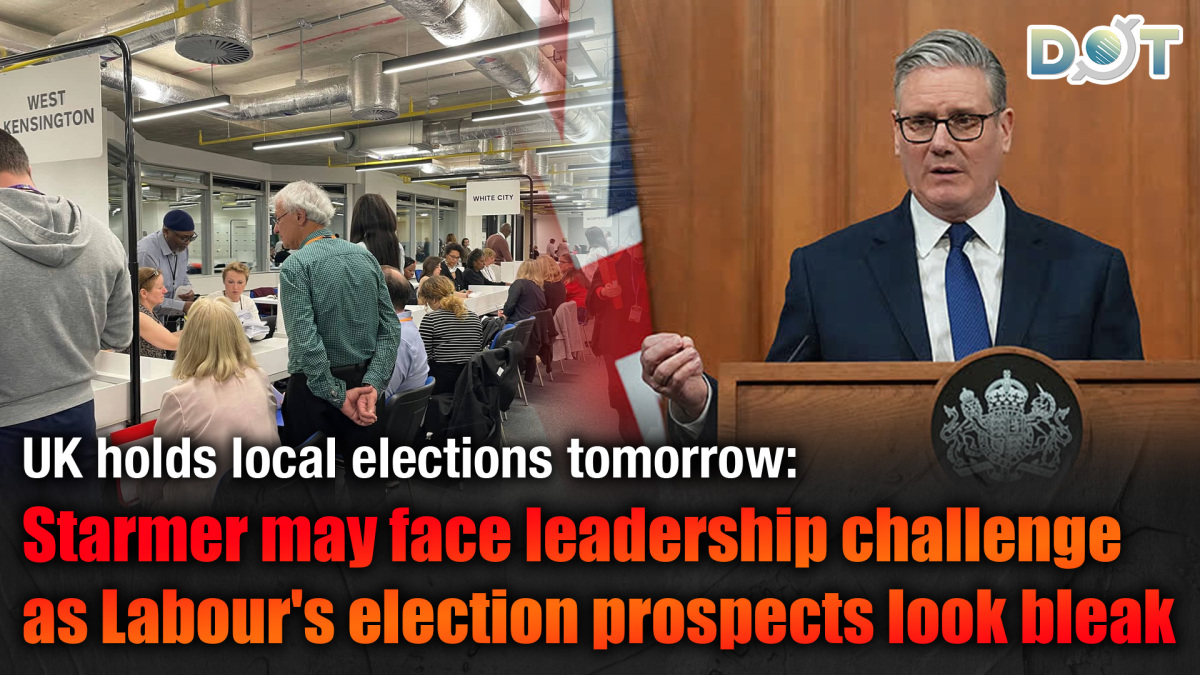
The United Kingdom will hold local elections on May 7, and the two-party system — long regarded as an almost default rule in modern British political structure — now appears to be quietly unravelling. According to an analysis by the Financial Times, British politics seems poised on the edge of a lasting transformation. With the governing Labour Party and the opposition Conservative Party chronically underperforming and their vote bases increasingly fragmented, the UK political landscape is shifting from traditional two-party dominance towards a new phase in which five, or even seven, parties — including regional forces — compete for power. Analysts suggest that Britain's enduring reliance on the two-party system as the foundation of its governance could now threaten the stability of the country's constitutional order.
Current polling shows that Labour, the Conservatives, and their three main challengers — the Liberal Democrats, Reform UK and the Green Party — each command broadly similar levels of support, ranging from 12 to 26 per cent. The combined support of the two traditional major parties, both long criticised for poor governance, barely exceeds one-third of the electorate. In Scotland and Wales, the pro-independence Scottish National Party and Plaid Cymru are expected to further consolidate their dominance in local government.
First-past-the-post in crisis
The British electoral system employs the first-past-the-post method, under which the candidate with the highest support in a single round of voting is automatically elected, regardless of vote share. For decades, British politics was long shaped by a duel between Labour and the Conservatives, with election winners almost always hailing from the two major parties. Now, amid growing political fragmentation, Britain's first-past-the-post system faces a distinctive problem of democratic legitimacy: as votes disperse, winning candidates may secure victory with only a very small plurality.
The Financial Times noted that in the 2017 general election, Labour under former leader Jeremy Corbyn won 40 per cent of the vote but still lost to the incumbent Conservatives. Yet in 2024, when Sir Keir Starmer led Labour to a historic victory, its vote share was only around 34 per cent — partly a result of vote-splitting. In local elections, this phenomenon is even more pronounced. Last May, a Liberal Democrat candidate won a local election in Cornwall, England, with just 19 per cent of the vote. This January, the far-right Reform UK captured a seat from Labour in Wales with 22 per cent.
The fragmentation of UK political parties has fuelled calls for electoral reform, including the introduction of proportional representation. A YouGov poll in January found that 45 per cent of British voters support proportional representation, compared with just 25 per cent who back the current system. The British electorate that voted for Brexit a decade ago is now evolving towards a more fragmented landscape, closer to a European-style multi-party system. Should the far-right opposition Reform UK seize the momentum and rise further, this pressure is set to intensify.
Coalition governments are increasingly likely
Analysts say political fragmentation challenges the governing capacity of UK political parties, and the likelihood of cross-party coalitions will gradually rise. After the local elections, England may see more local authorities with no overall control, and the number of independent councillors is also expected to grow. In Wales and Scotland, whether the two ascendant regional parties can secure a majority — and whether they will negotiate and compromise with mainstream parties in seeking to govern — will be key points of focus.
Tony Travers, professor at the London School of Economics, questioned whether Britain's different parties would necessarily be able to cooperate effectively in post-election governance: "Things could become more difficult." Alan Renwick, deputy director of the Constitution Unit at University College London, argued that once the tight bond between British voters and political parties is broken, it is very hard to restore: "We could see the next election produce an outcome that is very difficult to justify."
Labour polls slump, Starmer may face internal revolt
Britain's governing Labour Party is facing a slump in its electoral fortunes ahead of the local elections, and Prime Minister Starmer, who has been occupied with overseas visits, could face a crisis over his leadership. The Times reported on May 4 that some Labour MPs intend to write to the Prime Minister demanding he take responsibility if the party suffers a heavy defeat, and they would not rule out pressing him to set a departure timetable. The Daily Mail also reported that a Labour cabinet minister has already amassed enough support to mount a challenge, ready at any moment to call on Starmer to resign.
Current polling suggests Labour is highly likely to face a crushing defeat. Reports indicate that Labour currently holds nearly half of the approximately 5,000 local council seats across the UK, but the latest poll projections suggest the party could lose as many as 2,000 seats, with even its traditional strongholds in London, the old industrial areas in northern England, and Wales unable to escape unscathed. In Scotland, Labour even risks being overtaken by the far-right Reform UK, presenting a major challenge.
London's vote share may hit a record low
In the crucial battleground of London, Labour faces the prospect of losing control of multiple local councils, with some seats falling to the Greens, Reform UK, the Conservatives, and the Liberal Democrats. Some experts believe Labour's vote share in the capital could well hit a historic low. Starmer has also recently been embroiled in a series of controversies, including revelations of poor judgment in appointments, particularly his decision to appoint Lord Mandelson — a Labour peer closely linked to the late convicted American sex offender Jeffrey Epstein — as British Ambassador to the United States, which drew universal criticism.
Reports disclosed that Health Secretary Wes Streeting has reportedly secured the support of 81 Labour MPs, reaching the threshold to trigger a leadership challenge. An anonymous MP was also quoted as saying there is deep dissatisfaction within the party over persistently low poll ratings and the string of controversies surrounding Starmer's premiership. Streeting, however, dismissed the reports as baseless and called on party colleagues to unite ahead of the elections.
Starmer, who has been in office for less than two years, stated recently that he intends to serve a full five-year term, and his allies say he would not accept any resignation proposal or timetable. Some Labour MPs believe that no alternative figure currently commands sufficient support to replace him, and that talk of infighting will only further drag down an already bleak electoral outlook.
Related News:
OMG | UK's King gives Trump bell: 'Ring it when you need to get hold of us'
UK PM refuses to resign as ambassador appointment scandal grows




Comment